



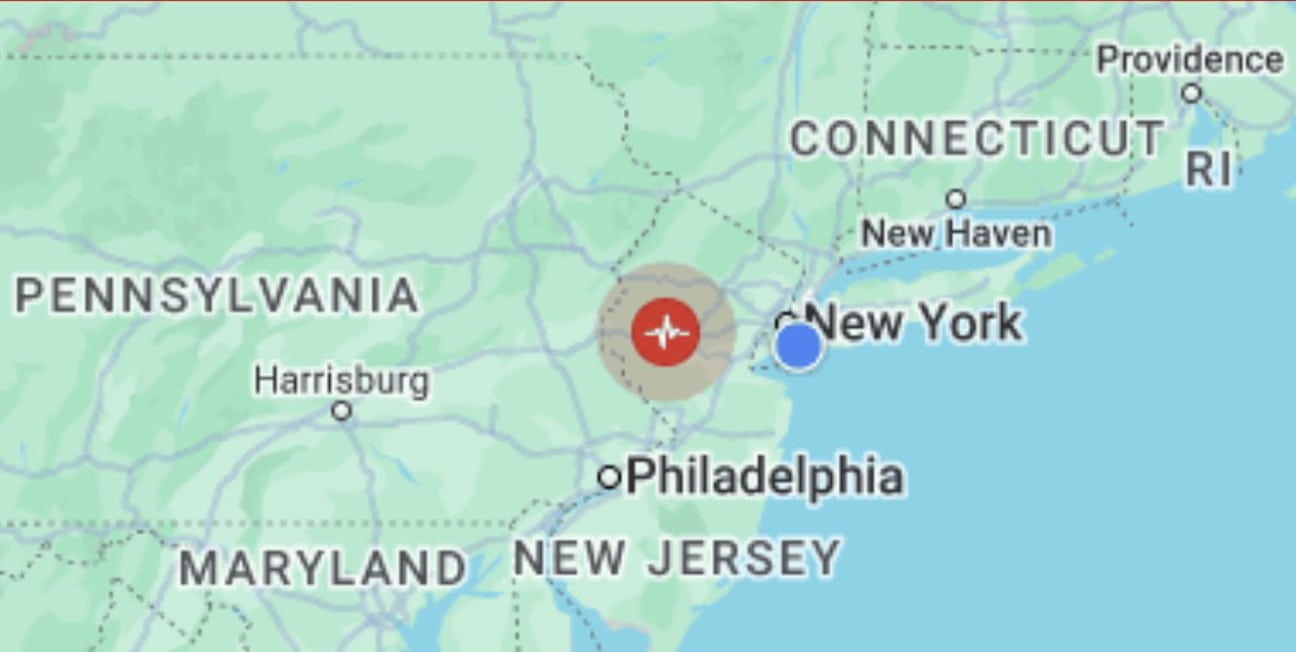
A 4.8 magnitude earthquake hit the northeastern U.S. at 10:23 AM on Friday, according to the United States Geological Survey (U.S.G.S.), sending tremors from Philadelphia to Boston and shaking buildings in Manhattan and the five boroughs of New York City.
The U.S.G.S. reported that the epicenter of the earthquake was in Lebanon, New Jersey, about 80 km west of New York City.
The New York Police Department said there were no immediate reports of damage, but sirens could be heard throughout the city. Several East Coast airports halted air traffic shortly after the tremor.
One of the Largest Earthquakes in 50 Years
The 4.8 magnitude earthquake was the third largest recorded in the northeastern United States in the last 50 years, according to data from the U.S. Geological Survey.
The largest earthquake, measuring 5.3, occurred in Au Sable Forks, New York, in 2002.
Is the Region Prone to Tremors?
Earthquakes are rare in the northeast because the phenomenon occurs more frequently and intensely in regions where tectonic plates meet.
Tectonic plates are large, semi-rigid blocks of rock that make up the Earth’s crust. The Earth is divided into fourteen major tectonic plates that move slowly and continuously over the mantle, sometimes coming closer together or moving apart. The movement of these plates results in the formation of mountains, ocean trenches, volcanic activity, earthquakes, and tsunamis.
The northeastern United States is not located where tectonic plates meet but rather in the center of the North American Plate. Therefore, earthquakes are not common in the region.
However, the area is not free from them. Friday’s earthquake occurred in the Ramapo fault system, which runs through the northern Appalachian Mountains in New York, New Jersey, and Pennsylvania. Faults are lines of fractures between two blocks of rock in the Earth’s crust, the geological layer closest to the surface. Movements along these fractures cause tremors, such as those felt on Friday morning.
In 2008, researchers from Columbia University analyzed 383 earthquakes in an area of 38,850 km² around New York and estimated that a magnitude 5 earthquake in the city or surrounding areas occurs on average once per century, while a magnitude 6 or greater occurs once every 670 years. An even larger one – magnitude 7 – is estimated to occur once every 3,400 years.
The historical record includes three earthquakes of magnitude 5 or greater, the most recent occurring in 1884, 140 years ago.
The Risks of an Earthquake in New York
Although earthquakes in the northeastern United States are smaller and less frequent than in places like California or Japan, the risks deserve attention from authorities.
A modest earthquake, like Friday’s, could cause millions of dollars in damage to cities like Manhattan. This is because the region is not prepared for them.
In the early 2000s, New York began requiring building designers to consider seismic risks. Before that, the main natural risk covered by the city’s building code was wind, which can exert significant pressure on buildings, especially skyscrapers. However, the vast majority of New York’s 1.1 million buildings were constructed before 2000 and, therefore, were not designed with earthquakes in mind.
While it startled those unaccustomed to tremors, Friday’s earthquake did not initially cause damage to the infrastructure of the major cities in the region and did not result in casualties in one of the most populous areas of the country.
Source: The New York Times and CNN