



If 3D printers can be used to make prosthetic limbs and topographic maps, why not houses? Habitat for Humanity, a U.S. nonprofit organization, is providing funding for architecture firms to build homes using 3D printers for low-income families.
“Many local Habitat organizations are seeking alternative ways to increase the production of affordable housing,” said a spokesperson for the NGO. “Habitat sees 3D-printed housing technology as an emerging technology that has the potential to increase our impact on affordable housing.”
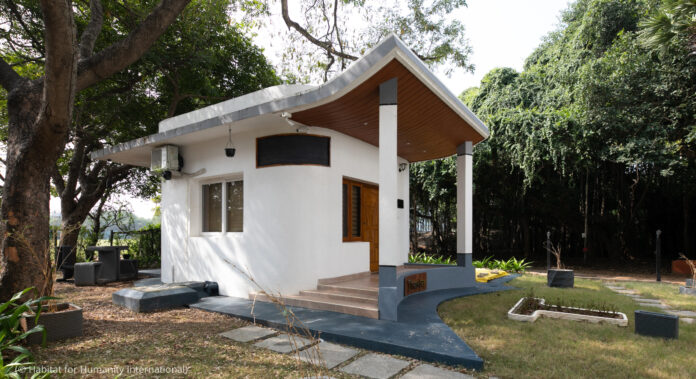
So far, the organization has helped build three 3D-printed houses — two in the United States and one in India.
Tvasta Manufacturing Solutions built the first 3D-printed house in collaboration with the Habitat for Humanity team in Chennai, India, in November 2020. The company printed a 56-square-meter concrete house in 30 days but hopes to reduce the construction time to about five days.
The technology limits construction material waste, is 30% cheaper than other types of construction, and withstands strong winds and rains.
The 3D-printed house in India not only has “a smaller carbon footprint during the construction process but also throughout the house’s lifespan,” Adithya Jain,
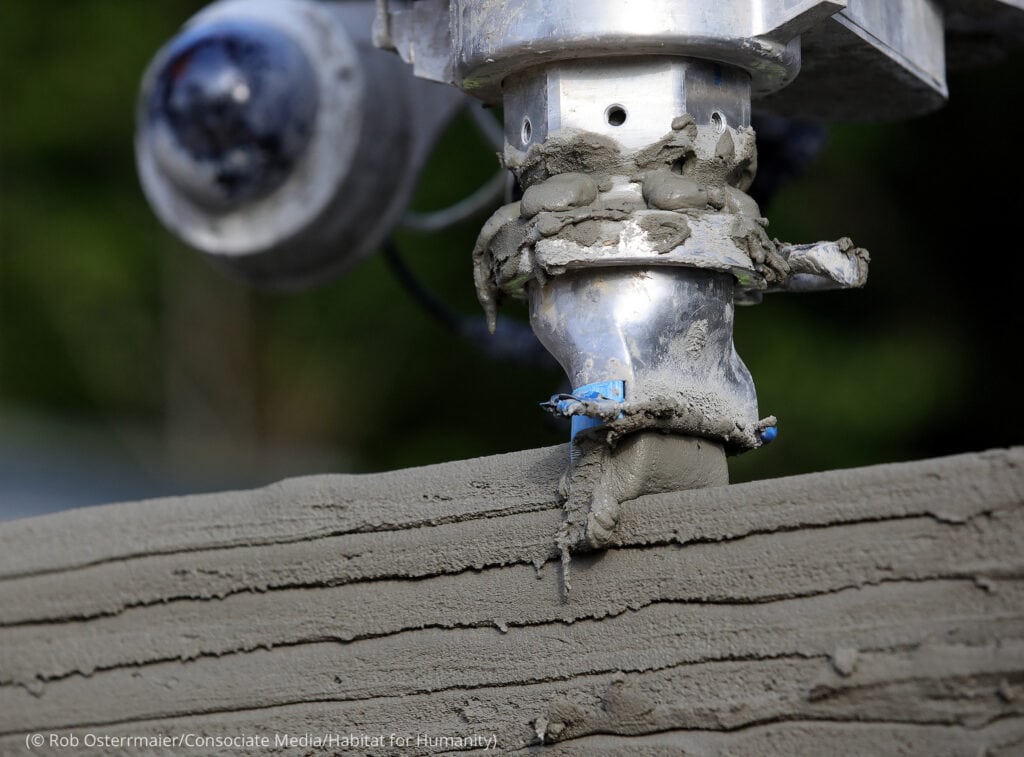
co-founder and CEO of Tvasta, told Reuters.
A year later, the NGO funded Alquist, a Maryland-based 3D printing company, to build a 3D-printed house in Williamsburg, Virginia — the first in the United States. Habitat for Humanity also funded a third house in Tempe, Arizona, which was completed in March.
Alquist began building the Williamsburg house in July 2021 and completed it in December 2021, using a 3D printer for the exterior walls and traditional methods for the interior.
The house is powered by solar electricity and includes its own 3D printer, so the
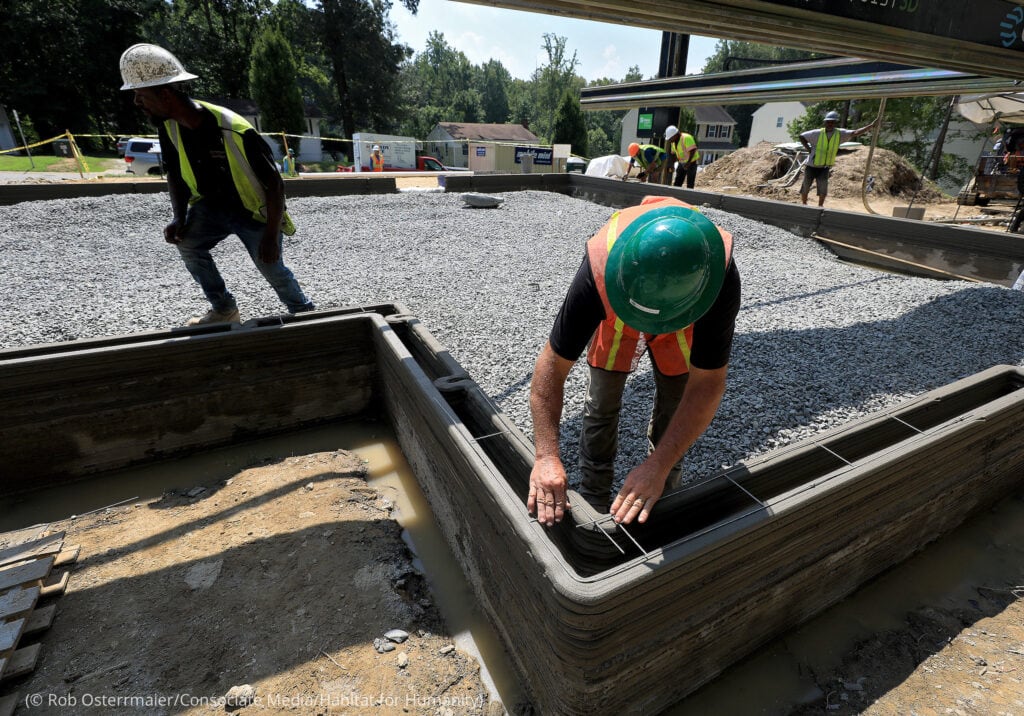 Metal stairs are embedded in the wet cement to add strength to the walls of this 3D-printed house from Habitat for Humanity on August 26, 2021, in Williamsburg, Virginia. (© Rob Osterrmaier/Consociate Media/Habitat for Humanity)[/caption>
owners can make accessories like doorknobs and light switch covers.
“What you see,” said Alquist founder and CEO Zachary Mannheimer, “is four years of blood, sweat, and tears figuring out how to make this happen.”
Habitat for Humanity funding enabled Candelaria Design — an architecture firm in Arizona — to build the Tempe house using a 3D printer for the internal and external walls. The completed house has three bedrooms and two bathrooms.
“If we can deliver decent, affordable, more energy-efficient homes at a lower cost, in less time, and with less waste, we think this could be a real game changer,” said Jason Barlow, president and CEO of Habitat Central Arizona.
Source: share.america.gov, by Noelani Kirschner