



It’s a sunny Thursday in Maceió, in eastern Brazil.
Ruty Pereira has no shortage of tasks to keep her busy at home. But here she is, sitting in the front row of a meeting at the local community center. Paintings of balloons and clouds decorate the walls.
Pereira’s 10-year-old daughter, Tamara, is perched on her lap. The girl’s mouth is slightly open. Her arms are folded, locked at the elbows.
There are other mothers here, sitting next to their children of the same age and with similar afflictions. Many of them are in wheelchairs.
In the middle of the meeting, Pereira speaks up. She wants to know if everyone is eligible for the money being discussed.
The group looks to the speaker, Alessandra Hora dos Santos, who has been their matriarch and champion for years. They listen to her responses, hoping to hear that all their hard work has finally paid off.
Over the past decade, the women in this room have gone from feeling voiceless and powerless to becoming outspoken activists, banding together to do something they might never have imagined. They are demanding that the Brazilian government compensate them for what they say was a failure to protect them from a notorious disease.
They want compensation, they say. They want reparations for their children.
A Heavy Diagnosis
For Pereira, it all started in 2015, when she was in her early 20s and pregnant. “I did all the prenatal checkups and everything was fine,” she says through an interpreter.
But then, when Tamara was born, something wasn’t right. Her head was too small.
The neurologist approached her and asked: “Mom, have you had Zika?”
The doctor was referring to a mosquito-borne virus that hijacks a critical protein for normal brain development. Like many children born to mothers infected with Zika during pregnancy, Tamara had microcephaly — an underdeveloped brain. The doctor told Pereira that her daughter would likely never walk or talk.
“It often affects not just the head, but the arms and legs,” says Mardjane Lemos, an infectious disease physician at Alagoas State University of Health Sciences, through an interpreter. “It affects hearing, vision.”
When Pereira heard the news, “my world collapsed,” she recalls. “When you plan for a child, it’s not just the child — it’s a whole life, a future, college, a home, everything.”
Pereira called her husband crying, desperate. He comforted her, saying: “Calm down, because God is the greatest doctor.”
Medical visits began immediately. Pereira took Tamara to weekly appointments that required an exhausting overnight public bus ride from their rural home to the hospital in the city. Later, Pereira would rush her daughter to the emergency room when things suddenly went off the rails — like when the balloon that helped secure Tamara’s feeding tube in her stomach burst or she vomited to the point of dehydration.
As Iana Flor, whose son Pedro was also disabled by Zika, put it: “It’s complicated because one day can be good and the next day it’s like a bomb.”
Still, despite the hardships and living with scarce resources, Pereira was committed. “When you have a special child, you dedicate yourself entirely to that child,” she says.
Her husband worked as a construction contractor, paying for groceries and other household expenses. But Tamara was entirely Pereira’s responsibility. “He expected me to take care of Tamara’s needs — all the doctors, all the therapies, all the specialists,” she says.
Pereira acknowledges there wasn’t much left for her husband and all his expectations that she cook, clean, and care for their daughter.
“I felt suffocated,” she says. “A woman, when she’s in a relationship, you kind of live for the other person. You stop having your own life.”
So, after 12 years of marriage, Pereira told her husband it was over. She and Tamara moved to a rental in a different neighborhood.
“I was alone all the time,” she says. “It was very hard.”
After the ‘End’
The isolation didn’t last long. When Pereira took Tamara to physical therapy, she met other mothers whose lives had also been upended by Zika. They found common ground in their caregiving struggles and financial hardships, and drew strength from each other.
In total in Brazil, about 3,300 “Zika babies” were born over a four-year period. The disease disproportionately impacted poorer and rural families “because those regions lack sanitation,” says Dr. Lemos. “Many of these women don’t have water systems in their homes,” which means they often have to collect rainwater in storage containers that serve as ideal breeding grounds for mosquitoes. “No one is going to throw water away even if there are larvae inside,” she says.
The consequences for families affected by the disease are long-lasting. “For them, Zika — it’s not over,” says Luciana Brito, psychologist, researcher, and co-director of the Anis Institute of Bioethics.
It’s a story that repeats around the world, says Brito — in big and small ways. A health crisis or natural disaster hits a community and it’s all anyone talks about. But quickly, people move on to the next tragedy somewhere else. For that original community, though, the challenge has only just begun.
In Brazil and elsewhere, Brito and her colleagues are exploring this disconnect between the official end of a disaster and the ongoing reality for those at the epicenter of the hardship.
“There is no end for the most affected people,” says Brito, who works with communities long after the rest of 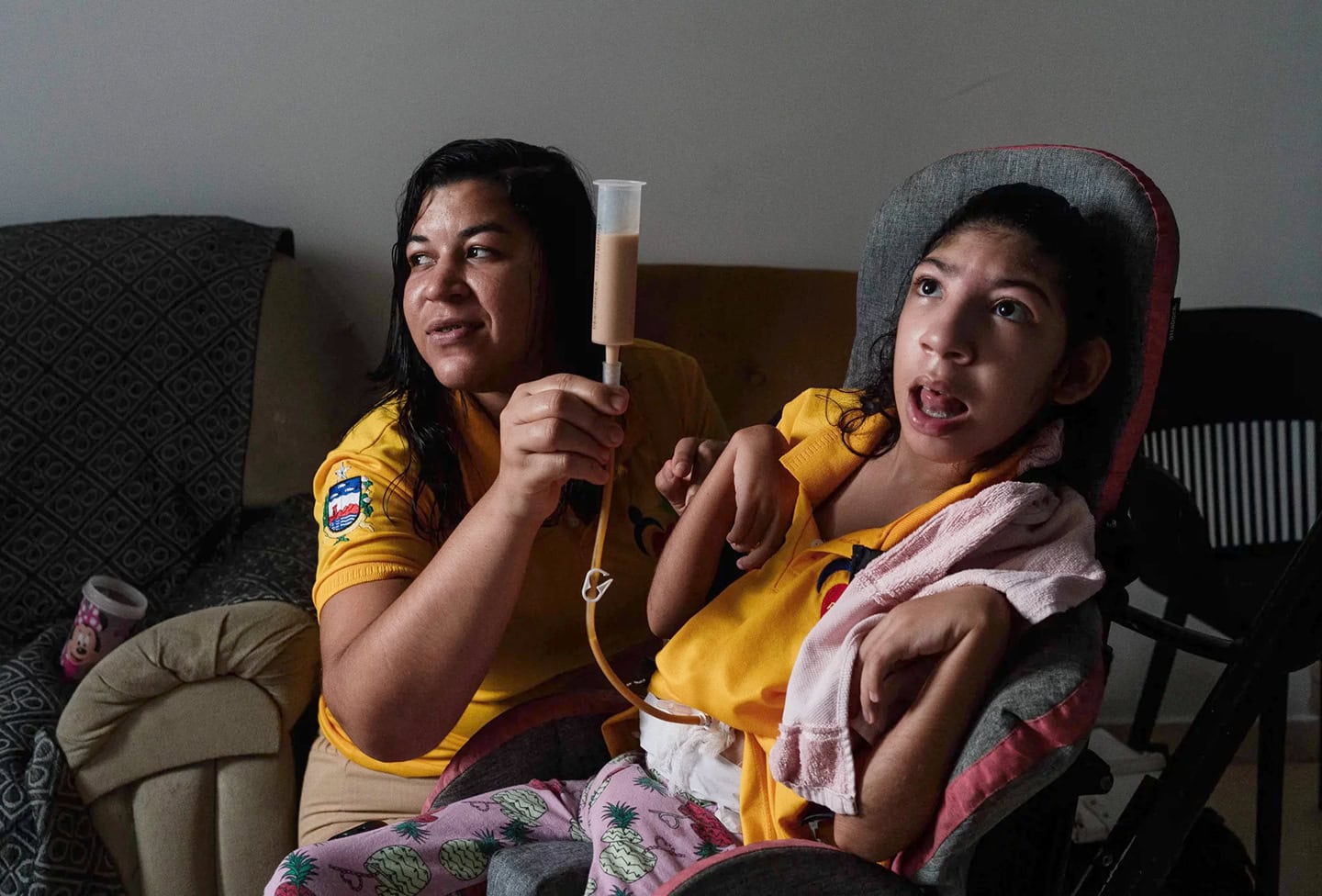 the world has largely moved on. She and her team helped Pereira and the other mothers form a community association to advocate for their needs. It’s called Família de Anjos, or Family of Angels, and is run by dos Santos.
Dos Santos points to a Brazilian saying to explain the ongoing struggle she and the other women — whom she calls “her mothers” — must face. “We have to kill a lion every day,” she says through an interpreter. “You conquer one thing and you already have to think about the next. So, every day we’re killing lions here.”
A Fight for a Home
The first lion the group faced was homeownership. “If you have a home, you have quality of life, you have dignity,” says Pereira.
In Brazil, low-income families with children with disabilities get priority for free public housing. But that wasn’t happening for these mothers. They made phone calls, but Brito says the authorities never got back to them.
So, on a hot day in 2020, Pereira joined a few dozen mothers in a protest outside a government housing office. Some held umbrellas to shield from the sun. All pushed their children in wheelchairs, wearing yellow T-shirts that said: “Microcephaly is not the end.”
“We demand a response,” they shout in a video recorded that day.
“I’ll never forget that special day when we stopped traffic for the good of our children,” says Pereira. “If you don’t fight, if you don’t show up, people think everything is perfect. And it’s not perfect at all.”
Pereira says the protest was both empowering and humiliating. Some of her children were crying. She remembers people yelling at them: “Go home, find clothes to wash.”
But it took just one day for the women to secure a meeting with the right official, who ultimately helped them get free housing. They were now homeowners.
Pereira was able to move into a ground-floor apartment in a housing complex outside Maceió. The place is small but cozy. “I love this apartment,” she says. “It’s mine. I didn’t get it from any man. I got it through my own fight.”
One day last summer, Tamara is sitting in her wheelchair in the living room. She has big brown eyes and an expressive face. Tamara is nonverbal, but engaged. “This girl is very cheerful and likes to be around people,” says Pereira. Every now and then, Pereira leans in to wipe a dribble of saliva from Tamara’s chin.
There’s a soft knock at the door. It’s Lenice do Nascimento, a dear friend of Pereira’s who lives in the building next door. That’s the thing about living here — Pereira is no longer alone. Her neighbors are the mothers and children she fought alongside to get this housing.
In fact, when Pereira decided to finish high school, it was do Nascimento who offered to care for Tamara at night so she could complete her studies.
“It was a dream for me to be able to study,” says do Nascimento through an interpreter, “but with family, with children, it becomes so hard and I couldn’t. So I can do it for her.”
Pereira flips through some of her school notebooks, each filled with careful handwriting. “I never thought I’d go back to school and finish,” she says. “But now that I have, I feel so fulfilled. I learned there’s a whole world ahead of me.”
For now, Pereira earns extra money cleaning houses on weekends, when another close friend cares for Tamara.
“These ladies, I call them my third arm,” she says. “We are sisters in resistance.”
The women have become a crucial source of support for Pereira. The result is that she feels more in control of her life — a life that remains centered around her daughter.
“Before her, I was an extremely selfish person. I had this character of saying, you live your life, I live mine,” says Pereira. “But now I live for Tamara. My daughter changed my life. She opened my heart, which is now more sensitive to love and forgiveness.”
A Demand for Reparations
A few months ago, the sisters in resistance won a particularly critical battle.
The women came to the important realization that none of this had to happen. The government, they say, could have introduced measures to reduce mosquito numbers and taught the community how to avoid Zika exposure to prevent all the hardship they endured.
So they began demanding reparations for their children from the Brazilian government. They saw it as fair compensation for everything they had endured. They also wanted an apology.
“The Brazilian government failed to provide basic sanitation, health conditions, basic public policies to provide the essentials for people,” says dos Santos. “What creates the perfect condition for the proliferation of infectious diseases.”
“These women were neglected by the government,” says Dr. Lemos. “I have no doubt about that.”
“It’s the recognition that these women matter,” says Brito. “They were forgotten by public authorities. And now, this bill [is] saying: ‘You matter to us.’ And the money is just a symbolic way to do that.”
Dos Santos took the case straight to Brazil’s capital, where she wore her favorite outfit. “I was wearing my yellow T-shirt,” she says. “Yellow being the color chosen to represent the Zika virus, black pants, high-heeled sandals.”
At the end of last year, the reparations bill passed the Brazilian Congress. It then went to the desk of President Luiz Inácio Lula da Silva — where he vetoed it, citing budget challenges. Then, this summer, Congress overrode the veto.
After nearly a decade of struggle, the bill became law.
Brazil agreed to pay each child a one-time reparation payment of about $9,000 plus an additional $18,000 per year for the rest of their lives. The bill refers to this money as compensation for dano moral, which translates as “moral damage.”
It’s a major victory and an admission of fault at the highest level of the Brazilian government. Pereira said the money will allow her to buy healthier food and maybe even get her own vehicle.
“It will bring more quality of life,” she says.
Flor agrees. “This bill will be a great help to all of us mothers,” she says. And it will “give dignity to these children.”
Some of the mothers were inside the National Congress Palace when the bill became law.
The women put their arms around each other, jumped up and down, and celebrated.
Source: npr.org by Ari Daniel