



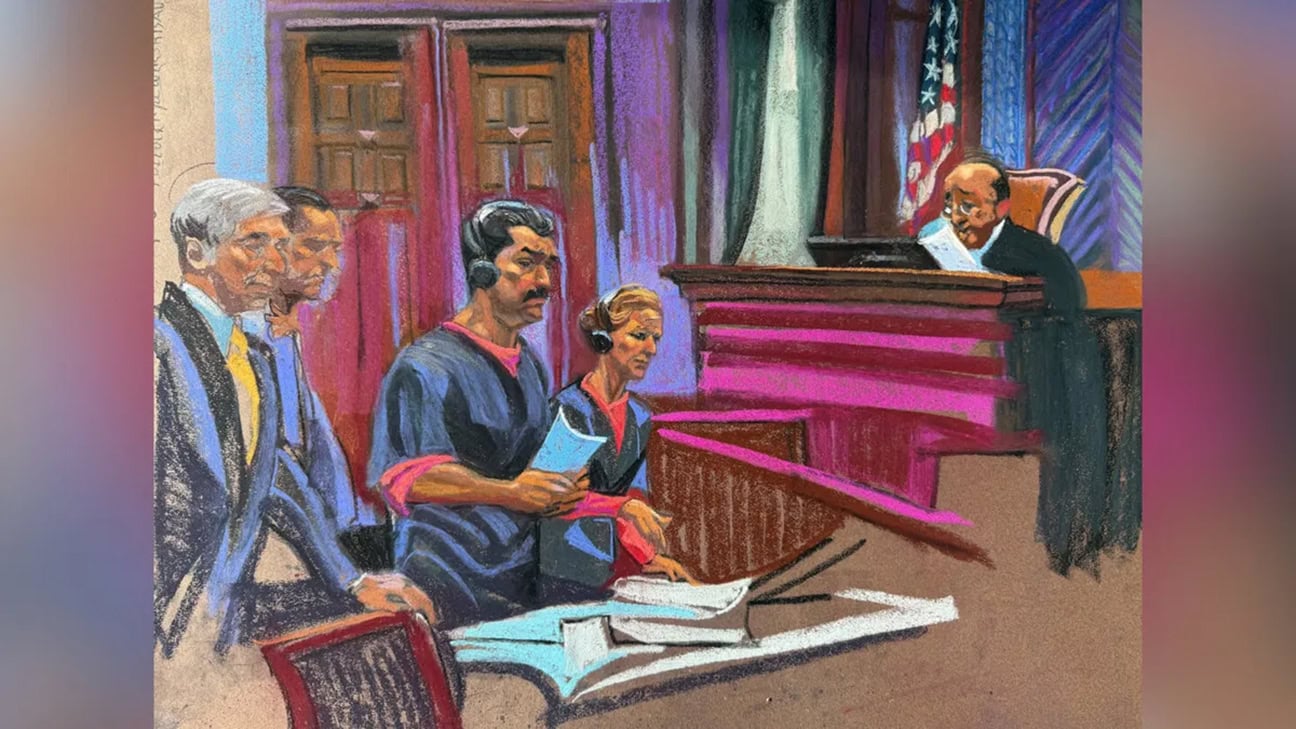
Now that deposed Venezuelan president Nicolás Maduro is on U.S. soil, the criminal case against him is underway.
Maduro pleaded not guilty to the four charges against him — narcoterrorism conspiracy, cocaine importation conspiracy, and possession and conspiracy to possess machine guns — during his first court appearance in Manhattan, N.Y., on Monday.
His wife, Cilia Flores, who was also charged in the superseding indictment and captured alongside her husband by U.S. forces during a pre-dawn operation in Caracas, Venezuela, on Saturday, also pleaded not guilty.
U.S. Attorney General Pam Bondi said in a social media post over the weekend that Maduro and Flores “will soon face the full wrath of American justice on American soil in American courts”.
Now begins what could be a long legal process of preliminary arguments, possible plea deal negotiations, and possibly a jury trial for the authoritarian leader who ruled Venezuela for more than a decade.
Shane Stansbury, who prosecuted the former president of Guatemala as a U.S. Assistant Attorney in the Southern District of New York, said the case will largely follow the typical path of any criminal proceeding, with some notable exceptions. “It’s just that things may take longer, given the nature of the case, the type of evidence involved, security considerations, and so on,” Stansbury said, who is now a professor at Duke University School of Law.
Legal experts say these complications mean Maduro is unlikely to go to trial this year, even as the case against him progresses. Here’s what to watch for.
Maduro’s head of state status will likely be discussed in court
An argument that Maduro’s defense team may make is that he cannot be criminally charged for his actions as head of state of Venezuela, say two former federal prosecutors who spoke with NPR.
Court records list Washington, D.C.-based attorney Barry Joel Pollack as Maduro’s defense counsel. He did not immediately respond to NPR’s request for comment on the charges. Flores is being defended by Houston-based attorney Mark Donnelly, who told NPR that they “expect to review and challenge the evidence the government has” and that “there’s a long road ahead”.
The U.S. stopped recognizing Maduro as the legitimate president of Venezuela in 2019, after he was reelected in an election deemed fraudulent by the U.S. and international observers. He assumed power in 2013 after the death of Venezuela’s previous leader, Hugo Chávez. (The indictment alleges that Maduro began trafficking drugs to the U.S. as early as 1999 and includes periods when he held other positions in the Venezuelan government.)
Still, there is precedent for the U.S. government bringing another country’s leader to trial, including the prosecution of Panamanian dictator Manuel Noriega in the early 1990s.
In that case, a federal appeals court rejected Noriega’s claim of head of state immunity. But Adam Fels, a former U.S. assistant prosecutor who now practices in the private sector in Miami, said the issue could arise again.
“I imagine those challenges, although they have been litigated before, will be litigated again,” Fels said.
Other national leaders prosecuted by the Department of Justice include former Guatemalan president Alfonso Portillo for money laundering and former Honduran president Juan Orlando Hernández, who was convicted on drug trafficking charges and pardoned by President Trump last month.
During his Monday court appearance, Maduro presented himself as the president of Venezuela and a prisoner of war.
The Venezuelan leader’s arrest may raise another legal issue
Since Maduro was not extradited to the U.S. through a legal process but rather captured by the U.S. military during a surprise raid in Caracas, legal experts say this could give the defense team another avenue for a legal challenge.
Fels pointed to the recent case of Mexican cartel leader Ismael “El Mayo” Zambada and how he ended up in U.S. government custody.
Federal prosecutors say Joaquín Guzmán López, son of former Sinaloa cartel leader Joaquín “El Chapo” Guzmán, forced Zambada onto a plane, drugged him, and brought him across the border to the U.S., where he was handed over to authorities.
“There was a challenge because there was concern about whether Mr. Zambada went to the United States of his own free will,” Fels said. “So I imagine that litigation will also be at least something that Judge [Alvin K.] Hellerstein, who is the judge in this case, will consider.” (Zambada pleaded guilty to drug trafficking charges last year.)
But this may be a high bar for Maduro’s lawyers to overcome. According to Stansbury, federal courts “generally refuse to interfere with the means of arrest”.
Some evidence may be classified, which could cause delays
The complex case against Maduro may also mean that discovery—the legal process in which prosecutors and the defense team share evidence—may take longer than usual. Stansbury said some evidence may come from intelligence sources or be classified.
“The government may not want to use any classified information at trial, but that doesn’t mean the government doesn’t have the obligation to turn over potentially classified material if it’s exculpatory or otherwise discoverable under federal rules,” he said.
The Classified Information Procedures Act (CIPA) sets rules for how defendants can use classified evidence in court and can prolong the pre-trial process. CIPA rules also applied in Trump’s classified documents case.
A plea deal is possible — but a trial too
Although Maduro has pleaded not guilty, there is still time for federal prosecutors and the defense to reach a plea deal.
Both legal experts who spoke with NPR noted that the two machine gun charges, which carry long prison sentences, may pressure Maduro to at least consider a deal.
Otherwise, the case goes to trial. Fels, who was one of the lead federal prosecutors in the Department of Justice’s successful prosecution of El Chapo in 2019, said federal prosecutors would still have a lot of work to prepare their case for court, including possibly interviewing corroborating witnesses.
“There was a substantial amount of evidence in the Chapo case. I’d like to think there is substantial evidence in this case too, given the efforts undertaken by the U.S. government to obtain and bring [Maduro] to justice,” Fels said.
“The question will be: How do you tie these allegations together and prove them with witnesses and documents in a way that makes sense to a jury?”
Source: npr.org by Joe Hernandez