



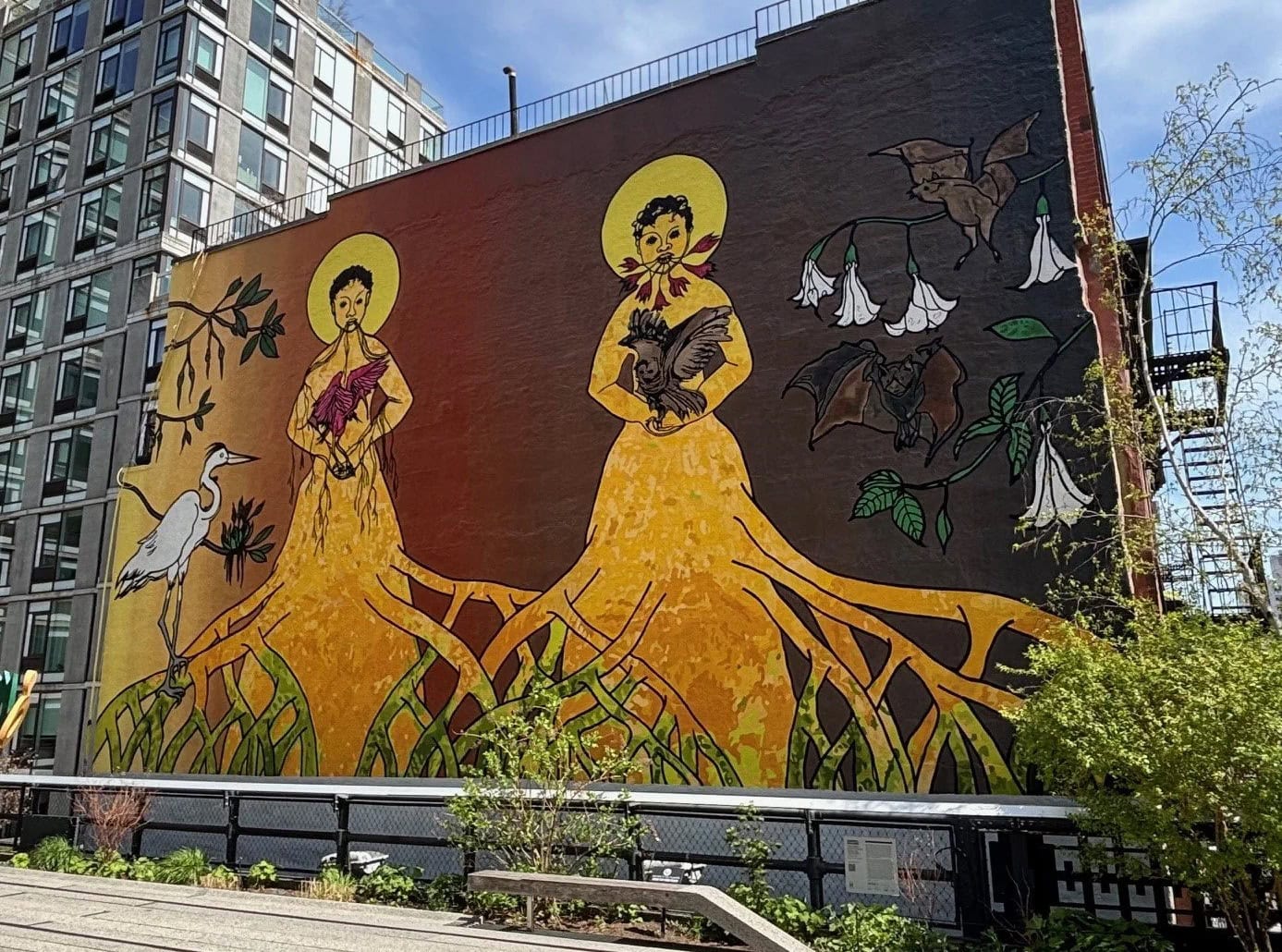
Rosana Paulino’s practice encompasses drawing, painting, suturing, printmaking, collage, sculpture, and installation. Her work highlights social, ethnic, and gender issues, with particular attention to exploring the enduring legacy of slavery and the history of racial and gender-based violence in Brazil. The artist weaves personal, scientific, and historical archives throughout her work, using these materials to demonstrate and then deconstruct violent colonial structures, particularly with regard to Afro-Brazilian women. Considering the impact that these archives and memories have on collective values and belief systems, Paulino examines the construction of myths—not only as an aesthetic pillar, but also as a key influence on cultural consciousness.
The Creation of the Creatures of Day and Night is a continuation of the artist’s mangrove series, which depicts tree-women as a mythological archetype and symbol of the Brazilian biome. Paulino notes that mangroves, like the Black and Indigenous peoples of the country, have been mistreated and exploited. The artist highlights the inherent symbolic meaning of this ecosystem: it is where life begins, as home to countless species and as a blue carbon reservoir, and where life ends, due to the decomposition of the mangrove itself. In The Creation of the Creatures of Day and Night, Paulino reimagines this duality between life and death as day and night. From left to right, the sky color fades from daylight to a deeper, midnight tone. Instead of golden halos traditionally seen in European representations of holy figures, the tree-women’s heads are framed by halos reminiscent of the sun and moon. Likewise, the animals surrounding the goddesses also reference the transition from day to night. On the left side of the composition, Paulino depicts two diurnal birds native to the mangrove biome: the white egret and, in the tree-woman’s hands, the scarlet ibis. To her right, the other goddess holds an owl and is flanked by two bats, both nocturnal. Together, these elements present a rich and new mythological framework for the mangrove, offering a break from representations shaped by colonization and exploitation.
Artist Biography
Rosana Paulino (b. 1967, São Paulo, Brazil) lives and works in São Paulo, Brazil. She has had solo exhibitions at institutions such as MALBA, Buenos Aires, Argentina (2024); Kunstverein Braunschweig, Braunschweig, Germany (2022); Museu de Arte do Rio de Janeiro, Rio de Janeiro, Brazil (2019); The Frank Museum of Art – Otterbein University, Westerville, Ohio (2019); Pinacoteca do Estado de São Paulo, São Paulo, Brazil (2018); Clifford Art Gallery, Colgate University, New York (2018); Museu de Artes Visuais da Unicamp, Campinas, Brazil (2018); EGEAC, Lisbon, Portugal (2017); and Museu de Arte Contemporânea de Americana, São Paulo, Brazil (2013). She has participated in important international group exhibitions, including O Legado Burle Marx, MAM Rio, Rio de Janeiro, Brazil (2024); 35th São Paulo Biennial, São Paulo, Brazil (2023); The Milk of Dreams, 59th Venice International Art Biennale, Venice, Italy (2022); Afro-Atlantic Histories, National Gallery of Art, Washington, DC (2022); Global Positioning, Public Art Foundation, New York, Boston, Chicago (2022); Brasilidade: Pós Modernismo, CCBB, Brazil (2022); 22nd Sydney Biennale, Sydney, Australia (2020); Carolina Maria de Jesus: um Brasil para os brasileiros, Instituto Moreira Salles, São Paulo, Brazil (2021); 21st Sesc VideoBrazil Biennial, Sesc 24 de Maio, São Paulo, Brazil (2019); Slavery in the Hands of Harvard, Harvard University, Boston, Massachusetts (2019); Histórias Afro Atlânticas, Instituto Tomie Ohtake, São Paulo, Brazil (2018); Mulheres Negras – Obscure Beuaté Du Brésil, Espace Culturel Fort Griffon À Besançon, Besançon, France (2014). Her work is present in the collections of major institutions around the world, including Centre Pompidou, Paris, France; University of New Mexico Art Museum, Albuquerque, New Mexico; Museu de Artes de Buenos Aires, Buenos Aires, Argentina; The Frank Museum of Art, Westerville, Ohio; Pinacoteca do Estado de São Paulo, São Paulo, Brazil; Museu de Arte de São Paulo, São Paulo, Brazil; Museu de Arte Moderna de São Paulo, São Paulo, Brazil; Centro Cultural São Paulo, São Paulo, Brazil; Museu AfroBrasil, São Paulo, Brazil; Museu Salvador Allende, Santiago, Chile; Pérez Art Museum, Miami, Florida; and Museu Oscar Niemeyer, Curitiba, Brazil.
Support
The main support for High Line Art comes from Amanda and Don Mullen. Significant support is provided by Shelley Fox Aarons and Philip E. Aarons, The Brown Foundation, Inc. of Houston, and Charina Endowment Fund.
High Line Art is supported, in part, with public funds from the National Endowment for the Arts, the New York State Council on the Arts with the support of Governor Kathy Hochul and the New York State Legislature, and the New York City Department of Cultural Affairs in partnership with the New York City Council, under the leadership of Speaker Adrienne Adams.
Rosana Paulino’s mural, The Creation of the Creatures of Day and Night, is made possible, in part, thanks to an in-kind donation from Meadow Partners and Canvas Property Group. Painted by the Overall Murals team.
Until December, The High Line (22nd St, NY)
Source & photos: www.thehighline.org