



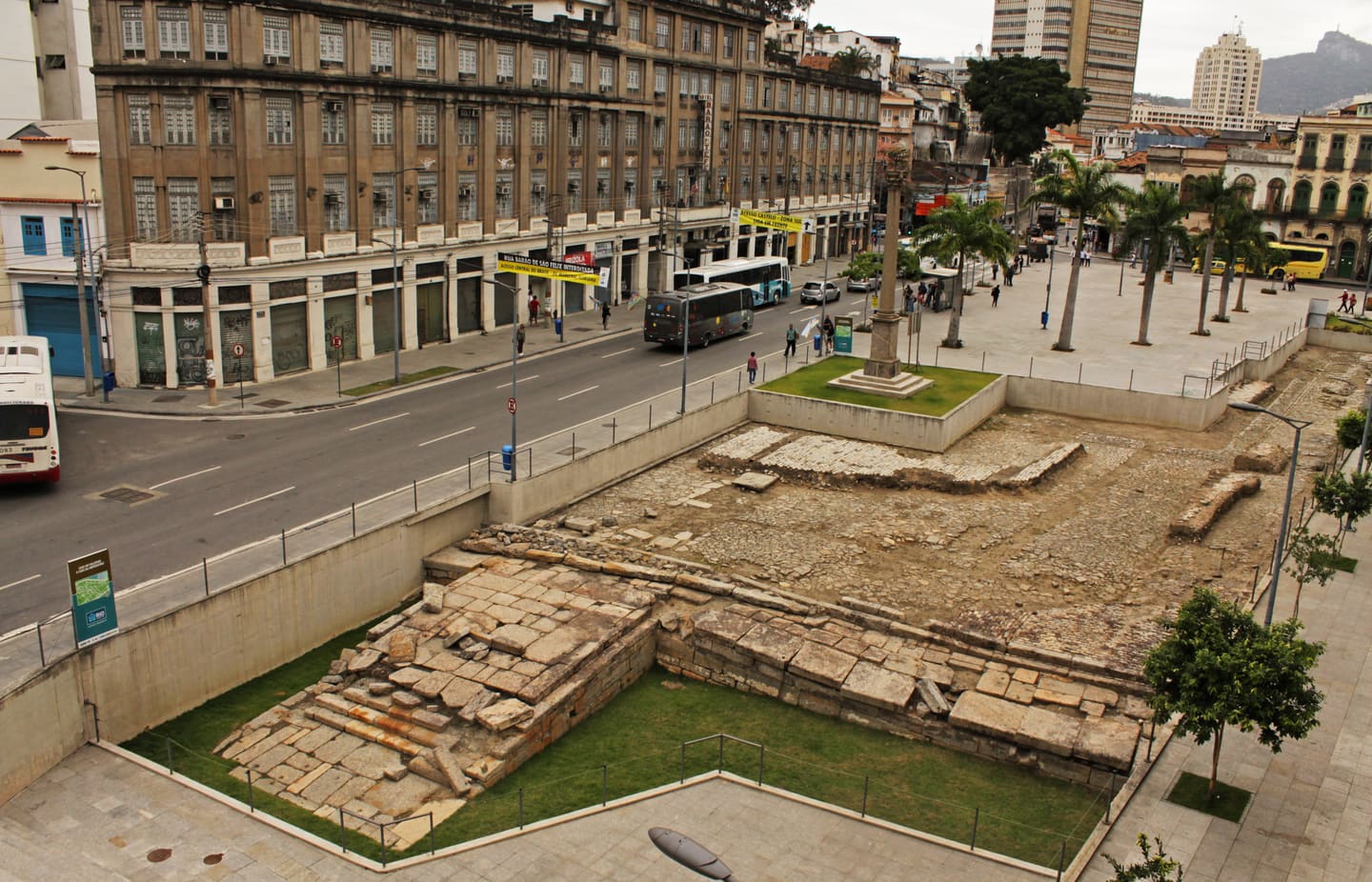
The archaeological site of Cais do Valongo, in downtown Rio de Janeiro, reopened in November after undergoing restoration work. The restoration of the monument cost R$ 2 million and included the installation of educational signage, exhibition panels, and protective railings.
Recognized as a UNESCO World Heritage site since 2017, the wharf was the main port of disembarkation for enslaved Africans in the Americas during the 18th and 19th centuries, according to Brazil’s historical and artistic heritage authority Iphan.
The remnants of the historical structure were discovered in 2011 during excavations for the city’s port revitalization project.
“This memory must be preserved as a port of our history and a beacon of change that needs to ensure that Black people are in control of their present and future trajectories — a path that moves further away from the vicious past of slavery,” said Minister of Racial Equality Anielle Franco.
Alexandre Nadai, communication coordinator of the Instituto Pretos Novos, dedicated to preserving both tangible and intangible Afro-Brazilian heritage, described the wharf as a landmark of a crime against humanity: the enslavement of millions of Africans in the Americas.
“People need to learn about the complex Valongo to understand what happened and all the crimes committed against Africans — crimes that are still being committed against Black people. We need to make people aware of this history if we want to mitigate all this structural racism on which our society is based.”
Little Africa
The Cais do Valongo is located in an area known as Little Africa, due to its predominantly Black population and its history linked to the African diaspora, with places like the Cemitério dos Pretos Novos, a burial site for Africans who had recently arrived at Valongo and died before being sold, and the Pedra do Sal, one of the cradles of urban samba in Rio.
“It was not just the enslaved labor that arrived through the wharf. They also brought a new possibility of civilization through their culture, spirituality, customs, and sociability, which profoundly mark Brazilian society today. One cannot think of Brazil without capoeira, samba, or maracatu,” said Ivanir dos Santos, babalaô and history professor at the Federal University of Rio de Janeiro (UFRJ) and a member of the Cais Management Committee.
Last month, Brazil’s social development bank BNDES also revealed efforts to preserve and recognize African memory and heritage in Little Africa.
Among the measures is a technical cooperation agreement with various government bodies, including Iphan and the Ministries of Culture and Racial Equality, aiming to develop a physical and spatial plan and establish a cultural district in the area within three years.
A consortium was also announced to launch a public notice aimed at strengthening local cultural institutions, creating a network of representatives of African memory and heritage in Brazil, and encouraging the creation of a new tourist route linked to national and international Afro-tourism.
The consortium is formed by the Center for the Articulation of Marginalized Populations (Ceap), the Instituto Feira Preta, and Diaspora Black, and will be tasked with raising R$ 20 million — half of which will come from the BNDES Cultural Fund and the rest from donors.
Management
After receiving 1 million enslaved individuals, the site was deactivated in 1831 due to the prohibition of the transatlantic slave trade, reports Iphan.
In 1843, it was filled in for the construction of a new wharf to welcome Princess Teresa Cristina, wife of Emperor Dom Pedro II, and renamed Cais da Imperatriz.
After being discovered in 2011, the Cais do Valongo was protected by Iphan in 2012, the same year it was opened to visitors. It became a Cultural Heritage site of the City of Rio de Janeiro in 2013 and was designated a World Heritage site in July 2017.
However, in 2019, the management committee, which had been in existence for a year and was required by UNESCO to monitor preservation efforts at the archaeological site, was dissolved after meeting only twice. The committee was recreated in March of this year.
Source: Agência Brasil