



From the South of Minas Gerais, Ana Paula Procópio Junqueira Leão, graduated in Public Relations, was born in Varginha and raised in Caxambu. Her parents were named Paulo César and Márcia; she grew up alongside her siblings Fabíola and José Bento. During vacations, Ana Paula spent time on the farm with her grandparents in Varginha and Cruzília, where she learned early on the value of work and life in the countryside.
Granddaughter of Manoel Procópio Bueno and José Bento Junqueira Andrade, it was with them that her admiration for agribusiness was born, which is why she still carries the family legacy as a milk producer and federal deputy.
Ana Paula is married to former mayor and former federal deputy Odelmo Leão, and has a daughter named Maria Hilda Junqueira.
Aryane Garcia – During your adolescence, at some point did you imagine being in the position you are in today?
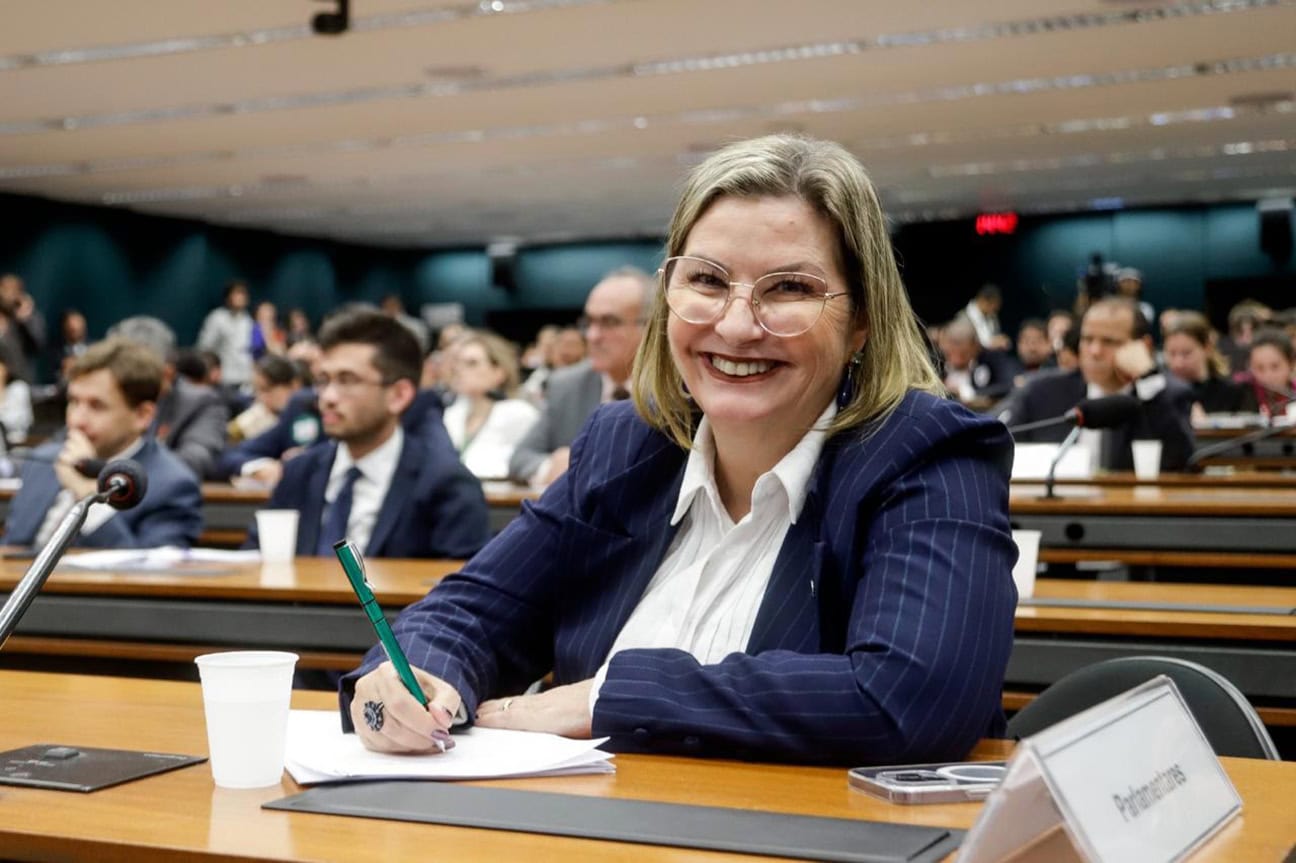 Ana Paula Junqueira – Never. I’ve always been one to live in the present, enjoy each phase, and learn from the journey, without imagining that one day I would be in the position I am today.
Aryane Garcia – Still in your childhood, which artists influenced you that have now lost relevance with the digital revolution and the advent of the internet?
Ana Paula Junqueira – Unfortunately none, because life was very different back then. When I was a child, I spent time playing with dolls, tag, dodgeball, and marbles. It was a simple, light, and very happy childhood.
Aryane Garcia – After years of learning, becoming a recognized professional in your field brings you labor advantages to opine on other areas/companies in the sector?
Ana Paula Junqueira – I believe so. When you experience politics from the inside, following decisions, successes, and challenges up close, you develop a more complete view of how the public sector works. That doesn’t mean knowing everything, but it means having a repertoire, responsibility, and maturity to contribute.
Aryane Garcia – Among your productive habits during the week, are there precepts you adapted and incorporated into your routine that you now advise to your other collaborators and younger colleagues?
Ana Paula Junqueira – After so many years working alongside Odelmo in the Federal Chamber and the Uberlândia City Hall, which adds up to nearly 40 years in public life, I developed some habits that I now bring to my mandate and always share with my team. The first is proactivity. Those who have lived in the Executive know that demands don’t wait. I learned to solve things on the spot, not let them pile up, and that has become part of my way of working.
Another very important point for me is staying always tuned in. I like to follow emerging issues, understand debates that are gaining traction, and keep an eye on new technologies that can facilitate management and improve service to the population. It’s something I’ve always done and continue doing in Brasília.
I also emphasize the importance of organization a lot. Keeping the agenda clear, knowing how to prioritize, and recording everything avoids misunderstandings and provides solidity when making decisions. These are habits I built over many years living politics from the inside—observing, learning, and participating. Today, they make all the difference in my daily life as a federal deputy.
 Aryane Garcia – What is your overview of Brazil’s economic situation in the last 20, 10, and 5 years?
Ana Paula Junqueira – In the last 20 years, Brazil has experienced advances and setbacks. We had moments of stability and growth, but also crises, recession, high inflation, and unemployment. Unfortunately, we find ourselves in the worst of scenarios.
Today we see a government that collects a lot but spends without planning, increases expenses recklessly, and weakens the confidence of those who want to invest and produce. This impacts everything: families, businesses, commerce, agribusiness, and especially municipalities, where life really happens.
There is a lack of organization in public accounts, a lack of prioritizing those who work, and a lack of courage to do what needs to be done. Brazil has strength, capacity, and a people who make things happen. What is missing is serious management, fiscal responsibility, and a real commitment to the citizen.
Aryane Garcia – Among the various difficulties and opportunities you encountered throughout your career, being part of agribusiness, the most profitable sector in Brazil, helps you understand the country’s social situation? What are your plans to collaborate with the inclusion of more youth and women in the sector?
Ana Paula Junqueira – Absolutely. Those who live in agribusiness know exactly the impact a crisis has on families’ daily lives. And what we’ve seen in recent years makes it clear that many people still don’t understand the importance of this sector. Agribusiness moves entire cities, ensures jobs, income, and food on people’s tables. Even so, it is still undervalued and often treated as the big villain.
I come from a chain that suffers a lot, which is milk production, and I know how price drops, input costs, and lack of support directly hit the producer. And even with so many difficulties, the countryside doesn’t stop, thanks to the effort of those who are there every day.
My work is precisely to prevent more producers from giving up on the countryside and to expand programs that strengthen female leadership and rural succession, because the present and future of agribusiness depend on them.
Aryane Garcia – Your daily and active participation with agribusiness economic statistics gives you a variety of growth opportunities. In your opinion, how will agribusiness remain strong in the coming years—according to your line of work?
Ana Paula Junqueira – Agribusiness will only continue growing if there is security to produce. That means predictability, respect for the sector, serious policies, and fiscal responsibility. Those in the countryside know there is no magic. There is work, management, and conditions to invest.
When the government gets in the way, creates insecurity, and treats the producer as an enemy, all that progress is compromised. If there is responsible management and respect for the producer, agribusiness will continue to be the engine of the country’s economy. Without that, no sector can sustain itself, no matter how strong.
Aryane Garcia – According to your experience, on a global level, does agribusiness face challenges in communicating to the world its importance in the impact on the entire production chain?
Ana Paula Junqueira – Yes, it does. Unfortunately, those who have never set foot on a farm or don’t understand the production chain create narratives that don’t match reality. The sector is still little understood because there is a distance between those who produce and those who consume. We need to show the world that behind every liter of milk, every food that reaches the table, there is hard work.
The biggest challenge for us producers is to combat misinformation. The way forward is to communicate better, open the doors of farms, show good practices, and bring people closer to the reality of the countryside. The world needs to understand that without agribusiness, there is no food, no strong economy, and no future.
Aryane Garcia – How to convince society that agribusiness is not the main responsible for global warming? What news or headline should be debunked for having falsely harmed the sector?
Ana Paula Junqueira – It’s not about convincing society, but about each one doing their part, especially those in leadership positions with great influence. Just show what rural producers already do every day: produce with quality, responsibility, and respect for the environment.
The headline that always needs to be debunked is that “Brazilian agribusiness destroys the environment.” Brazilian agribusiness is sustainable. We take care of the land because our work and our families’ future depend on it. Those who live the daily life of the farm know that there is no production without preservation, and it’s precisely that truth that needs to be stated clearly and without fear.
Aryane Garcia – The popularity of rural producers is at risk and what would be the reasons for the demonization of the ruralist composition?
 Ana Paula Junqueira – Yes, the popularity of rural producers is often at risk, and this happens for some clear reasons. First, there is enormous ignorance about how the countryside really works. Second, part of political polarization has turned the sector into an easy target, as if we produced problems and not solutions.
While the producer works every day to ensure food, jobs, and development, many prefer to point fingers without understanding reality. That’s why it’s so important to reinforce agribusiness’s role, show its value, and remind everyone that society as a whole depends on it.
Aryane Garcia – The common thread of agribusiness success is the economy. Do you think it’s possible for Brazil to lose purchasing power and go through an economic recession? How can Brazil shield itself from a food crisis?
Ana Paula Junqueira – Brazilians are already feeling the weight of a weak economy in their pockets. Purchasing power has fallen, taxes are high, and food prices keep rising. But make no mistake: it’s not the producer who is profiting from this. On the contrary, we see, for example, milk producers earning less and less.
The country risks a food crisis precisely when agribusiness is not valued as it should be. Protecting the producer and giving them conditions to produce with quality and responsibility is the best way to ensure food on people’s tables, generate jobs, and strengthen Brazil’s development.
Aryane Garcia – Among the various attitudes that accelerate Brazil’s growth, what is the greatest contribution this generation can deliver that will impact the next 30 years?
Ana Paula Junqueira – The greatest contribution this younger generation can give to Brazil is to seek knowledge and seize good opportunities from an early age. Education is the foundation of everything, and the more they learn, the better prepared they will be to face challenges that are part of any growth and exist in all areas. That’s how they will help build a better country for everyone.
Aryane Garcia – If you could choose a Brazilian city to live in until your last day, which one would it be and why?
Ana Paula Junqueira – It’s hard to choose just one, but it would certainly be some city in Minas Gerais. I have enormous love for my state and make a point of being present in the municipalities, getting to know the people, the culture, and the little details that make Minas so special. Whenever I can, I take advantage of trips to visit tourist spots and discover something new.
To tell the truth, my dream is to have an RV and travel everywhere, getting to know every corner. Then I would be completely happy!
ARYANE GARCIA
Journalist
@aryanegarcia