



Long ago, life left microscopic signatures on Mars—or did it? That’s the question NASA scientists have been trying to answer for years. On Wednesday, NASA researchers said the answer may lie in a rock sample that “contains potential biosignatures”.
The discovery, published on Wednesday in the journal Nature, puts the agency one step closer to answering one of humanity’s deepest questions about life in the universe, said Nicky Fox, associate administrator for NASA’s Science Mission Directorate.
“This discovery by our incredible Perseverance rover is the closest we’ve come to discovering ancient life on Mars. And if you haven’t noticed, we’re really excited about it,” Fox said during a press conference at NASA headquarters in Washington.
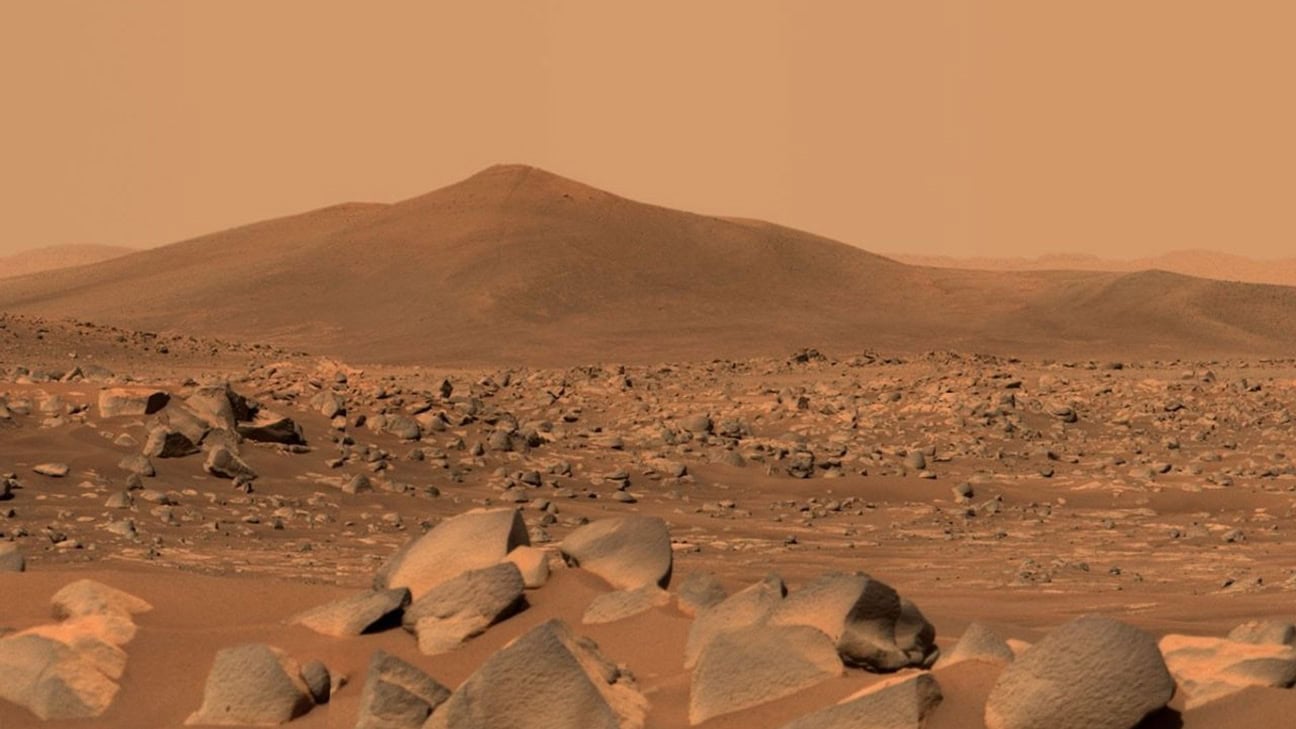
The exciting rock sample in question is called Sapphire Canyon. NASA’s Perseverance rover collected it last summer from a reddish, vein-filled rock along the edge of an ancient river valley about 400 meters wide known as Neretva Vallis.
The valley was carved by water flowing into the large Jezero Crater, which also hosted a lake billions of years ago.
“Jezero was selected because it’s in a location among Mars’ oldest terrains, exposing some of the oldest rocks anywhere in the solar system,” said Katie Stack Morgan, Perseverance project scientist at NASA’s Jet Propulsion Laboratory in southern California.
“These really ancient rocks give us a window into a period of time that’s not particularly well represented on our own planet Earth,” she added. “But it’s a time when life was emerging on Earth, and could have been on Mars too.”
Perseverance landed in the crater in early 2021, with the goal of collecting and analyzing samples that would allow researchers to study an ancient river delta—identified as a potentially rich source of signs of ancient microbial life.
Then, in July 2024, Perseverance found the rock that has intrigued scientists for months. NASA researchers say it has features like small black “poppy seed” dots and larger “leopard spots”—patterns that are often telltale signs associated with life.
“This is the kind of signature we’d see made by something biological,” Fox said. “In this case, it’s like the equivalent of seeing residual fossils… leftovers from a meal. And maybe that meal was excreted by a microbe. And that’s what we’re seeing in this sample.”
Researchers using the rover’s instruments to analyze the dots and spots on the rock found minerals containing iron, phosphorus, and sulfur, said Joel Hurowitz, Perseverance scientist and lead author of the study from Stony Brook University in New York, at Wednesday’s press conference.
What’s exciting is that a combination of mud and organic matter reacted to produce these minerals and textures, Hurowitz said.
“When we see features like this in sediments on Earth,” Hurowitz explained, “these minerals are often the byproduct of microbial metabolisms that consume organic matter and produce these minerals as a result of those reactions.”
But, he added, there are also “non-biological ways to produce these features that we can’t completely rule out” as a cause with the current data, such as being heated to extremely high temperatures.
The next big step, said Hurowitz and others at the NASA event, would be to analyze these rocks more deeply—and in person. It would be the first time a pristine piece from another planet is brought to Earth.
Bringing the core sample back, NASA researchers wrote in the Nature paper, would allow it to be analyzed with specialized and highly sensitive instruments that “would determine the origin of the minerals, organics, and textures it contains.”
Perseverance has collected 30 samples on Mars so far, according to NASA, with six empty tubes still unfilled. But the agency is still working on a plan to bring them back.
NASA previously outlined plans to land a spacecraft carrying Martian specimens at a U.S. Air Force test base in Utah. But such a mission would cost billions and take years to complete—and in May, President Trump proposed cutting funding for the Mars Sample Return program, calling it “financially unsustainable.” Earlier this year, the agency said it was considering two different options for how to land and load the samples from Mars’ surface.
“We believe there’s a better way to do this, a faster way to bring these samples back,” said NASA’s interim administrator Sean Duffy on Wednesday.
Duffy also said NASA remains committed to crewed missions exploring space, as part of its scientific pursuits.
“So what we do on Mars,” he added, “these missions help us in what we’re going to do in the future as we return to the moon and eventually reach Mars.”
Source: npr.org by Bill Chappell