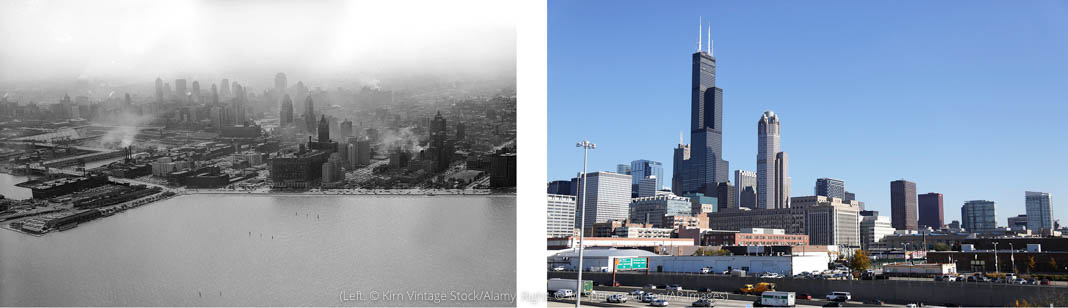
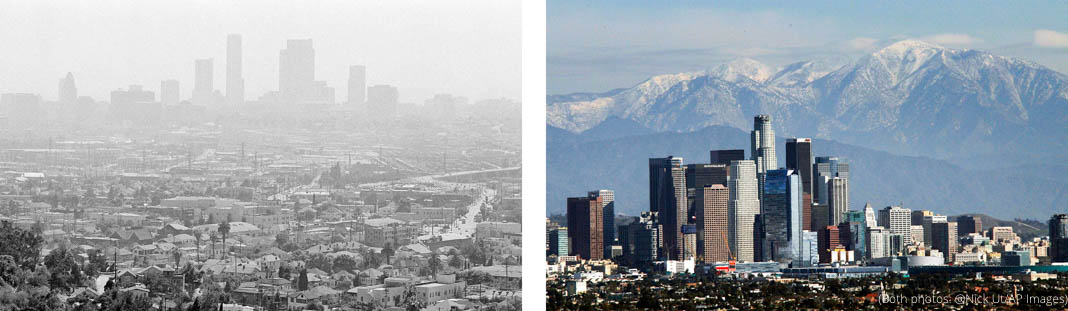
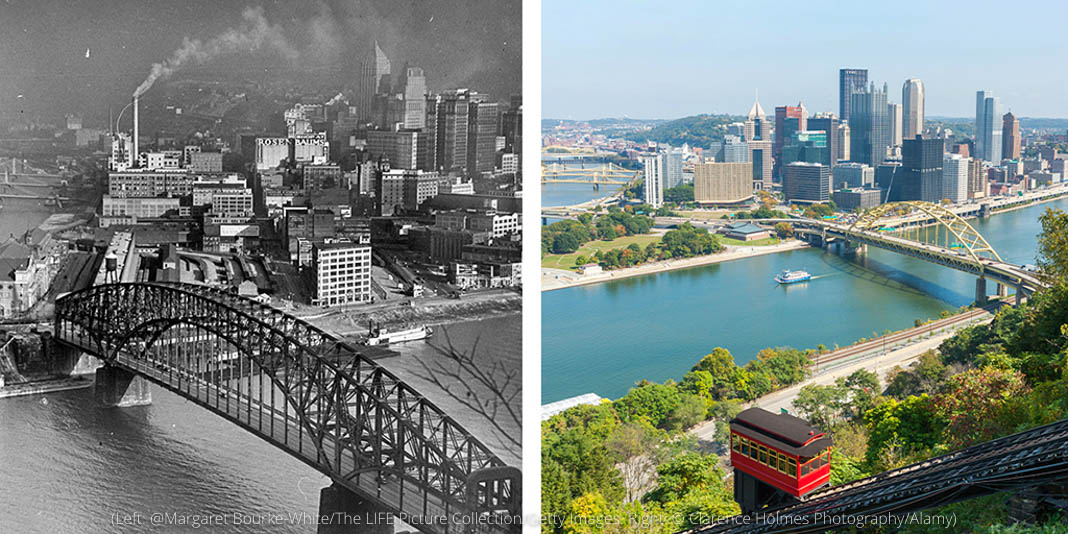
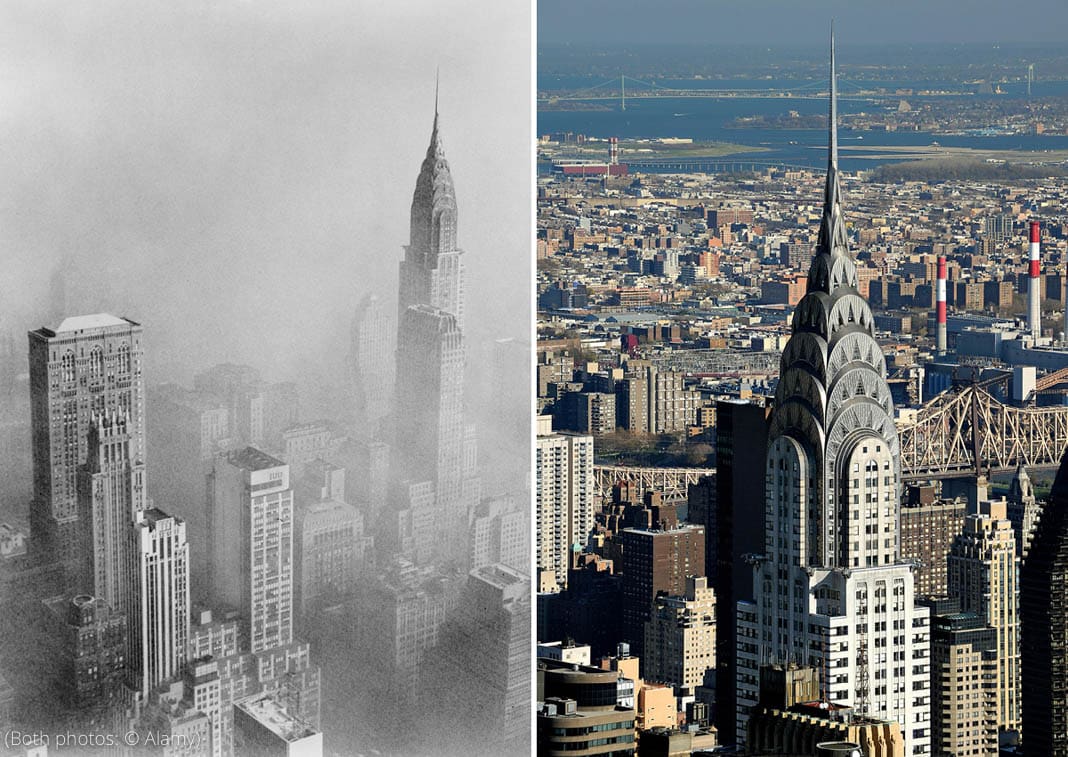
Local governments in many cities are tackling long-standing air quality issues, and many are seeing positive results. Here’s how four major urban areas — Chicago, Los Angeles, Pittsburgh, and New York — have made strides to help their residents breathe better.Chicago Chicago in 1945 (left) and in 2013 (right) (Photo left: © Kirn Vintage Stock/Alamy. Photo right: © M. Spencer Green/AP Images) Chicago (shown above in photos taken decades apart) was the first major U.S. city to develop a comprehensive climate plan in 2008, and has since continued to improve its air quality goals. Local technology initiatives, such as the 2016 Array of Things (AoT) project, are helping the city enhance its air quality. The AoT project uses sensors on light poles throughout the city to collect environmental data on an unprecedented scale. Chicago has also created the Pollution Prevention Unit to reduce emissions and is working toward a zero-emission transportation system, expanding bike lanes and investing in electric vehicles for municipal purposes.Los Angeles Left: A smog curtain over Los Angeles. Right: The snow-covered San Gabriel Mountains serve as a backdrop for the Los Angeles skyline. (© Nick Ut/AP Images Los Angeles is committed to setting and meeting climate goals to improve its air quality. New technologies, such as solar panels and hybrid and electric cars, have made building and energy practices more environmentally friendly in the city.The city is also launching a pilot project whereby all delivery trucks — which use diesel fuel — will create zero emissions by 2035. Los Angeles public libraries are launching a program for residents to borrow air sensors, just like they borrow books, for use inside or outside their homes to monitor pollution levels, which will be helpful during wildfire season.State policies have similarly helped California limit carbon emissions growth to 4% from 1990 to 2010. And a new rule from the federal Environmental Protection Agency allows California to set stricter emission limits for cars, light-duty trucks, and sport utility vehicles.Pittsburgh Pittsburgh at the confluence of the Monongahela and Allegheny rivers in 1936 (left), and in 2014 (right) (Photo left © Margaret Bourke-White/The LIFE Picture Collection/Getty Images. Photo right © Clarence Holmes Photography/Alamy) Once famous for its steel mills, Pittsburgh is now a model city for how government initiatives and new technologies can create a cleaner environment. People visiting Pittsburgh today can see the Tower at PNC Plaza, a 33-story office building that has surpassed the highest certification requirements in sustainable design from the U.S. Green Building Council. The mayor’s office is also investing in fossil fuel-free public transit, renewable energy across municipal facilities, and working to halve all transportation emissions by 2030.New York Smog hangs over the Chrysler Building in New York in 1953 (left). Fine particulate pollution has dropped 40% in the last 20 years, bringing cleaner air photographed in 2011 (right). (Both photos: © Alamy) New York, one of the most densely populated cities in the world, has thousands of buildings and constant traffic. But thanks to air quality measures implemented by local and state governments, fine particulate pollution in New York has decreased by 40% over two decades. New York is also on track to meet its 2025 climate goals through infrastructure projects that will provide 100% clean energy to the city by 2040.Source: share.america.gov , by Lane Mikula, freelance writer