



For the first time, the US government is encouraging people to avoid “highly processed” foods, which it says are driving diet-related diseases. But this recommendation puts many Americans in a tough spot. Studies show that many people want to reduce the amount of ultra-processed foods in their diets, but have trouble figuring out which foods fall into that category.
“I think advertising is really good at making people think foods are minimally processed when they’re actually ultra-processed,” says Alexandra DiFeliceantonio, who studies the neuroscience of food choice at Virginia Tech.
Ultra-processed foods are industrially manufactured products that contain ingredients rarely found in your kitchen, such as preservatives, artificial sweeteners, colorings, natural flavors, and emulsifiers. Numerous studies have shown that these foods increase the risk of a range of health problems, including diabetes, heart disease, depression, and obesity.
“When people ask me about ultra-processed foods, they’re usually most confused about grains, carbs, and starches,” says Dr. Dariush Mozaffarian, who leads the Food is Medicine Institute at Tufts University. These foods include breads, crackers, pretzels, pea snaps, veggie sticks, pastas, and puffed rice or corn. “People want to know how to choose healthier versions of these products,” he says.
So, Mozaffarian gives his patients two practical golden rules to follow when selecting grains and starches: the 10-to-1 test and the water test.
1. The 10-to-1 test
“A food should have at least 1 gram of fiber for every 10 grams of carbohydrate,” says Mozaffarian. For example, if you’re looking to buy a granola bar, check the nutrition label. If there’s 30 grams of total carbohydrate in the bar, there should be at least 3 grams of fiber too. If not, choose a different bar.
This test, he says, ensures that foods aren’t loaded just with refined flours and sugars. “So there’s a balance between refined starches, whole grains, bran, seeds, and other healthy ingredients,” explains Mozaffarian.
And, he says, the food should also pass “the water test.”
2. The water test
Simply take the starchy food—say, a piece of bread, a cracker, pretzel, or cereal—and put it in a glass of water. Let it soak in the water for three or four hours and see what happens.
Specifically observe if the grain or starch dissolves or disintegrates in the water, he says.
Minimally processed grains, like whole wheat breads and steel-cut oats, still have the plant’s cell wall intact, which surrounds the chains of carbohydrates and forms a kind of shield or barrier around them. The plant cell wall protects the carbohydrates from dissolving in water.
So, if the carbohydrate doesn’t dissolve in water, it’s likely a minimally processed food, says Mozaffarian. And it’s a healthy choice because, he says, the cell wall does something even more important: it makes the grain hard to digest.
After you eat a carbohydrate, enzymes in your mouth and stomach break down the starch into simple sugars, which then enter your bloodstream. In a way, says Mozaffarian, the water test models the process in your digestive tract.
Your enzymes can’t act on the carbohydrates when they’re protected by the cell wall. So you digest minimally processed grains much more slowly than ultra-processed ones. This slow digestion is good for you, says Mozaffarian. “It doesn’t overload your liver and the hormones that handle metabolism.” And in the long term, it reduces your risk of weight gain and diabetes.
This slow digestion also means the carbohydrate travels farther into your gut, where it can feed the microbes in your large intestine, called the microbiome. You need a healthy microbiome to thrive.
On the other hand, ultra-processed grains and starches don’t make it far into your gut because of how they’re manufactured, says Dr. Meroë B. Morse, assistant professor at MD Anderson Cancer Center. Companies, in effect, pre-digest the grains, corn, or potatoes, and in the process remove the plant cell wall. “The grain or starch is ground down to its individual ingredients and then repackaged and glued back together,” she says.
So the enzymes in your gut quickly break down the carbohydrates into simple sugars.
“These foods are digested very quickly in your stomach and can create a glucose spike,” explains Morse. “And when you have a glucose spike, insulin levels tend to rise.” Over time, these spikes can contribute to insulin resistance and, eventually, diabetes, she says.
So when choosing grains, starches, and other carbohydrates, you want those that stay intact both in your gut—and in a glass of water.
That’s where the water test comes in.
A simple experiment
A few weeks ago, my 10-year-old daughter and I baked a whole wheat bread in our kitchen. And we decided to put it to the water test.
For comparison, we bought a French baguette at the supermarket that contained preservatives, dextrose, wheat gluten, plus “dough conditioner” and “crumb softener.”
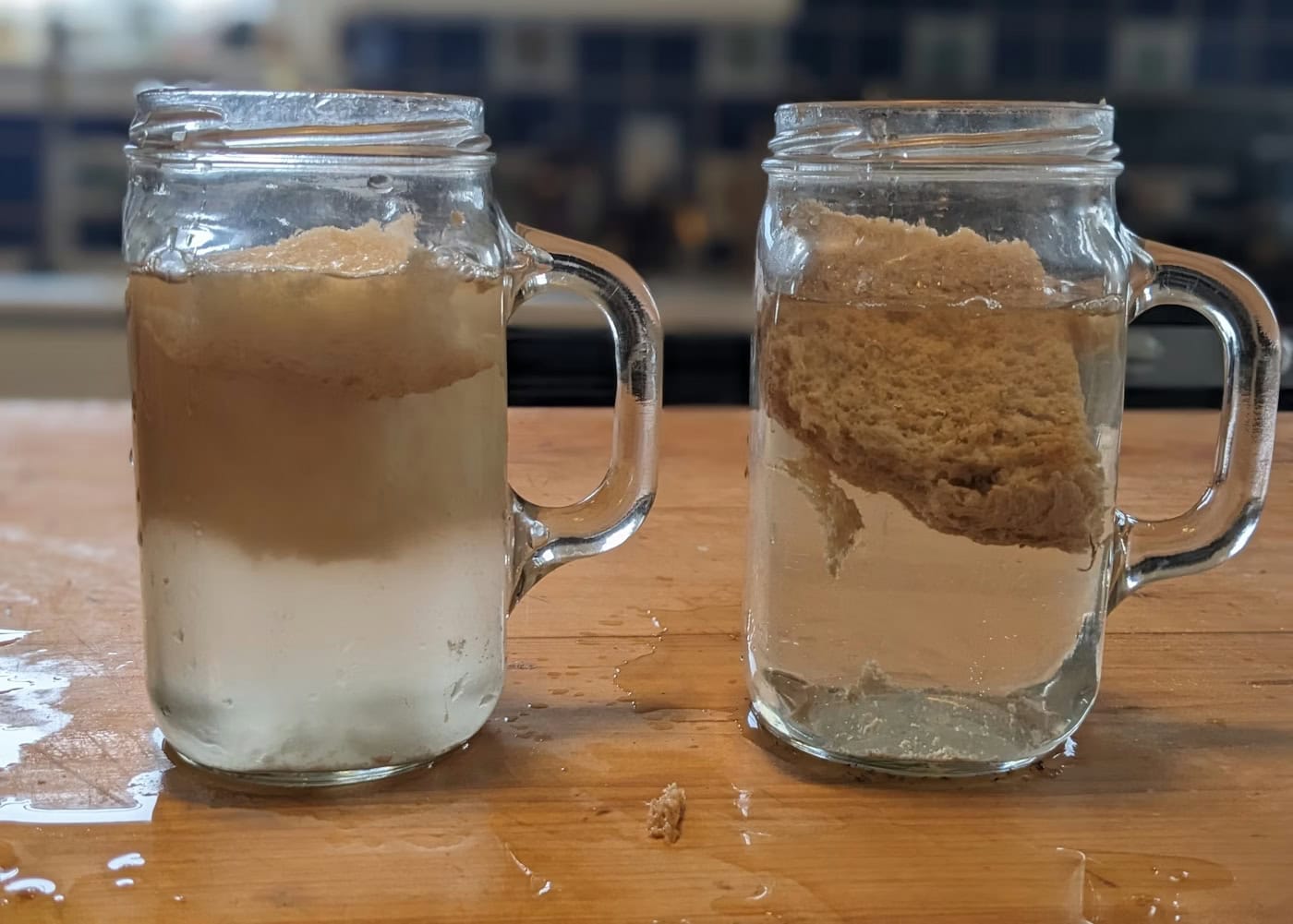
We took a piece of each bread, put them in two glasses of water, and waited about three hours. Then we examined each piece.
The homemade whole wheat bread had absorbed some water but remained intact, and there were no signs of the starch dissolving in the water. The water stayed clear. Ding, ding, ding! Our homemade whole wheat bread passed the water test with flying colors.
But the French baguette had transformed remarkably. “Whoa!” my daughter exclaimed as she pulled the bread from the glass of water. “It’s like a sponge, or slime, or Play-Doh!”
The baguette had absorbed a huge amount of water and nearly turned into a kitchen sponge that you could wring out and reuse. Plus, the water in the glass was cloudy and white because the starch had started dissolving into it.
Bzzzt! The baguette failed the water test. This result confirmed that this bread is ultra-processed.
But the water test did something more for my daughter. It helped her understand—and see firsthand—how ultra-processed breads can look similar to homemade ones but act very differently inside our bodies.
“It’s kind of gross,” she said, squeezing the ultra-processed piece of bread like a sponge. “Bread shouldn’t be like that.”
Source: npr.org by Michaeleen Doucleff