



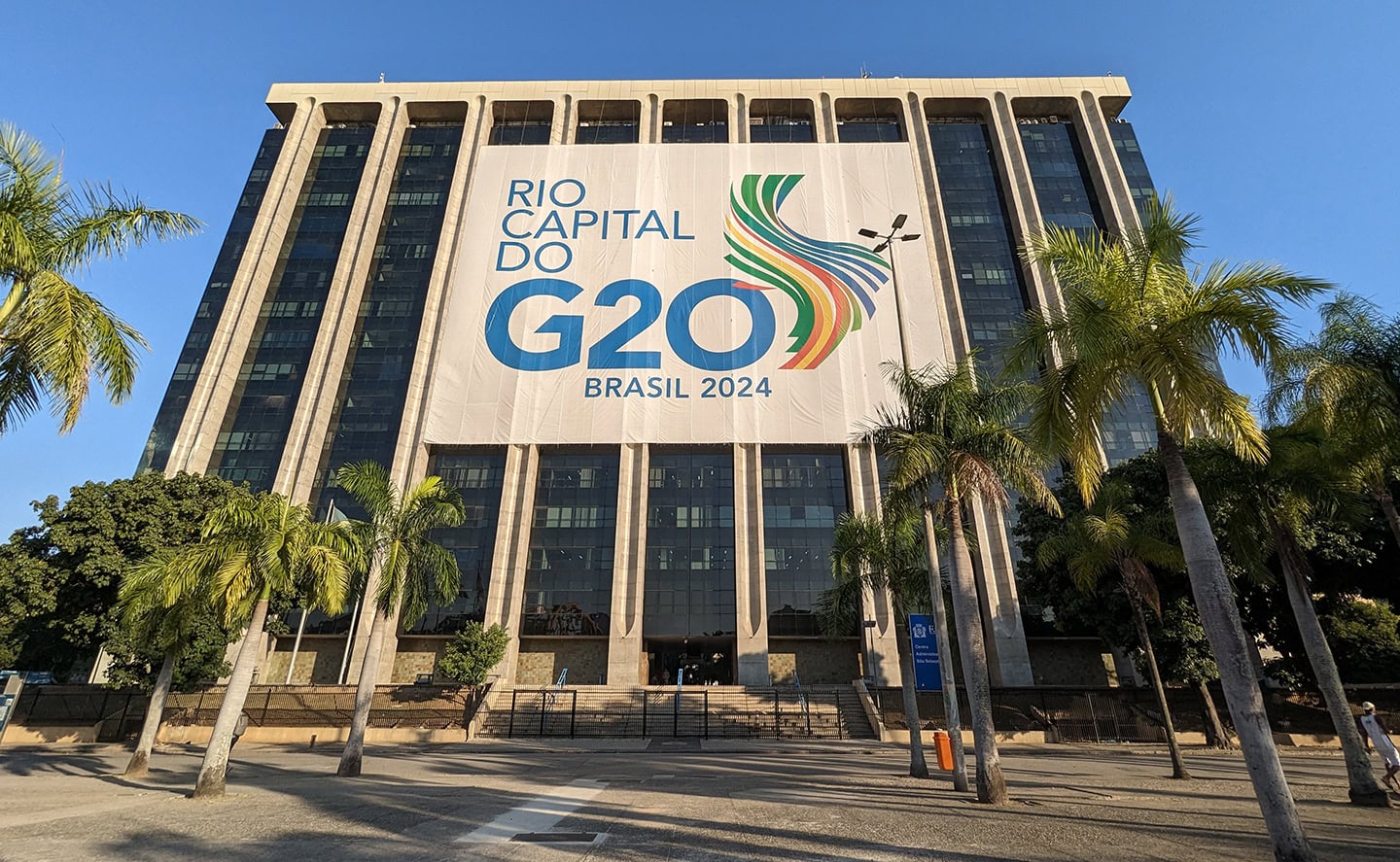
The G20 is the forum for economic cooperation among the 19 largest economies in the world, along with the European Union and, starting in 2023, the African Union. With an annual rotating presidency, the G20 operates in annual cycles, involving various ministerial and technical meetings that culminate in the summit of heads of state and government. In Brazil, the G20 summit will be held in Rio de Janeiro on November 18 and 19, 2024.History of the G20The group was established in the context of the Asian economic crisis, which spread to other emerging markets in the late 1990s. The G20 was created as an informal forum for coordination among Ministers of Economy and Finance and Central Bank leaders.The macroeconomic imbalance, originating and spreading in Asia and Latin America, highlighted the need to include developing countries in discussions about international economic and financial stability, thus expanding discussions that were previously held only within the G7/G8.Elevated to a summit meeting since 2008, after the most severe global economic crisis since 1929, the importance of the group is evident in the numbers: its members collectively represent about 85% of global GDP, more than 75% of international trade, and about two-thirds of the global population.While in the past the group emerged to provide responses to crises, today it serves as a privileged space to anticipate instabilities and create joint solutions in areas ranging from trade to tourism, culture to climate change.G20 in BrazilFor Brazil, leadership in the G20 represents an opportunity for international reintegration through a high-level economic forum in which the country has traditionally made active contributions. This leadership potential extends beyond the G20, as Brazil will host COP30 in 2025.Under Brazilian presidency, the G20 adopts the motto “Building a Fair World and a Sustainable Planet,” focusing on three priority themes: energy transition, fair sustainable development (with an emphasis on combating hunger, poverty, and inequality), and reform of multilateral institutions.Reaffirming its commitment, Brazil announced the creation of two working groups for the G20 – the Global Alliance Against Hunger and Poverty and the Global Mobilization Against Climate Change – along with a bioeconomy initiative. Discussions related to finance, coordinated by the Ministry of Finance, will address topics such as financing to combat climate change, renegotiation of national debt, tax progressivity, and reform of the governance of international financial institutions.The G20, both in its composition and scope, has the potential to shape the history of Brazilian foreign policy, creating a positive legacy from the Rio de Janeiro Summit, the G20 capital.G20 in Rio de JaneiroRio de Janeiro expects to host 41 events in November. According to a survey by the Visit Rio foundation, these events are expected to generate R$ 432.5 million for the local economy. Of the total, 13 are directly linked to the G20, with an expected economic impact of R$ 32.6 million and revenue of R$ 1.6 million in Service Tax (ISS).Highlights of the calendar include the Social Summit, the Giga Climate Mural Workshop, the Urban 20 Summit, the 1st Municipal Planning Forum: Sustainable Cities, the Oceans 20 Summit, the Munich Security Conference, and the meetings of the T20 Think Tanks. These events not only attract international attention but also provide a significant boost to the local economy.Source: G20
G20 to be held in Rio in November
-
Facial biometrics will be mandatory for mobile phone users
Starting in 2027, mobile phone users will need to undergo biometric validation to contract and maintain phone lines. The requirement was approved by the National Telecommunications Agency (Anatel) and aims to curb fraud, since the line holder will now be identified. Biometrics will be performed through facial recognition with proof of life, which will be…