



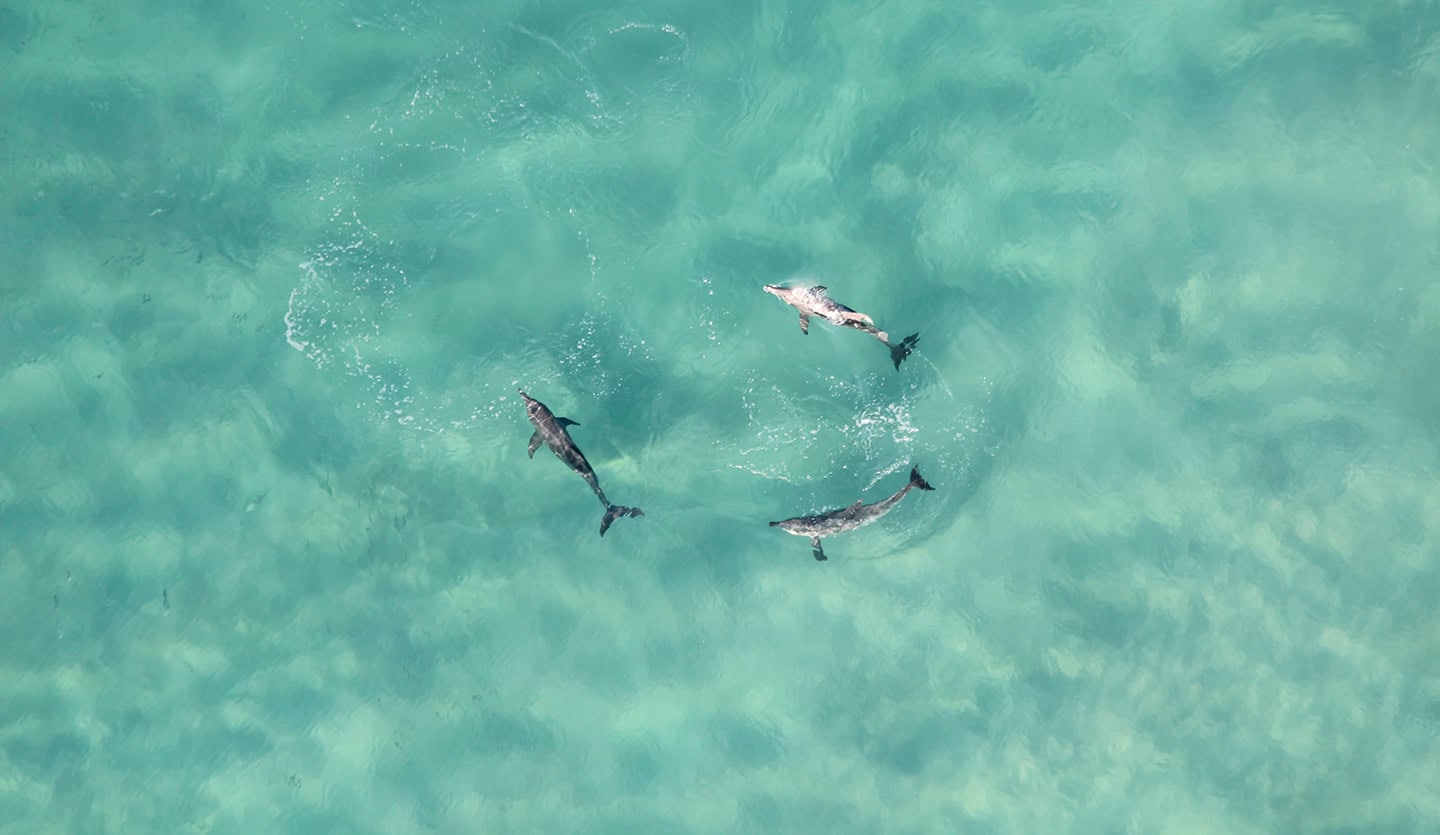
The appearance of a group of dolphins at Arpoador Beach in Ipanema, in Rio de Janeiro’s South Zone, delighted beachgoers and visitors on Sunday (22), in a rare and symbolic scene on World Water Day. According to Agência Brasil, the animals were seen close to the shore, including many calves, which amplified the episode’s repercuss on social media and drew attention to the environmental conditions of Rio’s coastline.
In an interview with Agência Brasil, the coordinator of the Projeto Spinner Dolphin, José Martins, stated that the animals observed apparently belonged to the bottlenose dolphin species, also known as boto, whose scientific name is Tursiops truncatus. It is one of the most well-known dolphin species in the world, present in coastal and oceanic waters of virtually all the planet’s seas, except polar regions.
The presence of the group on Rio’s coastline, according to the expert, holds important environmental significance. José Martins highlighted that these animals serve as natural markers of marine ecosystem quality. “These dolphins are bioindicators. If they are appearing on Rio’s beaches, it’s because environmental conditions are good. When the sea is calm like today, females usually seek the protected area between Ilha das Cagarras and Arpoador for food or to socialize and care for their calves,” he said.
Dolphins and environmental quality
Martins’ assessment reinforces the importance of observing marine fauna as a parameter for measuring the health of coastal environments. The presence of dolphins near the beach is generally associated with a set of favorable factors, such as lower environmental stress, food availability, and suitable sea conditions for the animals’ movement and stay.
In the case of Arpoador, the combination of calm seas and a protected coastal strip may have favored the group’s approach. The area between Ilha das Cagarras and Rio’s South Zone coastline is recognized as a key space for marine species circulation, especially when fish are abundant and water turbulence is low.
Martins also drew attention to another element observed on site: the presence of fishing boats nearby. For him, this reinforced the hypothesis of fish abundance in the region, a condition that helps explain the dolphins’ activity. “Both – dolphins and fishermen – are after the same thing,” said the oceanographer and environmentalist.
Dolphin calves heighten interest and symbolism of the sighting
One of the aspects that most impressed witnesses was precisely the presence of calves among the animals. The image of dolphins swimming close to the shore at one of Rio de Janeiro’s most iconic coastal spots contributed to the rapid spread of images on digital platforms and public interest in the phenomenon.
Despite the calves’ presence, José Martins ruled out interpreting the episode as a reproductive peak. According to him, this interpretation does not apply to the species observed at Arpoador. “They normally reproduce year-round. Since the animals seen today were accompanied by calves, this means they are not in a reproductive peak,” Martins analyzed.
This explanation is relevant because it helps better understand the behavior of Tursiops truncatus along Rio de Janeiro’s coastline. Rather than an exceptional concentration for reproductive reasons, their appearance is more likely linked to habitual use of the coast for movement, feeding, socialization, and calf care.
Posts gain traction on social media
The visual impact of the scene caused videos and photos of the dolphins to spread rapidly across social media. Among the most shared images were those from industrial designer Gabriel Klabin, who has worked with drones and aerial technologies for nearly twenty years. Beyond professional work, he develops a personal project focused on observing and documenting landscapes, sea, and wildlife.
Discussing his approach, Klabin highlighted the goal of bringing the public closer to nature through images. “The idea is to create images that bring people closer to nature and provide a more sensitive perception of the territory,” he said.
The designer also explained that his work requires preparation but equally depends on listening and sensitivity to the environment. “Planning this work mixes technique and intuition. There’s an important part of study, but it depends a lot on being present, observing, and respecting the timing of things.”
The dissemination of these recordings helped turn the dolphin sighting into one of the day’s most visually striking events in Rio de Janeiro. At the same time, the occurrence opened space for broader reflection on marine conservation, ecological balance, and coexistence between urban life and nature in one of the city’s most emblematic areas.
Rare scene reinforces the value of coastal preservation
The presence of dolphins at Arpoador was not just a spectacle for those on the beach. The event also underscored the importance of protecting marine and coastal ecosystems, especially in areas under intense urban, tourist, and economic pressure.
When experts identify these animals as bioindicators, what is at stake is the fauna’s ability to concretely reveal the conservation status of the environment. In this sense, this group’s appearance on Rio de Janeiro’s coastline emerges as a positive sign and, at the same time, a reminder that maintaining this quality depends on preservation policies, monitoring, and responsible use of coastal areas.
On the Sunday marking World Water Day, the scene of dolphins before beachgoers and admirers took on even greater symbolic meaning. More than a moment of collective enchantment, the animals’ passage by Arpoador offered a powerful image of the connection between biodiversity, environmental balance, and quality of life in coastal cities.
Source: brasil247.com