



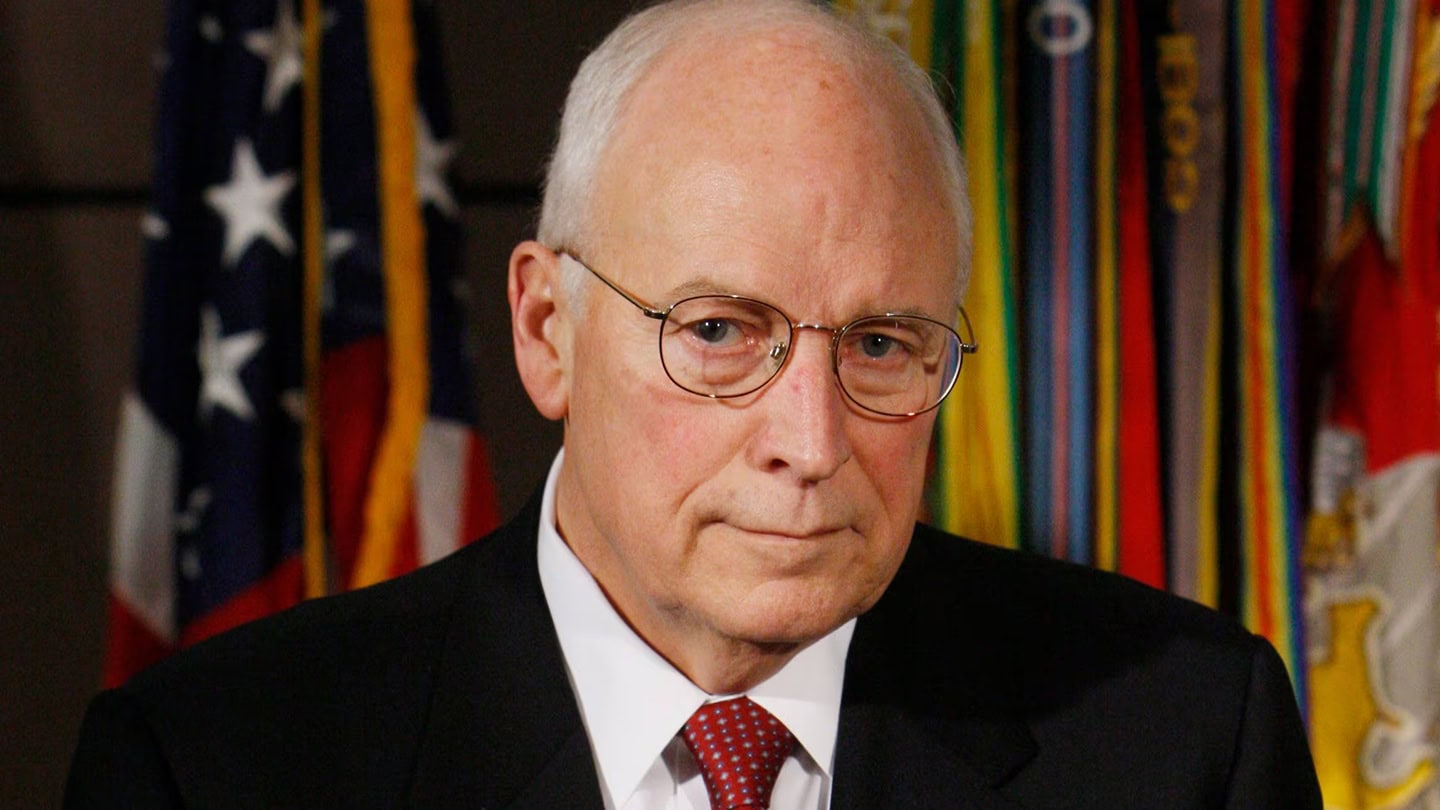
Former Vice President Dick Cheney, who extolled the power of the presidency, died on Monday at the age of 84, his family said in a statement.
The cause was complications from pneumonia and heart and vascular diseases, the statement said. Cheney had a history of heart problems.
“Dick Cheney was a great and good man who taught his children and grandchildren to love our country and to live lives of courage, honor, love, kindness, and fly fishing,” the statement said. “We are grateful beyond measure for everything Dick Cheney did for our country. And we are blessed beyond measure to have loved and been loved by this noble giant of a man.”
In a statement, former President George W. Bush, who chose Cheney as his vice president, said the death “is a loss for the nation and a sadness for his friends. Laura and I will remember Dick Cheney as the decent and honorable man he was.”
Bush added that Cheney “was a calm and steady presence in the White House amid great national challenges. I relied on him for his honest and frank advice, and he never failed to give his best.”
An inauspicious beginning
There was little in Cheney’s early life that foreshadowed the immensely influential role he would one day play at the highest levels of American politics. Born the son of a conservation government worker in Lincoln, Neb., in 1941, he flunked out of Yale University and worked as a lineman for a power company in his new home state of Wyoming. Add to that a couple of convictions for drunk driving, and it’s an inauspicious youth.
But Cheney turned it around: marriage to his high school girlfriend, Lynn; two daughters; a college degree from the University of Wyoming; graduate school at the University of Wisconsin.
While Cheney was turning his life around, the U.S. was immersed in the upheavals of the Vietnam War. Cheney supported that war but never fought in it. He received five military deferments. Critics clung to that decades later, when Cheney helped lead the U.S. into another controversial war—this one in Iraq.
From ordinary to extraordinary
The future vice president began his political career as an intern in Congress in 1969. That same year, he went to work for a future partner in the Bush administration—Donald Rumsfeld, who ran an economic office in Nixon’s White House.
Cheney left the White House before Nixon’s resignation, but in 1974 he was back working for the new president, Gerald Ford. Cheney rose quickly, becoming Ford’s chief of staff at age 34.
It was then that he began to develop a philosophy that would fully blossom in George W. Bush’s White House. His belief was that the power of the presidency should not only be protected but also restored. In the 1970s, he watched as Congress enacted reforms in response to Watergate and Vietnam.
“We saw the War Powers Act, an anti-impoundment control law, and time after time, administrations gave up presidential authority to do their job,” he said in a 2002 interview with Fox News. “We’re not going to do that in this administration. The president is determined to defend those principles and to pass this office, his and mine, to future generations in better shape than we found it.”
War, a recurring theme
In 1978, Cheney ran for Congress in Wyoming and won. It was also the year he suffered the first of a series of heart attacks. He served in Congress for a decade and finally resigned to become defense secretary for President George H.W. Bush.
That post brought Cheney’s first confrontation with Saddam Hussein, when he directed Operation Desert Storm in the Middle East. The war ended quickly after Iraqi troops were expelled from Kuwait. At the time, some thought the U.S. should continue to Baghdad and topple Saddam’s regime. President Bush refused; in 1994, Cheney defended that decision.
“The notion that we should now go to Baghdad and somehow take control of the country strikes me as extremely serious in terms of what we would have to do once there,” he said. “You’d probably have to put a new government in place. It’s not clear what kind of government it would be, how long you’d have to stay. For the U.S. to get militarily involved in determining the outcome of the struggle over who governs Iraq strikes me as the classic definition of a quagmire.”
Cheney left the Pentagon when the first President Bush lost to Bill Clinton. Two years later, he flirted with his own presidential run but instead went to the private sector, joining the energy services giant Halliburton.
Changing the vice presidency—and foreign policy
The job made Cheney a rich man, but he remained involved in conservative politics. In 2000, he was asked by Republican presidential candidate George W. Bush to lead the search for a running mate. Bush later surprisingly announced that he had chosen no one other than Cheney.
In the job, Cheney became a lightning rod for administration critics. Cheney also redefined the vice presidency. He became President Bush’s closest adviser and a dominant player in policy-making. Critics claimed that Cheney was really the man in charge in the White House.
The events of September 11, 2001, only reinforced that notion. While Bush was in Florida that day, Cheney was at the White House. He was literally carried by Secret Service agents to an underground bunker. In an interview years later on NBC’s Meet the Press, Cheney said it was he who told Bush not to return to the White House.
“I said: ‘Delay your return. We don’t know what’s happening here, but it looks like, you know, we were targets,’” Cheney said, adding that “things we did later that day were directly tied to ensuring presidential succession.”
After the September 11 attacks, Cheney advocated a new aggressive foreign policy in which potential threats would be met with swift and preemptive action. The U.S. would no longer wait for an enemy to strike first. He helped sell the Iraq War by issuing dire warnings to the American people. At the same time, he famously predicted that the mission itself would be relatively easy.
On Meet the Press, Tim Russert, who then hosted the show, asked Cheney if the American people were ready for a long and bloody battle.
“I don’t think it’s going to unfold that way, Tim, because I really do believe that we will be greeted as liberators,” Cheney said.
As the war dragged on, Democrats clung to that statement as evidence of how Cheney’s determination to go to war had clouded his judgment. There was talk that his views had changed since his early days in politics.
Controversy follows Cheney
Although Cheney’s disposition was never particularly sunny, critics attacked the vice president as a relentlessly dark figure. Late-night comedians called him Darth Vader. Even President Bush had fun with the image of his vice president one Halloween.
“This morning I was with the vice president,” Bush told reporters. “I asked what costume he was planning. He said: ‘Well, I’m already wearing it,’ and then muttered something about the dark side of the force.”
There were other controversies that dogged Cheney as the Bush administration’s popularity plummeted in its second term. In 2007, his chief of staff and top adviser, Lewis “Scooter” Libby, was convicted of perjury in an investigation into the leak of the name of CIA covert operative Valerie Plame. Cheney was not legally implicated in the case but was tarnished by the scandal nonetheless.
Then, in one of the most bizarre incidents involving someone as high-ranking as Cheney, he accidentally shot and wounded a friend, lawyer Harry Whittington, in the face and chest with birdshot during a quail hunt on a Texas ranch in 2006.
Even in a strange story like this, some of Cheney’s classic traits, like secrecy, were on display. The story didn’t come out for two days, and when it finally did, Cheney took days more to talk about it, finally giving an interview to Fox News.
On Cheney’s last day in office, he was in a wheelchair, the result of an accident, bundled up against the freezing cold, and watched as President Barack Obama was sworn in.
Out of office, he emerged as a frequent and frank critic of the Obama administration, even accusing the president of not understanding that the U.S. was at war.
In February 2010, he made a surprise appearance at CPAC, the Conservative Political Action Conference in Washington. The crowd erupted.
It was one of Cheney’s last moments of great public adulation. With the rise of Donald Trump, Cheney’s brand of politics and his interventionist foreign policy fell out of favor in the party. Trump frequently criticized Cheney for starting what he called “forever wars.”
That extended to the next generation when Trump attacked Cheney’s daughter, former Rep. Liz Cheney (R-Wyo.), when she voted to impeach Trump after a pro-Trump mob’s riot at the U.S. Capitol.
Trump’s relentless criticism of her contributed to Liz Cheney’s defeat when she ran for reelection in 2022. Along the way, her father appeared in TV ads on her behalf.
“In 246 years of our nation’s history, there has never been an individual who represents a greater threat to our republic than Donald Trump,” Dick Cheney said in the ad.
It was his last major public moment in the political arena. Two years later, he would endorse Democrat Kamala Harris against Trump for president.
In the end, the power of the Cheney name was greatly diminished in GOP politics. His legacy became one of contradictions: Trump supporters despised him, while some Democrats embraced him—albeit reluctantly—and many others would always condemn him as a war criminal for his role in Iraq.
Now Cheney has died, with a legacy in government service, foreign policy, and the balance of power between branches of government. Whatever his contradictory legacy, he leaves a personal mark on a presidency greater than any vice president before him.
Source: npr.org by Don Gonyea