



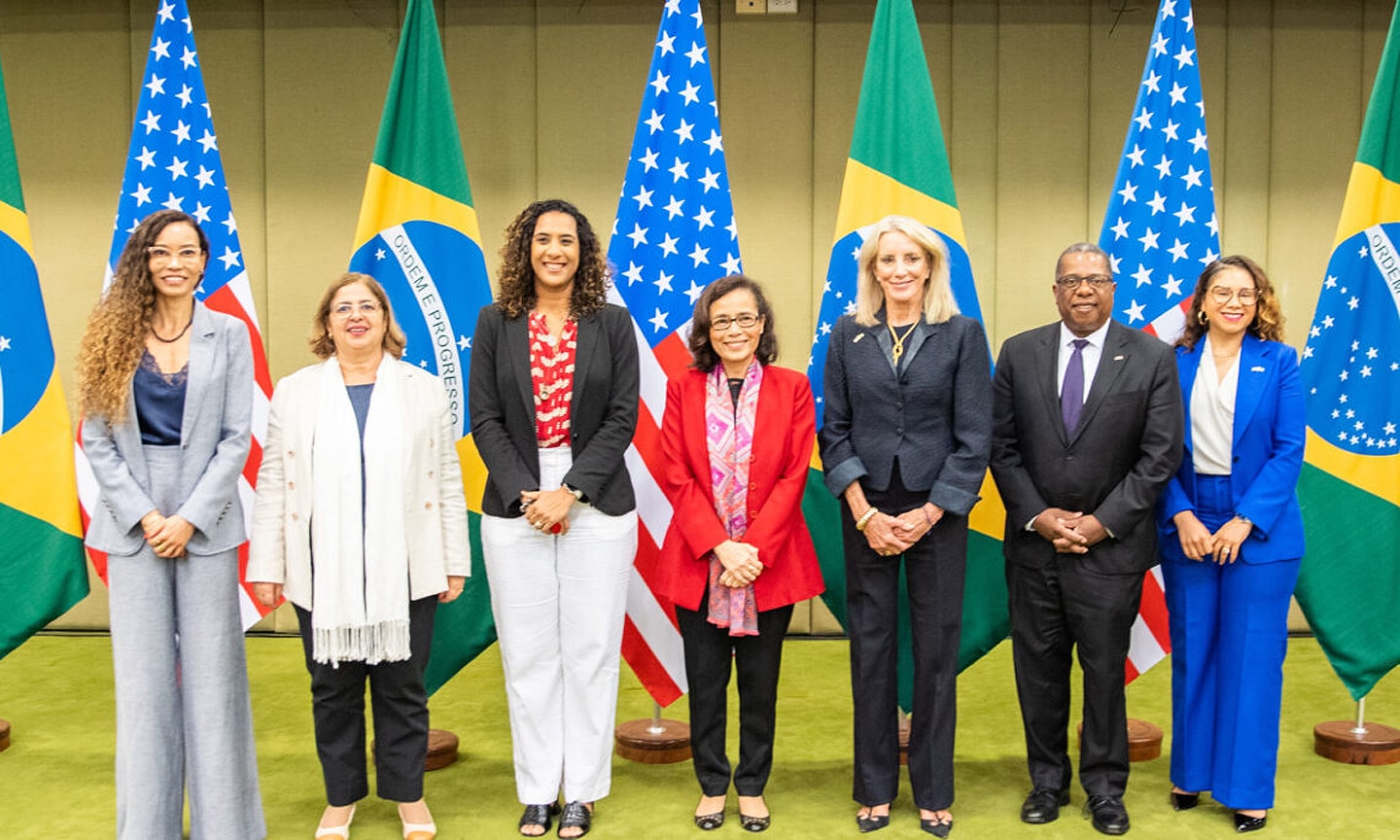
On May 23, 2023, the governments of Brazil and the United States held the first meeting of the Joint Action Plan to Eliminate Racial and Ethnic Discrimination and Promote Equality (JAPER) since 2013, at the Itamaraty Palace in Brasília. The meeting fulfills the commitment made by Presidents Luiz Inácio Lula da Silva and Joseph R. Biden during their meeting on February 10 in Washington, D.C., to revitalize JAPER as a central element of U.S.-Brazil relations.
The JAPER highlights the importance both countries place on advancing racial equity, promoting human rights and social inclusion, and eliminating all forms of discrimination. Social and economic development, the fight against hunger, and the creation of opportunities that benefit members of marginalized racial and ethnic communities, including those of African descent and indigenous communities, are important pillars for strengthening democracy and democratic institutions.
The bilateral discussions were opened in the presence of Brazil’s Minister of Racial Equality, Anielle Franco, the Secretary-General of the Ministry of Foreign Affairs, Ambassador Maria Laura da Rocha (in her capacity as Acting Minister of Foreign Affairs), the Minister of Women, Cida Gonçalves, and the Deputy Secretary for Human Rights and Citizenship, Rita de Oliveira; and from the U.S., the Deputy Assistant Secretary of State for Western Hemisphere Affairs, Brian A. Nichols, Special Representative for Equity and Racial Justice, Desirée Cormier Smith, and the U.S. Ambassador to Brazil, Elizabeth Frawley Bagley.
Both governments committed to working together through JAPER to engage marginalized racial and ethnic communities in both countries, including people of African descent and indigenous communities.
The discussion outlined a joint work plan and focused on four bilateral priorities: 1) increasing access to education, 2) providing greater access to healthcare, 3) addressing violence and promoting justice, and 4) nurturing culture and preserving memory.
Both sides also agreed to explore the role of civil society in JAPER.
Education
Regarding the educational exchange of JAPER, which facilitates study opportunities for Brazilians in the United States and vice versa, Desirée Cormier, U.S. Special Representative for Equity and Racial Justice, highlighted that 465 Brazilians have already benefited from this program. She emphasized the importance of building on this success and ensuring inclusion. Additionally, Cormier expressed “the commitment to work together to expand educational opportunities and access for individuals of African descent and indigenous populations in Brazil and the United States.”
Racial Violence
In addition to education, culture, and health, Brazil and the United States outlined joint efforts to combat violence against Black individuals. During the meeting, Minister Anielle Franco and American representative Desirée Cormier highlighted the shared concern that young Black men are disproportionately affected by violence in both countries.
The Brazilian minister emphasized that JAPER will closely collaborate with Brazil’s Ministry of Justice and Public Security to address violence against Black individuals. The minister stated that the focus remains on combating and confronting the ongoing genocide of the Black population, referencing notable examples such as George Floyd and Marielle Franco. Acknowledging the importance of addressing this critical issue, the minister asserted that it is imperative for JAPER to prioritize and actively engage with the issue of violence against Black individuals.
Longtime Partners
The U.S. Deputy Assistant Secretary for Western Hemisphere Affairs, Brian A. Nichols, highlighted the mutual benefits of exchanging experiences and emphasized the shared history and challenges between the two countries. He acknowledged historical aspects such as slavery, the marginalization of indigenous peoples, antisemitism, and discrimination, and recognized the progress made while admitting the ongoing work ahead. He expressed the opportunity for collaboration to find solutions that will benefit both populations.
As the two largest democracies in the Americas, Brazil and the United States are committed to advancing racial equity through JAPER and ensuring that this initiative is at the center of the celebrations for the bicentennial of U.S.-Brazil diplomatic relations in 2024.
Source: https://br.usembassy.gov and Agência Brasil