



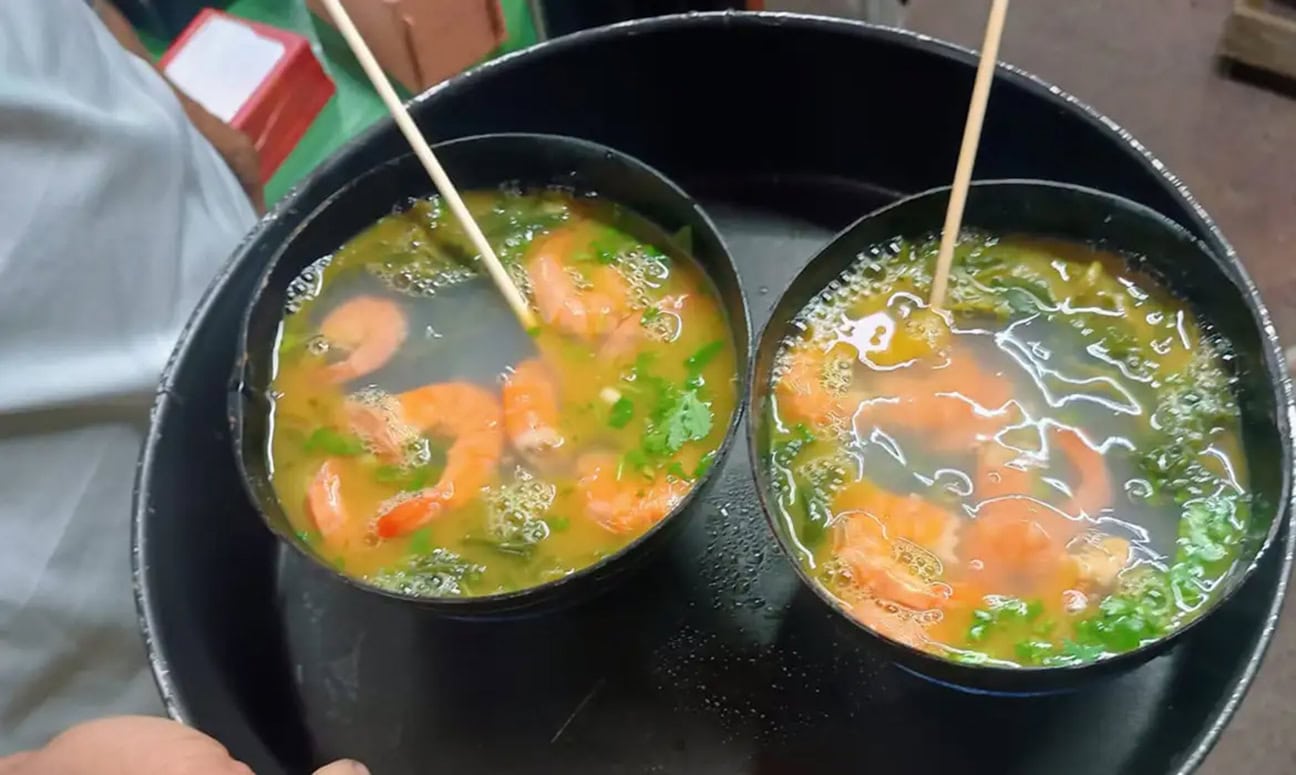
Served steaming hot in a cuia at the end of the afternoon, tacacá soup is a must-try dish in Brazil’s Amazonian cities.
Made with manioc, dried shrimp, and jambu – the plant that causes tingling –, the dish has indigenous origins and is prepared by tacacazeiras, or tacacá producers.
Now, the craft of these cooks, who are guardians of the recipe, has been recognized as Brazil’s cultural heritage by the National Institute of Historic and Artistic Heritage, IPHAN.
In general, tacacá recipes are family secrets passed down from generation to generation. Each one has her own way of balancing the alkalinity of the goma with the acidity of the tucupi, seasoned with chicory, basil, and even garlic, varying from vendor to vendor.
Once registered as heritage, it is up to the institute to develop a plan for its safeguarding. The measure should include ways to promote the cuisine, manage small businesses, access raw materials, and improve sales points.
Source of Pride
At 71 years old, Maria de Nazaré, known as Tia Naza, says she learned to make the dish from her grandmother and mother. For 15 years, selling it in Manaus has been her main source of income.
“Tacacá has always been part of my life. I used to sell it in the late afternoon, after work, in front of my house. I raised two grandsons who became lawyers, two who became doctors, and one who became a journalist,” she said.
Nazaré was in Brasília this week and participated in the IPHAN meeting that made the craft national heritage. She celebrated the decision.
“Being a tacacazeira means being proud of our unique ingredients. Amazonian cuisine is alive, powerful, and deserves to be celebrated,” she declared.
Over the years, tacacá broth has undergone variations. It began to be served with crab, popcorn, and even in a vegan version with heart of palm or olives.
Research
To include the craft of tacacazeiras as cultural heritage, the institute organized a research and documentation project on the tradition involved in preparing the dish, as well as related knowledge, from purchasing ingredients to commercialization.
The work was carried out in partnership with the Federal University of Western Pará (UFOPA). The team visited seven Brazilian states, documenting and listening to the cooks about the registration.
In the dossier that supported the decision to include the craft in the Book of Knowledge, institute experts say that tacacazeiras are “guardians of knowledge and secrets” and continue “not only the preparation methods of an elaborate dish, but also forms of sociability”.
These women, the document continues, are also responsible for transmitting “exclusive knowledge,” step by step, so that the practice is not lost.
History
Tacacá is a traditional indigenous dish, but its commercialization was first recorded at the end of the 19th century, with urban expansion in the region and a lack of labor.
At that time, women began selling food on the streets as a survival strategy, balancing domestic tasks with income generation.
Source: Agência Brasil