



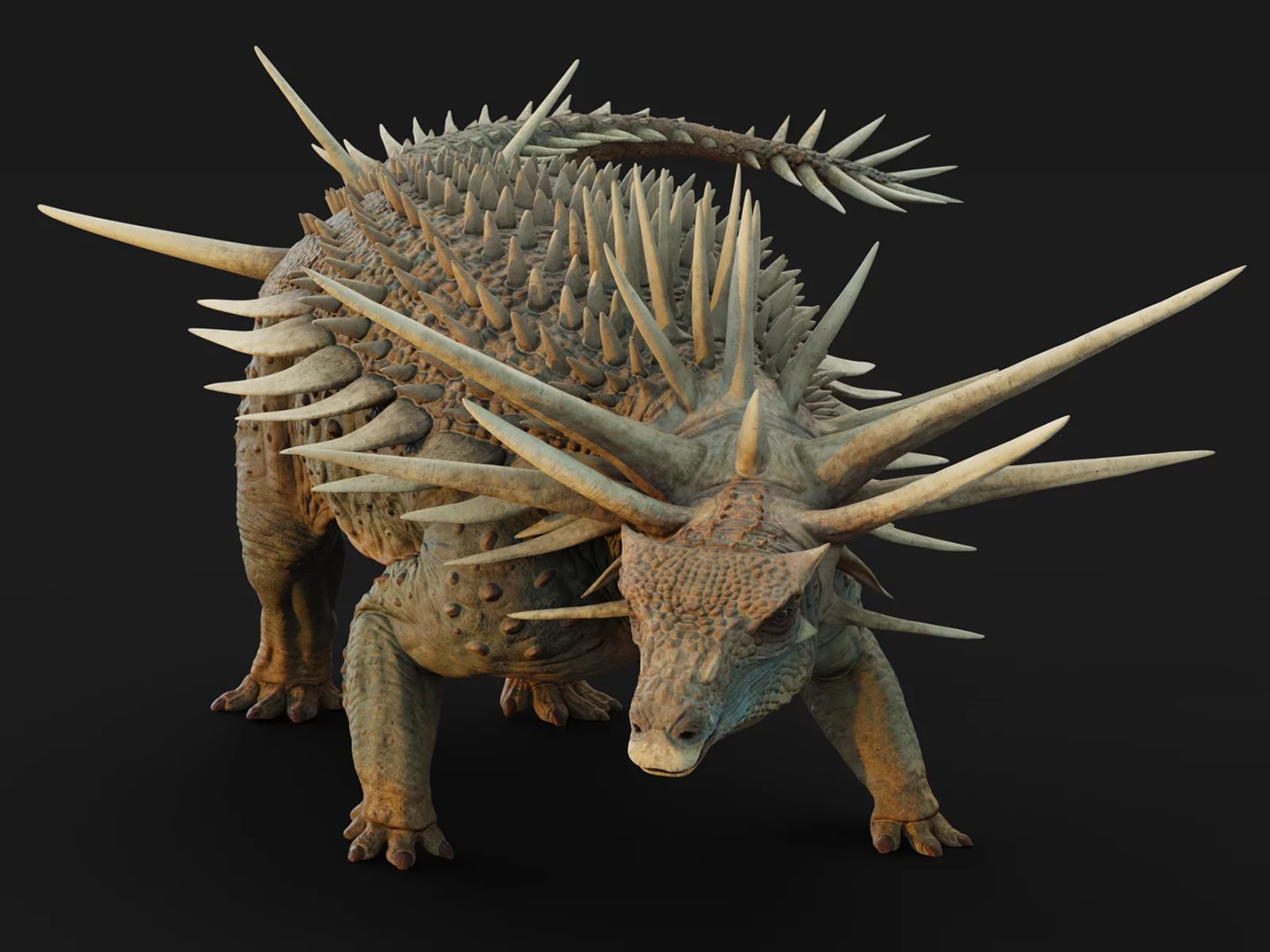
A dinosaur that roamed what is now Morocco more than 165 million years ago had its neck covered in nearly meter-long spines, a weapon in its tail, and bony body armor, according to researchers who excavated the remains of the curious creature.
The discovery of the animal Spicomellus in the Moroccan city of Boulemane painted a clearer picture of the strange spiny ankylosaur, which was first described in 2021 based on the discovery of a single rib bone.
Researchers now understand that the four-legged herbivore, which was the size of a small car, was much more elaborately armored than originally believed, according to a study published last month in the journal Nature.
“The Spicomellus had a diversity of plates and spines extending across the body, including meter-long spines on the neck, huge spines projecting upwards over the hips, and a wide range of long blade-shaped spines, armor pieces composed of two long spines, and plates along the shoulder,” said study co-leader Susannah Maidment in a statement to the Natural History Museum in London.
“We’ve never seen anything like it in any animal before.”
The Spicomellus‘s ribs were lined with fused spines projecting outward — a feature never observed before in any other vertebrate, living or extinct.
Project co-leader Richard Butler, professor of paleobiology at the University of Birmingham, described seeing the fossil for the first time as “chilling”.
“We simply couldn’t believe how strange it was and how different from any other dinosaur, or indeed any other animal we know, living or extinct,” Butler told the Natural History Museum.
“This turns much of what we thought we knew about ankylosaurs and their evolution upside down and demonstrates how much there still is to learn about dinosaurs,” he added.
The researchers suggest that the Spicomellus‘s complex bony structure was used both to attract mates and to fend off rivals.
Discovering that the dinosaur had such elaborate armor that possibly prioritized form as much as function differentiated the animal from its predecessors, which had less elaborate and more defensive coverings on their bodies.
In addition to the eye-catching spines along the outer part of the Spicomellus, the animal’s tail remains also provided a new striking detail for scientists.
Fused vertebrae descending to the tail formed a “handle,” probably leading to a club-shaped weapon at the tip — a detail that ankylosaur scientists previously believed had not evolved until the Cretaceous period, millions of years later.
“Finding such elaborate armor in an early ankylosaur changes our understanding of how these dinosaurs evolved,” said Maidment.
“This shows how significant African dinosaurs are, and how important it is to improve our understanding of them,” she said.
Source: npr.org by Alana Wise