



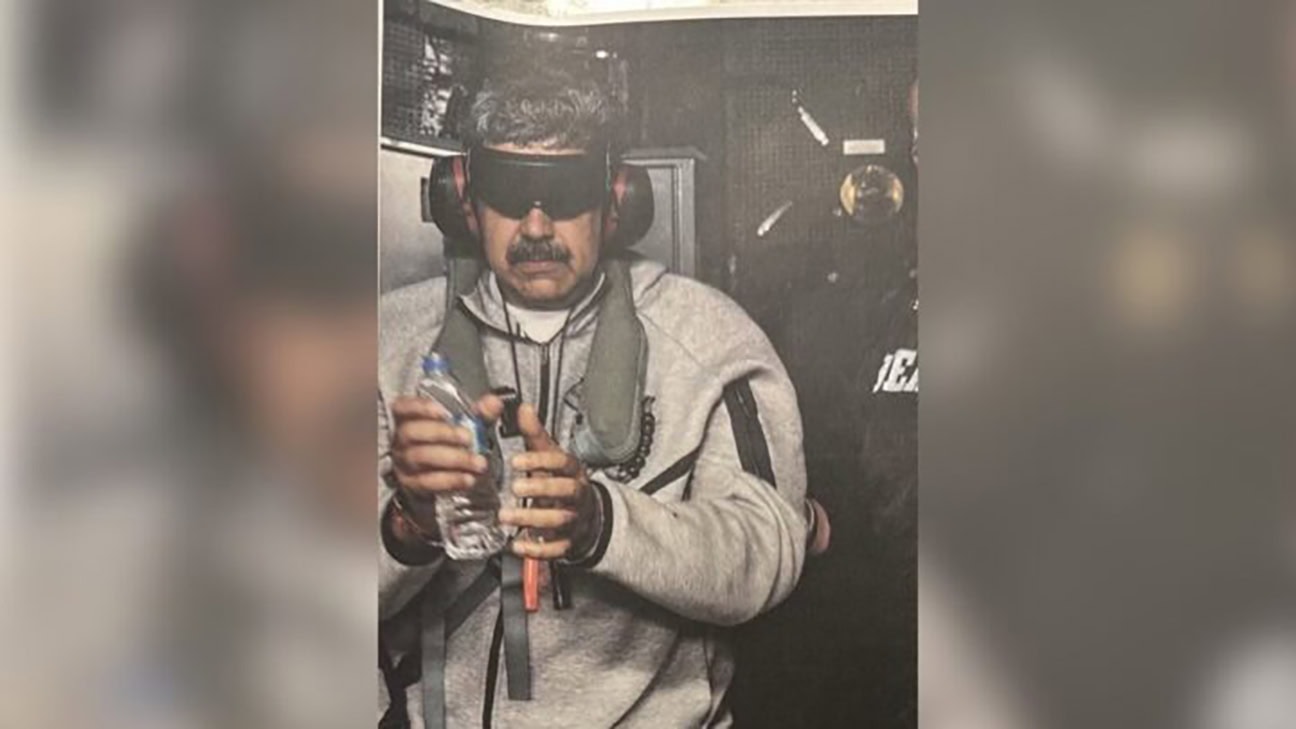
It would be hard to blame anyone who woke up on Saturday morning—seeing the news that the United States had invaded Venezuela and exfiltrated its dictatorial ruler—and thought he or she might still be dreaming.
A hard pinch and a cup of coffee later, and reality set in. But the questions remain.
So, what does this mean politically, and what should Americans make of what happened?
Here are some lessons as the dust settles in Caracas:
1. It was a bold and surprising move for a president who campaigned against American intervention.
Donald Trump, the “America First” candidate and president, proved quite belligerent. In less than 12 months in office this second time, he carried out attacks in seven countries—Iran, Nigeria, Yemen, Iraq, Syria, Somalia and, this weekend, oversaw a bold nighttime raid operation in Venezuela. American forces captured the country’s president, Nicolás Maduro, and his wife, sending them to New York to be tried for drug trafficking.
Calling the action surprising and revealing does no justice, especially considering Trump built his career in opposition to the neoconservatives’ “endless wars” and nation-building in countries like Iraq and Afghanistan.
On Saturday, Trump said the United States will “run” the country until he finds a suitable leader.
“Well, we’re going to run it with a group,” Trump said, “and we’re going to make sure it’s run properly.”
He noted that “people who are right behind me” will run it. That included Secretary of State Marco Rubio and Secretary of Defense Pete Hegseth.
Rubio, on Sunday, tried to walk it back a bit, describing what the US is doing as a “quarantine,” intended to effect “policy”.
2. Like in Iraq, there were shifting justifications for removing Maduro.
When the United States was about to commit to toppling Saddam Hussein from Iraq more than 20 years ago, the Bush administration presented different arguments and justifications for the intervention that seemed to shift like Middle Eastern sand.
Was it that Hussein funded the kinds of terrorists responsible for the 9/11 attacks? Was it getting rid of a dictator who didn’t align with American values? Was it creating a democracy that could serve as a model for the rest of the Middle East? Or was it that Hussein had weapons of mass destruction that he couldn’t be allowed to keep before they resulted in a “mushroom cloud,” as then-President George W. Bush warned in 2002?
In Maduro’s case, is it regime change because of a dictator who again doesn’t align with American values, fighting drug trafficking, seizing oil, or some version of all of it? Each had its moment as justification for the Trump administration’s saber-rattling.
During Saturday’s press conference, Trump emphasized oil as a key motivator. He said American oil companies would come in and modernize the country’s oil production and refining capabilities. He said the companies would invest billions and “use that money in Venezuela.” He said the “biggest beneficiary will be the people of Venezuela” and Venezuelan expats in the US. It’s not clear how that would be managed.
Trump has a long history of saying the United States should “take the oil.”
“You’re not stealing anything,” Trump said about taking Iraq’s oil in a 2011 ABC interview. “We’re reimbursing ourselves.”
Fast-forward to 2023, when Trump was out of office, talking about Venezuela.
“We’re buying oil from Venezuela,” Trump said during an event in North Carolina. “When I left, Venezuela was about to collapse. We would have taken care of it. We would have taken all that oil. It would have been right next door. But now we’re buying oil from Venezuela, so we’re enriching a dictator a lot. Do you believe that? Nobody believes it.”
On Sunday, the administration came out in force defending its actions, attributing the reasoning mainly to drugs. The White House repeatedly claimed it was containing the flow of fentanyl by targeting alleged drug boats off Venezuela’s coast, even though fentanyl isn’t widely produced in Venezuela. Vice President JD Vance, who has been a vocal critic of American intervention abroad in other cases, took up that critique on social media.
“[C]ocaine, which is the main drug trafficked from Venezuela, is a profit center for all Latin American cartels,” he wrote on Sunday. “If you cut off the cocaine money (or even reduce it), you substantially weaken the cartels overall. Plus, cocaine is also bad!”
He noted that “a lot of fentanyl is coming out of Mexico,” which is why Trump “closed the border.” That also raises questions about what’s next.
Vance also mentioned oil: “I understand the anxiety about using military force, but should we just allow a communist to steal our stuff in our hemisphere and do nothing?”
Rubio, meanwhile, said this was a law enforcement action to apprehend fugitives, because of a 2020 indictment against Maduro for cocaine trafficking. That, by the way, seems part of the administration’s reasoning for not seeking congressional authorization.
These explanations are probably more politically palatable to the MAGA base than saying the United States is at war with Venezuela or, as Trump said, that the United States is now running another country—with no clear exit goals.
3. Speaking of Rubio, this action certainly seems to point to his growing influence with Trump.
Rubio, who is of Cuban descent, has always been more hawkish than Trump on foreign policy, particularly when it comes to Latin America.
During this Venezuela operation, Trump seems to be leaning on Rubio. Rubio was a central figure in the administration’s Saturday announcement and did the Sunday show rounds to defend the action.
In this second term, Rubio has taken on several roles. After the gutting of the United States Agency for International Development, or USAID, Trump made him director of that program, as well as interim archivist of the National Archives; he is Trump’s interim national security adviser and Secretary of State, who is also fourth in the line of presidential succession.
All of this is evidence of how far Rubio has come to infiltrate Trump’s inner circle. It’s a stunning reversal from the bitter campaign a decade ago, when Rubio compared Trump to “third-world strongmen” and a “con artist” with “small hands,” while Trump dismissed him as “Little Marco.”
4. Right-wing authoritarians are OK, but left-wing dictators are not?
Trump referred to Maduro as a “dictator” four times during his Saturday press conference (an “outlaw dictator,” “illegitimate dictator,” “now-deposed dictator,” and “dictator and terrorist”).
But there are many other dictators, authoritarians, and strongmen around the rest of the world, many of whom Trump has praised over the years.
Trump has allied with people like Hungary’s Viktor Orbán, Argentina’s Javier Milei, rolled out the red carpet for Saudi Arabia’s Mohammed bin Salman, seems deferential to Russia’s Vladimir Putin, and during his first term, made overtures to North Korea’s Kim Jong Un.
Couldn’t there be justifications for toppling those leaders too, that an American administration could invent, following Trump’s logic?
It’s not such a big leap to suggest the difference is political (and oil).
5. Don’t expect MAGA to abandon Trump.
Yes, there’s undoubtedly irony in Trump campaigning against intervention and what he did in Venezuela. There will be—and already are—voices of opposition in Trump’s base.
But dedication to Trump among the faithful is deep—and there’s a whole conservative media infrastructure built to insulate him and give the base talking points.
It started in the first moments of Saturday morning after the raid. On Fox News, for example, panelists pointed to Democrats’ arguments that the move was illegal as something to mock and tear down. They focused instead on how few in Venezuela defended Maduro and the 2020 indictment against him. A network legal analyst essentially said Trump’s action shows the long arm of American justice doesn’t end at US borders.
Given the hyperpartisan ways Americans consume their news, don’t expect a full abandonment of Trump. It’s more likely to become a rallying point.
Republicans were already inclined toward action in Venezuela before what happened this weekend. A December Quinnipiac University poll found, overall, 63% of people opposed military action in Venezuela. That included 68% of independents. But 52% of Republicans were in favor.
Moreover, remember, this is a group of voters with a lot of practice favoring a tough and hawkish approach to foreign policy. (See: war, Iraq.) The Republican Party, for decades, was held together by a three-legged stool of fiscal conservatism, cultural conservatism, and hawkish foreign policy.
Trump’s approach to the economy and foreign policy challenged that tradition and seemed to saw off two of those legs, creating some uncomfortable contortions for the GOP, while culture was the main thing holding the MAGA coalition together.
So, reverting to a hawkish foreign policy doesn’t seem so far from what the Republican Party has been.
6. Democrats have to be careful with their messaging.
House Minority Leader Hakeem Jeffries challenged Rubio’s insistence that the US actions “weren’t an invasion” on NBC’s Meet the Press on Sunday.
“This wasn’t just an anti-narcotics operation,” Jeffries said. “It was an act of war. It involved, of course, Delta Force. .. We have to make sure that when we get back to Washington, D.C., [after the holiday recess], legislative action is taken to ensure no further military steps are taken without explicit congressional approval.”
But focusing solely on the legality of the move could be a political trap for Democrats. Trump and Republicans are very good at trying to put Democrats in a position of seemingly defending drug traffickers and bad people.
Remember, the reason Democrats did well electorally in 2025 was because of the economy, specifically the cost of living. If they do well in 2026, it’ll probably be again because of that—not whether Trump’s incursion into Venezuela was legal or violated international norms, as crassly political as that sounds.
Still, Democrats can’t ignore Venezuela and focus only on affordability. They could point out the apparent hypocrisy of deposing Maduro over drugs while forgiving the former head of Honduras, who was convicted of drug trafficking.
They could also shift the focus to how this is a distraction from the fact that many people are struggling to buy groceries, homes, and health care.
It’s about “highlighting Republican priorities,” said a Democratic strategist who asked to remain anonymous because of his role with an outside group.
“They’re more focused on making war than fixing health care,” the strategist said.
7. The real test of the politics of this will be with what’s next.
Americans, including Trump and Vance, have been skeptical of US foreign intervention not because the US military can’t pull off regime change, but because of what happens on Day 2 and beyond.
Trump was asked on Saturday about the “mixed US track record of deposing dictators without necessarily a plan for what comes next.”
The president gave a nonspecific and incongruent answer.
“Well, that’s why we have different presidents, but with me, that’s not true,” he said. “With me, we’ve had a perfect record of victories.”
He went on to cite the administration’s killing of Qassem Soleimani in 2020, the former Iranian Quds Force leader, and Abu Bakr al-Baghdadi, the former ISIS leader. Neither was a head of state. He also talked about the US bombings of Iran’s nuclear facilities last year.
But Trump didn’t outline the plan for what’s next for Venezuela or his foreign policy.
This is the president’s most politically vulnerable point in this second term. He’s facing his worst approval ratings, will turn 80 in June, and is approaching lame-duck politically irrelevant status.
So, it may not be surprising that Trump is trying to stay in the headlines, like with this action in Venezuela, and divert attention from other issues more negative for him politically.
Source: npr.org by Domenico Montanaro