



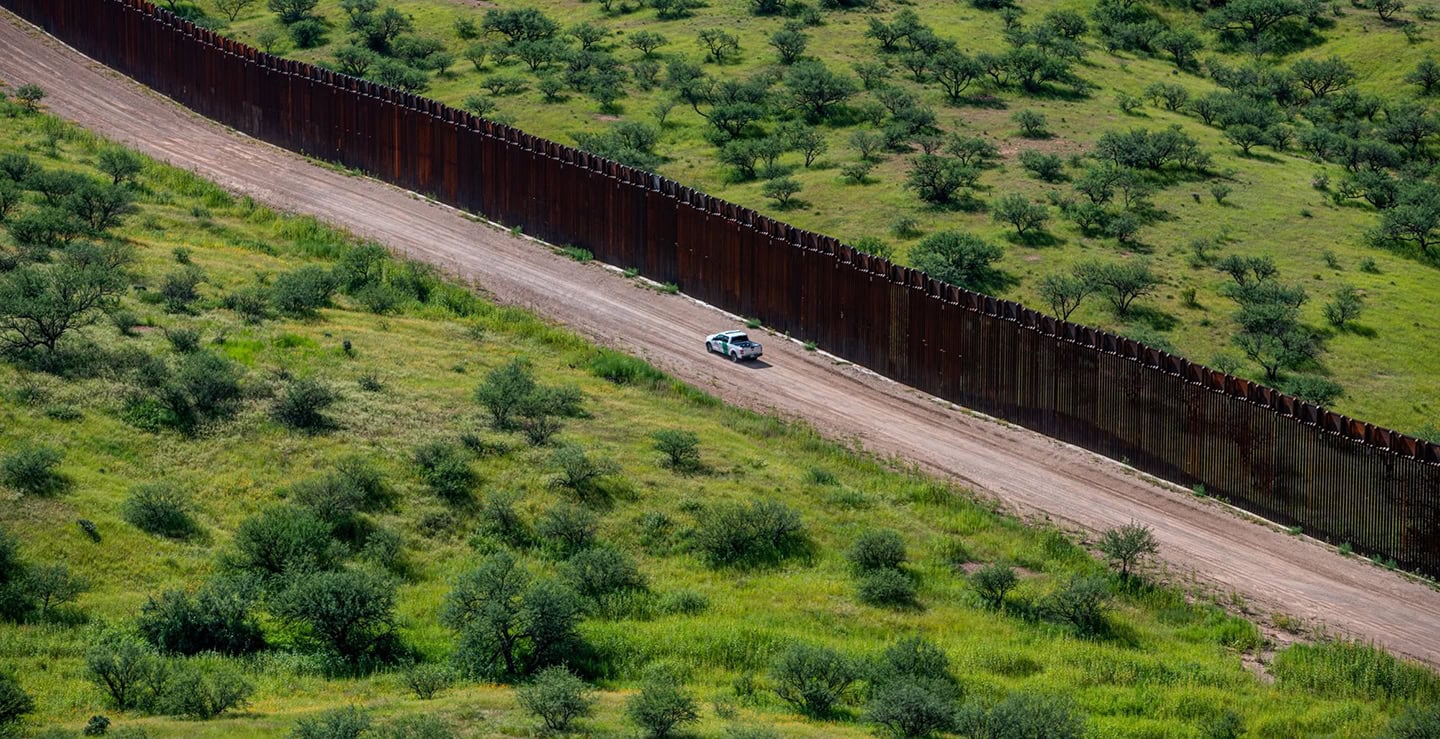
The United States and Mexico share a land border of nearly 3,200 km. Along it, the American states of California, Arizona, New Mexico, and Texas border the Mexican states of Baja California, Sonora, Chihuahua, Coahuila, Nuevo León, and Tamaulipas.Where do people live on the border?The Department of Health and Human Services estimates that the US-Mexico border region is home to about 15 million people. More than 1 million live in 15 sister city groups established over decades of bilateral relations to coordinate emergency response plans. The largest cities in the US on the border are San Diego, California; El Paso, Texas; and Laredo, Texas.Where do people cross the border?People can cross international borders in a controlled manner at ports of entry. As of September 2023, there were 47 active land ports of entry along the US-Mexico border.How is the border patrolled?Border security is managed by Customs and Border Protection (CBP), a component of the Department of Homeland Security. CBP’s law enforcement arm, the United States Border Patrol, monitors border regions and beyond, conducting searches on transports and investigations. The Border Patrol uses electronic sensors, video monitoring, and night vision goggles to identify individuals attempting to cross the border. On the southern border, the Border Patrol operates from 68 stations grouped into nine sectors. Even so, there is an average of more than 200,000 encounters with unauthorized entrants per month.Source: USA Facts
An Overview of the US-Mexico Border
—
by
-
Facial biometrics will be mandatory for mobile phone users
Starting in 2027, mobile phone users will need to undergo biometric validation to contract and maintain phone lines. The requirement was approved by the National Telecommunications Agency (Anatel) and aims to curb fraud, since the line holder will now be identified. Biometrics will be performed through facial recognition with proof of life, which will be…