



It is the time-honored method for dealing with plagues and pandemics: those with means flee the crowds. In the past, Roman aristocrats would retreat to their country villas and summer homes; wealthy citizens left cities like Philadelphia during the Yellow Fever outbreak of 1793, leaving the poor to fend for themselves in the fetid city.
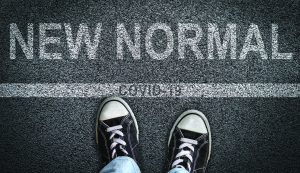 Photo: Ronnie Chua/Shutterstock
Although there are certainly those who fled to less densely populated areas of the country, the COVID-19 pandemic witnessed the virtual version of this ancient practice: those who could transfer their lives to virtual networks did so.
The COVID-19 pandemic bifurcated the world of work. Some — like university professors, office workers, and other professionals — were able to continue their professional lives sheltered at home, virtually escaping the pandemic. For many others, work could not be performed as easily online, and thus they were temporarily laid off or fired or had to work in the increasingly dangerous “real world.”
What will our lives be like after COVID-19?
One possibility — the one many of us desire — is a return to something resembling the status quo. But, as a historian analyzing what the future will bring, it is more likely that we will retain habits and behaviors that we were forced to learn because of the pandemic.
While we have already witnessed an explosion of in-person activities as quarantines were relaxed, this urge to gather in large crowds may prove temporary. It is possible that, after an initial surge of physical meetings, we will find that we actually prefer meetings and other business conducted virtually.
Employees may argue that they were just as productive working remotely as they were gathered in an office. Companies, therefore, may continue to allow employees to work from home, saving on the costs of renting or owning office space. Similarly,
 Photo: Maridav/shutterstock
conferences and business travel are likely to be significantly reduced — assuming airlines survive the impending pandemic-induced recession.
The economic consequences of the pandemic have led some to wonder if globalization as a whole may be under threat, as globalization is partly defined by the ease of movement across international borders.
Telemedicine and online education — already practiced before the pandemic — will become more widely used. I do not believe that all of our lives will transfer online, but we will find that a greater portion of our lives will be conducted online. That is, the ratio of online life to physical life will shift toward the former.
This will only benefit a portion of the population, of course, those with technological capacity and the privilege of living and working online. Those residing in rural areas or other “connectivity deserts” may find it difficult to transfer their lives online, with myriad social and economic consequences.
Four ways life may be different after COVID-19
• Virtual meetings may become the norm. Staley said that while people enjoy meeting in person after the relaxation of quarantine rules, this may prove temporary. It is possible that, after an initial surge of physical meetings, we will find that we actually prefer meetings and other business conducted virtually.
• We may want more personal space. You may have noticed that you feel a bit uncomfortable seeing characters on TV shows hugging and shaking hands. Staley said that this feeling is unlikely to disappear completely, even after the pandemic ends. It is very likely that we will expand the boundaries of our personal space.
 Photo: Cinemanikor/Shutterstock
• Large sporting and musical events will be very different. Staley expects event organizers to limit the number of fans who can attend and instruct them to arrive at the event at staggered times to avoid mass gatherings at entrances. Similarly, there will be a schedule for when one can leave the stadium after the event.
• A new era of workers’ rights may be imminent. Staley admits that the “essential” workers who received so much praise and attention during the pandemic may revert to being poorly paid and undervalued workers. Or they may be widely replaced by automation.
The physical spaces through which we move will be redesigned to organize and control movement. Some retail establishments, for example, have limited the number of people who can be in the store at any given time, and some supermarket chains have drawn lines on the floor that demarcate the approved path to follow while in the store.
Before COVID-19, urban densification was the big trend among urban planners and advocates. Now I wonder if people will want to live in such dense conditions.
Whether at work or at home, a lasting consequence of the COVID-19 pandemic will be a growing chasm in our lives between the bifurcated virtual and physical worlds.
Source: http://origins.osu.edu