



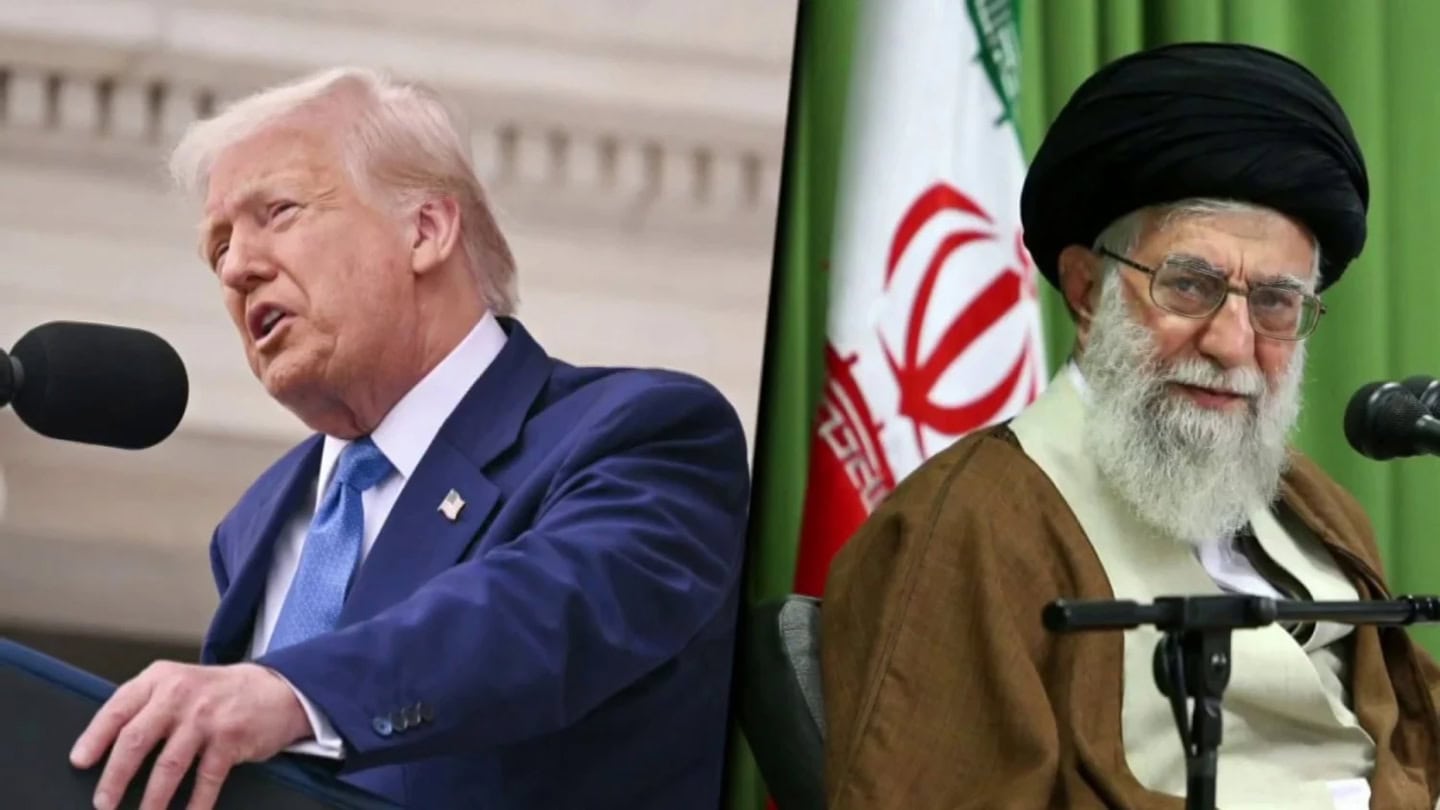
President Trump on Wednesday refused to say whether the United States is nearing a decision to attack Iranian nuclear facilities, after Iran’s supreme leader warned the U.S. against an attack and rejected Trump’s call for surrender.
“You don’t seriously think I’m going to answer that question,” Trump said when a reporter asked at the White House if the U.S. would attack Iran. “I may do it. I may not do it. I mean, nobody knows what I’m going to do.”
Trump’s statements came as several lawmakers urged the president to refrain from military action against Iran.
In a Wednesday interview with NPR’s Here and Now, Sen. Tim Kaine, D-Virginia, warned against entering a war with Iran.
“A third war in the Middle East this century would be a horrific, horrific mistake, and it would put U.S. armed forces members at risk and also risk destabilizing the region,” he said. Earlier this week, Kaine introduced a war powers resolution that would require Trump to seek congressional approval before U.S. troops could engage in military conflict with Iran.
Also on Wednesday, Iran’s Supreme Leader Ayatollah Ali Khamenei warned in a nationally televised speech: “The Americans must understand — any U.S. military incursion will undoubtedly lead to irreversible consequences.”
This comes amid nearly a week of fighting between the U.S. ally Israel and Iran, and amid signs from U.S. and Israeli officials that Trump may be considering an attack on Iran.
In a series of social media posts on Tuesday, Trump demanded Iran’s “unconditional surrender” and boasted: “Now we have total and complete control of the skies over Iran,” raising speculation that U.S. forces were already more involved than previously acknowledged.
Khamenei responded to the demand in his Wednesday speech, his second public appearance since Israel launched attacks against his country last week.
“This is a nation that will never surrender to any form of imposition,” he said.
On Tuesday, Trump also issued a direct threat against Khamenei. “We know exactly where the so-called ‘Supreme Leader’ is hiding. He’s an easy target, but he’s safe there — We’re not taking him out (killing him!), at least not for now.”
Trump met with national security team
Trump met with his national security team in the White House Situation Room for more than an hour on Tuesday to discuss the conflict. The meeting took place shortly after Trump left a summit of the Group of Seven major economies in Canada a day early to work on what he called a “real end” to Iran’s nuclear program.
Trump has repeatedly stated that Iran cannot have a nuclear weapon.
Trump met with national security team
Trump met with his national security team in the White House Situation Room for more than an hour on Tuesday to discuss the conflict. The meeting took place shortly after Trump left a summit of the Group of Seven major economies in Canada a day early to work on what he called a “real end” to Iran’s nuclear program.
Trump has repeatedly stated that Iran cannot have a nuclear weapon.
A person familiar with the matter, speaking on condition of anonymity due to the sensitivity of the issue, told NPR that Israel believes the U.S. will eventually join the offensive against Iran and is currently awaiting a formal decision from Washington.
There were few signs of diplomatic efforts underway.
Trump told reporters on Friday that Iranian officials had reached out to try to negotiate. “They even suggested coming to the White House,” Trump said. “I said: ‘Too late,’” he said.
Two Iranian centrifuge facilities hit
On Wednesday, the International Atomic Energy Agency, the UN’s nuclear watchdog, said two centrifuge production facilities in Iran had been hit, hours after the Israeli military said it attacked a plant in Iran.
Centrifuges are critical for uranium enrichment, a key step in the nuclear weapons production process.
This comes a day after the head of the nuclear agency, Rafael Grossi, told the BBC it was likely that all centrifuges at Natanz, Iran’s largest nuclear facility, had been severely damaged by Israeli airstrikes.
But he said there was “very limited damage, if any” visible at Fordo, the country’s second-largest underground nuclear enrichment plant.
U.S. Embassy in Jerusalem closes
The U.S. Embassy in Jerusalem said it would remain closed until Friday, citing security concerns. Some embassy staff and family members have already begun leaving Israel.
The U.S. ambassador to Israel, Mike Huckabee, wrote on social media that the embassy was working on evacuation plans for Americans who want to leave. He says Americans will be notified of flights or ships if they sign up on a government website for travelers.
With Israeli airspace still closed to commercial traffic, tens of thousands of travelers remain stranded — both trying to leave the country and struggling to return. Israel’s Transportation Ministry estimates that up to 150,000 citizens are currently abroad. Some foreigners have left Israel overland via Jordan and Egypt, while others have been evacuated by sea.
Israeli airlines, for now, have been authorized to operate some emergency flights to bring Israelis back from Cyprus, France, Greece, and Italy.
Source: www.npr.org By Rebecca Rosman, Franco Ordoñez