



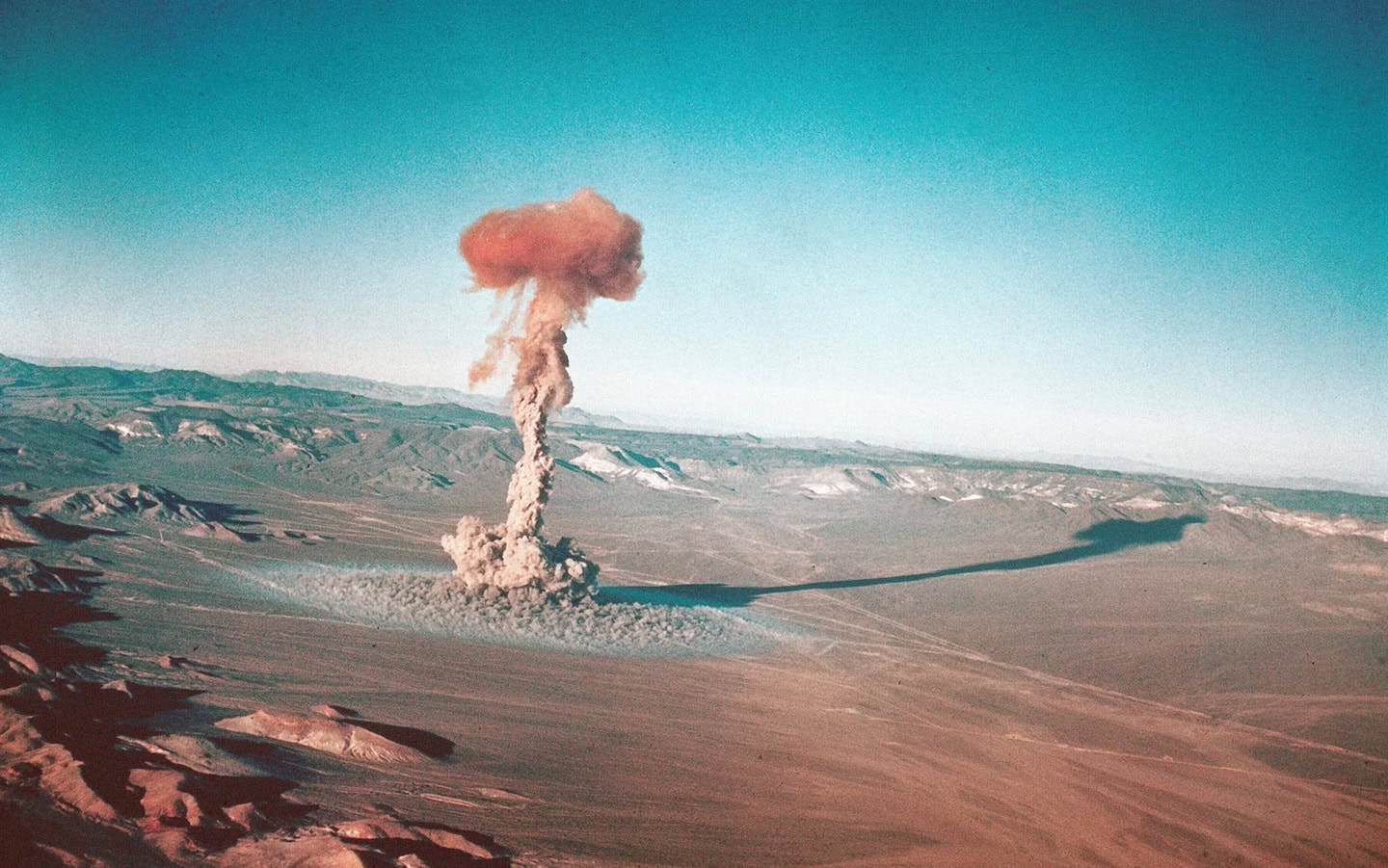
President Trump said on Thursday that the US would begin testing nuclear weapons again for the first time in decades.
“We stopped many years ago, but with others doing tests I think it’s appropriate to do the same,” the president said to reporters aboard Air Force One.
Experts say resuming tests would be a major escalation and could alter the nuclear balance of power.
“I think a decision to resume nuclear tests would be extremely dangerous and would benefit our adversaries more than the United States,” said Corey Hinderstein, vice president for studies at the Carnegie Endowment for Nuclear Peace.
Here’s what a test would involve and why the president might be calling for one now.
There is currently only one place where America could test a nuclear bomb — near Las Vegas, Nevada. The Nevada National Security Site, about 97 km northwest of Las Vegas, is currently the only place where America could test a nuclear weapon, says Robert Peters, senior researcher in strategic deterrence at the Heritage Foundation.
The site in Nevada spans about 3,367 km², larger than the state of Rhode Island. Starting in the 1950s, scientists conducted atmospheric nuclear tests at the site, but from 1962 to 1992, the tests were conducted underground.
Today, tests would likely be conducted “in a complex of deep mine shafts underground,” Peters said.
Scientists dig a deep shaft directly below the ground or on the side of a mountain. They then place a nuclear device in a chamber at the end of the shaft and seal it. The detonation is contained by the rock, reducing the risk of atmospheric radioactive fallout.
While underground tests are much safer than atmospheric ones, they still pose risks, Hinderstein said. In the past, some radioactive fallout leaked from test shafts. Additionally, the test could shake buildings as far as Las Vegas, and Hinderstein said some of Vegas’s newer buildings could even be at risk of damage.
“All those high-rise skyscrapers — including the Stratosphere, including the Trump Hotel,” she said. “They weren’t designed for massive and significant seismic activity.”
America’s last test in Nevada was more than 30 years ago. At the end of the Cold War, the world’s major nuclear powers declared a voluntary moratorium on nuclear tests. Russia, then the Soviet Union, tested its last nuclear weapon in 1990, the US conducted its final test in 1992, and China carried out its last test in 1996.
The voluntary testing moratorium has been maintained as part of an effort to preserve nuclear stability. The US currently uses scientific experiments and supercomputer simulations to ensure its bombs still work.
Last year, NPR was one of the few organizations to gain rare access to the ultra-secret underground tunnels where the tests take place. Scientists working in the tunnels said they were confident they could continue certifying the safety of American nuclear weapons without tests.
While a full-scale nuclear detonation would “complement” current experiments, “our assessment is that there are no system issues that would be answered by a test that are worth the cost, effort, and time,” Don Haynes, a nuclear weapons scientist at Los Alamos National Laboratory, told NPR as they walked through the tunnels.
In fact, Hinderstein says, preparing a nuclear test is not a simple matter. While a basic demonstration test could be done in about 18 months. Conducting a test that produced scientifically useful data would likely take years.
Trump’s announcement is likely reacting to some recent Russian tests. On Sunday, Russia announced it had successfully tested a new nuclear-powered cruise missile. Then, on Wednesday, President Vladimir Putin announced the successful test of another doomsday weapon — a nuclear-powered underwater drone that Russia says could be used to attack coastal cities.
Trump never mentioned Russia by name, but suggested recent tests were behind the announcement. “I see them testing,” he said aboard Air Force One, “and I say, ‘Well, if they’re going to test, I think we have to test.’”
While testing nuclear-powered weapons is not the same as testing nuclear weapons themselves, Russia’s tests are highly provocative. They come months before the expiration of the last nuclear treaty between the US and Russia, designed to limit their arsenals.
The back-and-forth has all the signs of the start of an arms race, noted Jon Wolfsthal, director of global risk at the Federation of American Scientists.
“We’ve seen this play out throughout the Cold War through nuclear tests, nuclear deployments, nuclear investments,” he said.
Many experts warn that now is not the time to resume nuclear tests. Hinderstein, who served as deputy administrator of the National Nuclear Security Administration, the agency responsible for American nuclear weapons, from 2021-2024, said a decision to resume tests would not be in America’s interest.
At the end of the Cold War, the US had conducted more than a thousand nuclear tests — far more than any other nation (China, by comparison, had conducted only 45).
Other nations, “have more to gain from resuming nuclear tests than the United States,” she said.
The tests would likely be expensive, adds Paul Dean, vice president of global nuclear policy at the Nuclear Threat Initiative. “The cost estimates I’ve seen are around, more or less, $140 million per test,” he said.
“It’s not necessary to conduct a nuclear explosion test now,” agreed Robert Peters of the Heritage Foundation. But he added: “There may be compelling reasons to test in the coming months and years. It’s how bad things are getting.”
Source: npr.org by Geoff Brumfiel