



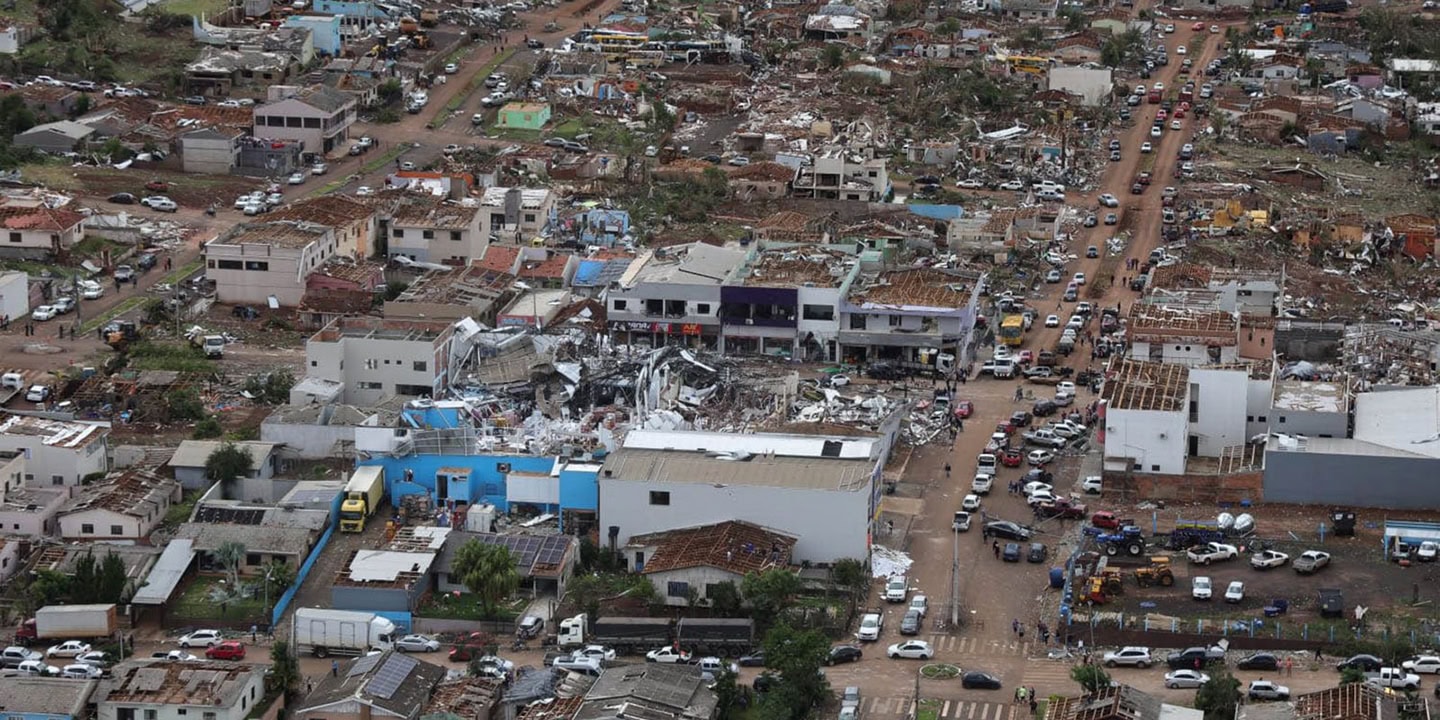
The tornado that hit the interior of Paraná on Friday (8) was classified as EF3, with winds of up to 250 km/h, according to the Paraná System of Technology and Environmental Monitoring (Simepar). The extreme phenomenon left six dead, more than 750 injured, and destroyed 90% of the city of Rio Bonito do Iguaçu, in the south-central region of the state.
According to g1, the victims were identified as:
• José Neri Geremias (53)
• Adriane Maria de Moura (47)
• Jurandir Nogueira Ferreira (49)
• Claudino Paulino Risse (57)
• José Gieteski (83)
• Julia Kwapis (14)
Julia was at a friend’s house when she was carried away by the wind gusts. Her father, Roberto Kwapis, reported that she was preparing to receive the Confirmation sacrament over the weekend, and the family was planning a barbecue to celebrate.
High-Intensity Phenomenon
According to meteorologist Samuel Braun from Simepar, the tornado’s classification was determined based on images of destruction and radar data. “The atmospheric environment was very humid and hot. There are also other factors, for example, the difference in winds between the surface and higher atmospheric levels. In meteorology, we call this wind shear. So, this wind shear was extremely high. Several factors contributed to the formation of these storms and the tornado in this city,” he explained.
The phenomenon was caused by an extratropical cyclone that hit the south of the country, causing intense rains and winds also in Rio Grande do Sul and Santa Catarina.
Large-Scale Destruction
Aerial images show completely destroyed houses, overturned vehicles, and uprooted trees in Rio Bonito do Iguaçu, a municipality of about 14,000 inhabitants located 400 km from Curitiba. The Paraná government reported that most of the city is uninhabitable and that hundreds of families lost everything.
A resident described the scene to TV Globo: “At the city entrance, there were already very clear signs that something horrible had happened. As we advanced, it became more chaotic. A real war zone. An overturned car, a tree in the middle of the street.”
Judo instructor Marcelo Gomes said he was with children at a cultural center when the tornado started. “A student’s father went to close the door and came running back. I noticed a security door starting to shake excessively, so I gathered the children and took them to a safer space. When I closed the door, a gust of dust, dirt, and mud came. We hugged inside the bathroom and started praying. When I opened the door, the entire cultural center had collapsed. It was a huge space, everything on the ground.”
Security guard Adilson Camilo reported that his house and pharmacy were destroyed. “We have a pharmacy and we ran out because my daughter was home. We got there, and in two minutes, everything started flying. Roof tiles flew, walls flew. We ran to the bathroom, and it exploded there too. We hugged and asked God to protect us. The tornado lasted 30, 40 seconds, and demolished everything. I have two cars, one of them flew ten meters. It seemed like an atomic bomb had been dropped.”
Rescue Operation and Humanitarian Aid
The Paraná government sent 30 firefighters from various cities and 20 agents from the Tactical Rescue Operations Group (GOST), with sniffer dogs, to help in the search for victims. Ambulances from Cascavel and Guarapuava were also mobilized to treat the injured, while the Health Secretariat made beds available in other regions of the state.
The Minister of Integration and Regional Development, Waldez Góes, announced that the Lula government (PT) is preparing to send humanitarian aid to Paraná, under the president’s coordination.
Governor Ratinho Junior (PSD) declared that a command and coordination base will be set up at the Central Firefighters Headquarters in Guarapuava, from where rescue and reconstruction efforts will be organized. Trucks with basic food, hygiene kits, and places to sleep left Curitiba in the early morning hours.
Other Regions Also Affected
In addition to Rio Bonito do Iguaçu, other cities in Paraná faced intense winds and structural damage. Dois Vizinhos recorded gusts of 82.4 km/h, Cornélio Procópio reached 76 km/h, and Campo Mourão, 74.2 km/h.
The extratropical cyclone also caused the fall of trees and power poles in municipalities in the Southeast region, including São Paulo and Rio de Janeiro. Authorities remain on alert for new severe storm formations in the coming hours.
The trail of destruction left by the tornado in Paraná is considered one of the most serious climate disasters in the state’s recent history, mobilizing joint efforts between the federal and state governments and rescue teams to help the victims and begin reconstruction of the devastated areas.
Source: brasil247.com