



We tend to attribute a certain degree of mental complexity to animals like cats and dogs. But fish generally don’t get that kind of praise.
“They don’t speak, they don’t bark,” says Caio Maximino, neuroscientist at the Federal University of South and Southeast Pará, in Brazil. “We usually think: ‘Well, these are animals with very simple minds. They’re like little robots that don’t do much.’”
But personally, Maximino doesn’t believe that. “These animals have very rich behavior, mediated by these internal states similar to emotions,” he says.
Previous research has largely focused on fish’s negative experiences, driven by fear, anxiety, and discomfort. “It has been shown that they feel pain, for example,” says Marta Soares, behavioral physiologist at the University of Porto, in Portugal. “And that was a big advance, actually.”
But Soares and Maximino wondered if fish could also feel pleasure. In a study published in the journal Proceedings of the Royal Society B, they and their colleagues conclude that fish can feel pleasure and actively seek it.
“Fish like things, want things,” says Soares. “Basically, it would be good to change people’s view of fish a bit.”
Very Cooperative Fish
To determine what fish can feel, the researchers turned to two coral reef species. The first was the bluestreak cleaner wrasse. This silvery-blue little fish with a black jet-like stripe eats blood-sucking parasites on other fish, including predatory species that could eat them otherwise. The whole system, says Maximino, is “a model of cooperation”.
“What they do is clean, clean, clean from 6 a.m. to 6 p.m.,” says Soares. In nature, “you have all kinds of different species” that stop in the wrasse’s territory for a cleaning before moving on.
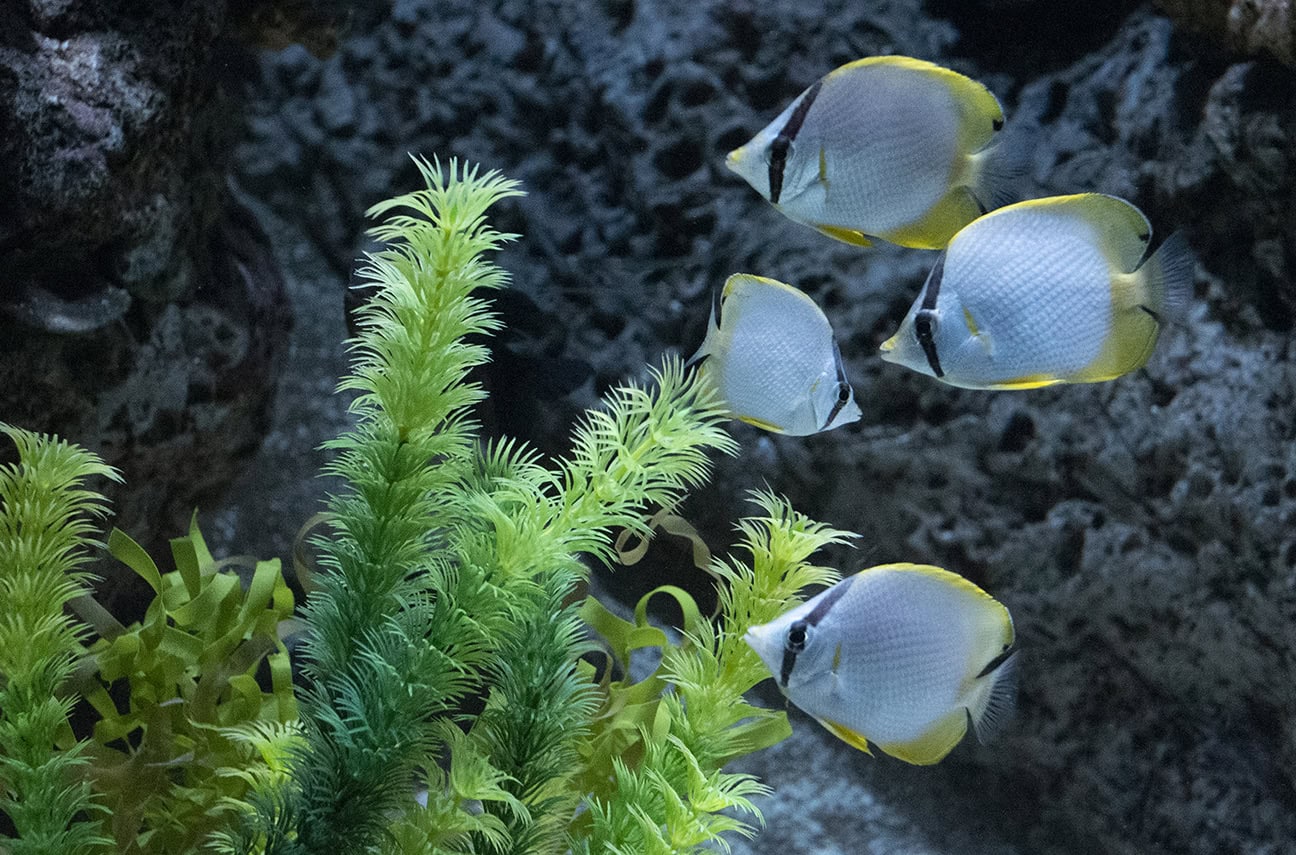
This includes the second species studied by the researchers — the threadfin butterflyfish. The scientists wondered if these impressive yellow, black, and white fish visited the cleaners for more than just health benefits. Especially because, in the lab, the butterflyfish didn’t need cleaning — they arrived parasite-free.
Soares had previously shown that cortisol levels, a stress hormone, in another type of reef fish dropped during a cleaning. “So we thought maybe there’s something more” happening, says Maximino. “Maybe there’s some pleasurable sensation produced by this massage.”
To find out, they conducted a series of experiments. First, Maximino observed that the butterflyfish preferred to spend time in the part of the tank where they had previously interacted with a cleaner fish.
“Not only [the fish had] memory of being cleaned there, but it wanted to go there,” says Maximino. “Like, ‘That was a really good place where I got a wonderful massage from that fish and well, I want that again.’”
Liking and Wanting
Maximino and Soares knew that fish have an opioid system (just like us), which regulates both pain and pleasure. And they thought that maybe this system is at least partially responsible for the butterflyfish’s interest in seeking a cleaning.
To test this idea, the researchers injected the butterflyfish with a low dose of an opioid mimetic, a drug similar to morphine that slightly increased opioid activation.
The result was that “they spent much more time seeking that place where they had experienced the cleaning before,” says Maximino. “So, that increased their preference.”
But when they injected the butterflyfish with naloxone — a drug that blocks opioid receptors and is used in people to reverse overdoses — they lost interest in the place where the cleaners had been. This suggested that there may be pleasure involved in the massage “and that this is mediated by these natural opioids in their brains,” says Maximino.
The scientists’ final question was whether there was a difference between liking the cleaning and wanting the cleaning. So, they placed a series of barriers in the tank that made it harder for the butterflyfish to reach the cleaner. This time, the same drugs — both the opioid mimetic and naloxone — had no effect. The butterflyfish continued to navigate the barriers to reach the cleaner, revealing that its motivation for the reward was not affected.
This meant that this other sensation of desire to receive the pleasurable stimulation — think of it as fish craving — may be governed by a different chemical, like dopamine.
Maximino explains it this way: “The opioid system is like ‘This is pleasurable,’ and the dopaminergic system is like ‘Go after what was pleasurable before.’ Opioids change how much you like something, but they don’t change how much you want something.”
“The main conclusion is that fish experience some kind of pleasure,” he says, “and work hard to get that pleasure again.”
Some scientists, however, may need a little more convincing.
“Can we unequivocally say this is pleasure in fish?” asks Susana Peciña, bio-psychologist at the University of Michigan-Dearborn, who was not involved in the research. “I’m not sure I would say it in those words. That said, it’s very hard to measure pleasure in animals, period, let alone in fish.”
Still, she finds the results exciting. For her, they suggest we need to rethink how fish are treated in aquariums and aquaculture. “Can we think of ways for them to have more positive experiences, better lives?” she says.
In the end, what this and other experiments are revealing, says Maximino, is that fish have rich behaviors that can be controlled, at least in part, by feelings — both negative and positive.
“Pleasure, wanting, desire, and all these positive emotions we feel — they’re not just human, chimpanzees, cats, and dogs,” he says. “Fish can feel them too. So, that’s a very ancient function.”
It’s a capability that Maximino argues was probably quite important in animal evolution.
Peciña agrees. If the results are confirmed in additional studies, she says, they may suggest “something deeper about what it means to be alive on Earth.”
Source: npr.org by Ari Daniel