



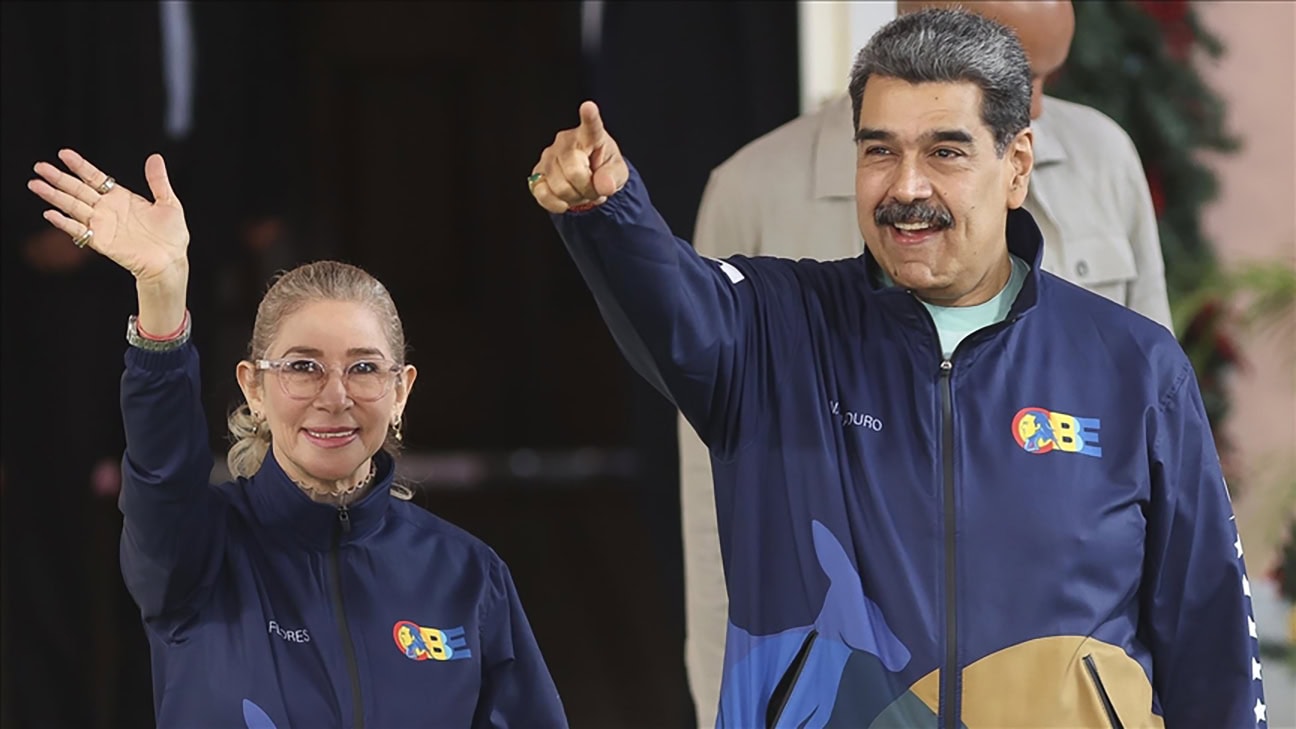
On New Year’s Eve, just three days before U.S. military personnel woke him from sleep and took him to a prison in New York, Venezuelan President Nicolás Maduro drove through downtown Caracas, narrating the city’s landmarks to a friendly interviewer.
As he drove, he lingered on history and nostalgia. He recalled a speech by Fidel Castro in 1959 in downtown Caracas, marveled at his childhood home, and after 40 minutes of conversation, finally acknowledged the U.S. warships gathered off the Venezuelan coast.
“If they want oil, Venezuela is ready for U.S. investments like those from Chevron,” Maduro said in a video broadcast by state television. “Whenever they want, wherever they want, and however they want.”
The olive branch he appeared to extend was, of course, too little and too late for the Trump administration, which said it was negotiating the terms of his exit. But it revealed how Maduro, 63, has always operated on his own timeline, indifferent to deadlines imposed by adversaries.
“I think this is the effect of negligence and lack of empathy with Venezuelan society,” said Boris Muñoz, a Venezuelan journalist who interviewed Maduro as a lawmaker in 2003 and has covered him ever since. “There were many moments when he could have stepped aside or corrected course, and he didn’t. He just kept going.”
When Maduro took office as president in 2013, Muñoz wrote a profile for the Mexican magazine Gatopardo, detailing how the leader was shaped by far-left politics from an early age.
He grew up with his parents and three siblings in a two-bedroom apartment in southern Caracas. His father held leadership positions in a local workers’ union, and as a teenager, Maduro, sponsored by the Liga Socialista, spent a year in Havana studying politics. Upon returning, he drove a bus and rose to leadership in a workers’ union in Caracas’s metro system.
After Chávez came to power in 1998, defeating the once-dominant center-left Acción Democrática and center-right Copei parties, Maduro was elected to Congress. In 2006, Chávez elevated him to foreign minister, placing him at the center of a political project obsessed with Simón Bolívar, the early 19th-century Andean colonial liberator born in Caracas. Bolívar dreamed of uniting the former Spanish colonies in Latin America against the outside world, a spirit that Chávez embraced, frequently invoking Bolívar’s name in speeches and including him in the new name adopted by the country in the constitution Chávez implemented in 1999: the Bolivarian Republic of Venezuela.
“Chávez had an army of spokespeople, but Maduro was prominent among them,” said Muñoz. “He was very loyal and a great surrogate for Chávez’s whims and desires.”
That loyalty proved decisive. Before dying of cancer in 2013, Chávez chose Maduro as his successor, entrusting him with a country already buckling under the weight of oil dependence and the perception that prosperity was coming to an end.
Venezuela rode a boom fueled by historically high oil prices — the lifeblood of its economy and virtually its only export — but that cushion collapsed soon after Maduro was sworn in as president in 2013. As writer Alma Guillermoprieto noted in her recent book, The Years of Blood, Chávez got lucky: “He had the good fortune to die before the bill arrived for the damage he caused to the economy.”
Maduro soon presided over the collapse of what was once one of Latin America’s most prosperous economies.
His government relied heavily on the state oil company Petróleos de Venezuela S.A. to distribute favors and bolster political loyalty. As deficits grew, authorities ordered the Central Bank of Venezuela to print money, a measure that rendered the local bolívar currency effectively worthless, said José Guerra, an economist who spent two decades at the Central Bank and served in the National Assembly from 2015 to 2021.
The result was economic devastation on a historic scale. From 2012 to last year, Venezuela’s GDP shrank nearly 80%, according to International Monetary Fund data. Inflation in 2018 exceeded 65,000%.
The collapse triggered one of the world’s largest migratory movements. At least 7.9 million Venezuelans fled the country, according to the UN Refugee Agency, seeking safety and means to feed their families. Many crossed the dangerous Darién Gap jungle passage linking Colombia to Panama, en route to the United States. Most remained elsewhere in Latin America.
“Maduro inherited a crisis economy, and he made things worse by appointing people to high positions who knew nothing about governing,” says Guerra.
Internal opposition to the regime became more apparent as Maduro struggled to control a process he considered democratic. In 2024, the Carter Center for Democracy, the only independent group allowed to monitor Venezuela’s presidential election, said the Maduro government imposed so many restrictions — including barring the opposition’s main candidate, María Corina Machado, from running — that the vote could not be considered legitimate. Based on 81% of ballot boxes tallied by its observers, the center said opposition candidate Edmundo González Urrutia won in a landslide with 67% of the votes. González fled the country, Machado was forced into hiding, and Maduro declared himself the winner.
The U.S. Department of Justice case against Maduro links Venezuela’s economic collapse to drug trafficking charges, alleging he was responsible for operating a vast drug trafficking operation that flooded narcotics into the United States. In his New Year’s Eve interview, he rejected claims that he was the head of a ‘narco-terrorist’ criminal organization and said the real U.S. goal was to seize Venezuela’s natural resources.
He is scheduled for his first appearance on Monday in a federal court in New York. In a video posted on Saturday by the White House, two U.S. Drug Enforcement Administration agents in New York hold his arms and escort him as he stands tall, smiles, and wishes viewers a happy new year — a figure molded in the certainties of a revolution, but with the consequences of his rule finally closing in on him.
Source: npr.org by Jorge Valencia