



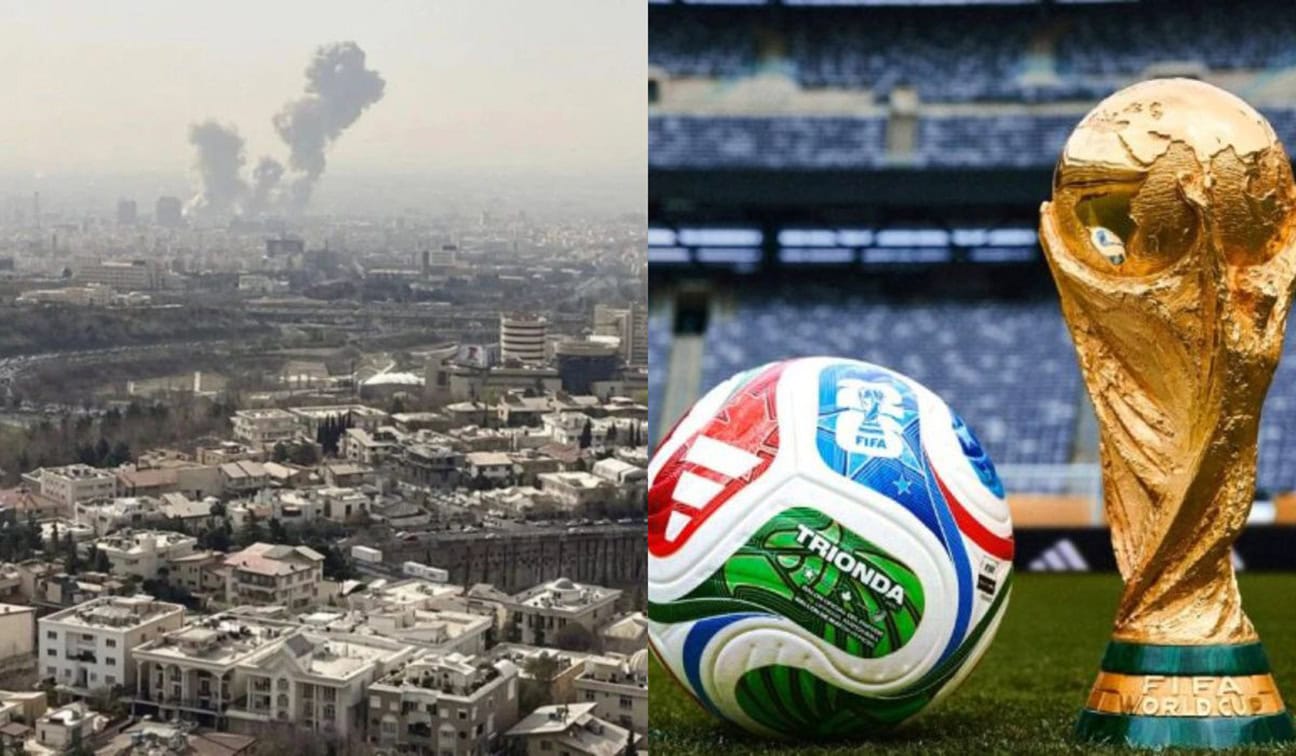
With only 100 days left until the FIFA World Cup, what should be a period of celebration is instead turning into one of turbulence.
The US and Israel’s attacks on Iran have raised major questions about whether the Persian country will withdraw from the 48-team tournament — a step no other country has taken after qualifying since 1950, when Scotland, along with others like India and Turkey, decided not to participate partly due to travel costs for the games in Brazil.
But Iran’s participation is not the only uncertainty. Violence in Mexico following the assassination of a cartel leader has raised doubts about the country’s ability to attract fans, while concerns about funding for the US host cities have also emerged in recent weeks.
And there is still outrage over ticket prices, and controversy surrounding President Trump and his administration’s policies, including military actions and enforcement of immigration laws.
Anxiety in the countdown to World Cups is nothing new. Concerns about violence preceded the 2010 and 2014 World Cups in South Africa and Brazil, while the selection of Russia and Qatar as hosts for the two previous tournaments also generated their own controversies.
But no men’s World Cup has ever been this big before, with 48 teams scheduled to play 104 matches in the US, Canada, and Mexico. And no recent World Cup has been held amid so much global geopolitical uncertainty.
Here are the main areas of concern ahead of the 2026 World Cup.
Will Iran withdraw?
That was the main question surrounding the FIFA World Cup when the US and Israel went to war with Iran this weekend. So far, there are no indications that Iran plans to withdraw, either to boycott it or for other reasons.
Iran is one of Asia’s strongest teams and is scheduled to play in its seventh World Cup this year.
The president of the Iranian Football Federation, Mehdi Taj, acknowledged the uncertainty on Iranian TV, according to Reuters and other media outlets.
“What we can say now is that, due to this attack and its severity, it is far from our expectations that we can look forward to the World Cup with hope,” Taj said, according to the news agency.
Iran is scheduled to play two matches against New Zealand and Belgium in Los Angeles, home to a large Iranian diaspora community. The country will also play against Egypt in Seattle.
FIFA has not commented directly. Its secretary-general, Mattias Grafstrom, said on Sunday that the organization would continue to “monitor developments on all issues around the world.”
“We had the final draw in Washington, where all teams participated. Our focus is to have a safe World Cup with everyone participating,” Grafstrom said.
Whether Iran will participate in the World Cup may be in doubt, but at least one thing is certain: its fans will have difficulty traveling to the US, given that Iran is one of the few countries facing a travel ban, although this does not affect the team and its coaches.
Will Mexico be safe for visitors?
The outbreak of violence by armed groups across the country after Mexico killed cartel leader Nemesio Oseguera Cervantes last month has raised security concerns in one of the tournament’s co-hosts.
Mexican President Claudia Sheinbaum stated that there will be no risks when the country hosts the World Cup, while FIFA President Gianni Infantino expressed his “full confidence” in Mexico.
Mexico is scheduled to host 13 World Cup matches, including four in Guadalajara, in the state of Jalisco, where Oseguera Cervantes’ group has its main base and where much of the violence occurred.
Concerns about violence are nothing new. Security issues were also raised ahead of the 2010 World Cup in South Africa, as well as in Brazil in 2014 — and both countries ultimately hosted their respective tournaments successfully.
Will the US host cities receive funding?
Financial concerns are a perennial issue ahead of major sporting events — and the US is proving no different.
The 11 US host cities have yet to receive $625 million in federal funding for crucial security costs to hold the tournament, including in Foxborough, Mass. The funding is supposed to be provided by the Department of Homeland Security through the Federal Emergency Management Agency, or FEMA.
A FEMA spokesperson directed NPR to a recent X post from DHS Secretary Kristi Noem, noting that “FEMA was in the final stages of reviewing the requests to ensure proper oversight,” but that the partial shutdown affecting the agency — which she blamed on Democrats — had put “significant portions of FEMA’s staff on administrative leave.”
For some host cities, the matter is becoming urgent. The White House FIFA World Cup Task Force has not yet responded to NPR inquiries.
“Without receiving this money, it could be catastrophic for our planning and coordination,” said Ray Martinez, operations director for the Miami Host Committee, at a congressional hearing, according to Politico.
Will fans be deterred by prices?
Perhaps no issue affects fans more directly than the sky-high costs they face to attend the World Cup.
FIFA has set the highest ticket prices ever for a World Cup, making tournament tickets unaffordable for many fans. Its use of dynamic pricing has also generated controversy; the most expensive tickets for the final in New Jersey initially sold for more than $6,300, jumping to nearly $8,700 in later sales.
Not only are ticket prices high — travel and accommodation costs have also skyrocketed. However, despite all the challenges, FIFA claims to have received more than 500 million ticket requests in its latest sales window.
That said, FIFA has provided little additional information to back up its claims, making it hard to determine whether demand is concentrated only on marquee matches like Colombia vs. Portugal in Miami or mainly focused on powerhouse teams like Argentina.
Will President Trump and his policies deter fans?
Perhaps the biggest unknown is the effect that Trump and his administration’s policies will have on World Cup participation.
The administration’s travel restrictions do not affect only Iranian fans; they also impact fans from three other countries that have already qualified for the tournament: Senegal, Côte d’Ivoire, and Haiti.
President Trump and his policies remain controversial both at home and abroad. Earlier this year, when Trump threatened to invade Greenland, some European officials raised the possibility of a boycott, though the initiatives never gained traction. Even former FIFA President Sepp Blatter urged fans to “stay away” from the US.
And the latest US and Israeli attacks on Iran — which follow the US capture of Venezuela’s Nicolás Maduro — have drawn renewed attention to the controversial awarding by FIFA of its peace prize at the tournament draw ceremony in Washington, D.C., in December.
The US has already seen a sharp drop in the number of visitors for several reasons, including increased border scrutiny (such as the potential requirement to share social media posts), as well as unease over violence due to high-profile killings involving US Immigration and Customs Enforcement.
Oxford Economics projects an increase in visitors linked to the World Cup, so the number of visitors could recover at least partially this year, although other surveys point to a reduced number of visitors from Europe to the US this year.
It is yet another sign of uncertainty in what promises to be the biggest tournament of all time with only 100 days left.
Source: npr.org