



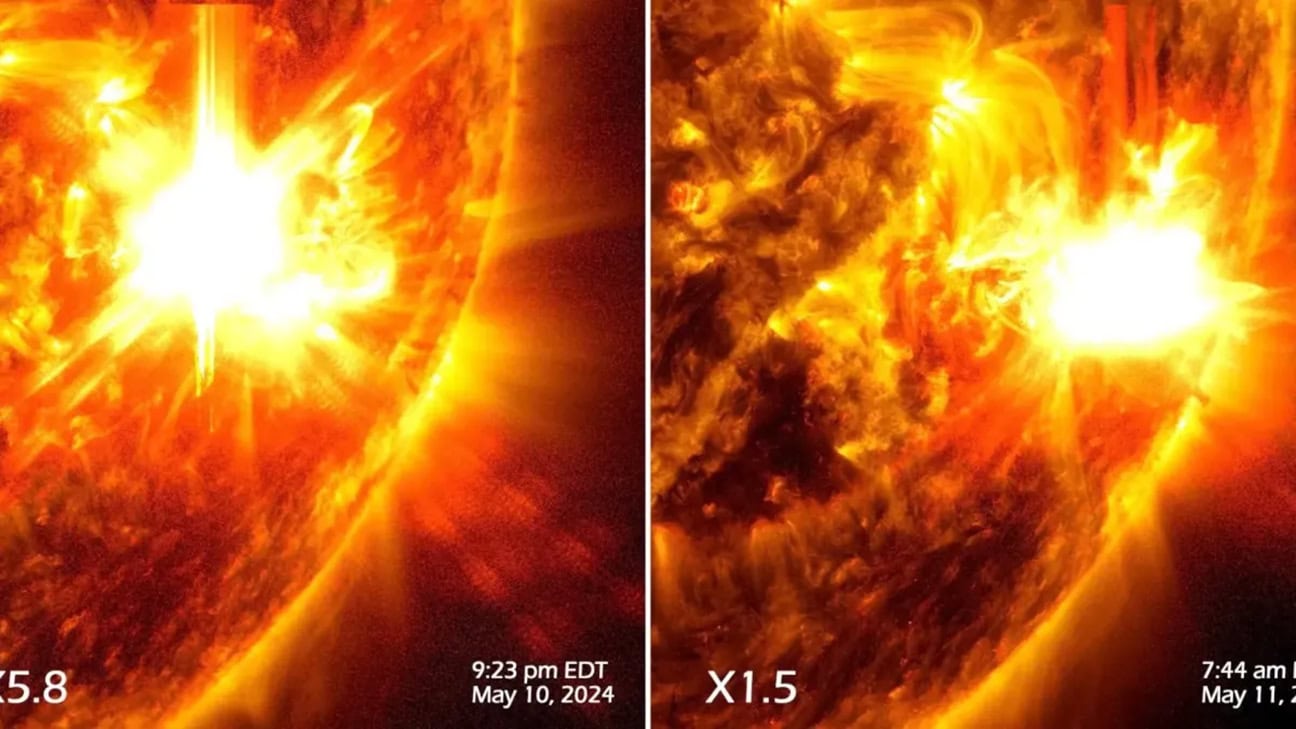
A series of intense solar explosions has put the scientific community on alert and is expected to result in solar material hitting Earth between Thursday (5) and Friday (6). Satellites recorded at least five X-class explosions—the most powerful category—in less than three days, all originating from the same active region on the Sun, identified as AR 4366. The information was disclosed by CNN Brasil.
According to the agencies, the strongest eruption, classified as X8.1, caused the ejection of solar material heading toward the planet, although weak impacts are expected.
According to records, the recent sequence began on Sunday (1st), with an X1.0 explosion. This was followed by the most powerful event, X8.1 class, followed by X2.8 and X1.6 eruptions. On Tuesday (3), a new X1.5 class explosion was observed, consolidating the fifth episode of this category in a few days—a pace considered unusual by experts.
NOAA reported that the X8.1 explosion was responsible for a coronal mass ejection expected to hit Earth. Even with moderate effects predicted, these events can interfere with radio communications, power grids, and navigation signals, in addition to posing risks to astronauts on missions. There is also the possibility of intensified auroras at higher latitudes.
The active region responsible for the explosions, the sunspot AR 4366, stands out for its size. According to astronomer Thiago Gonçalves, director of the Valongo Observatory at the Federal University of Rio de Janeiro (UFRJ), the sunspot is about 10 times the diameter of Earth and remains active. Since its emergence on January 30, 21 C-class explosions, 38 M-class, and five X-class have been recorded, reinforcing the exceptional nature of this recent period.
Solar explosions are part of the Sun’s natural behavior, which undergoes magnetic activity cycles averaging 11 years. During these cycles, the star’s magnetic field reorganizes, favoring the appearance of sunspots and explosions of varying intensities. Although events of this nature are relatively common, the concentration of strong explosions in such a short period is less frequent.
Scientists classify these explosions into categories indicating their impact potential. X-class explosions are the most severe, capable of affecting satellites and communication systems. M-class explosions have intermediate intensity and can cause occasional disruptions in radio transmissions, while C-class explosions are smaller and generally have few perceptible consequences. Below them are B and A classes, progressively weaker and with practically imperceptible effects on Earth.
Even without expectations of major disruptions, the sequence of events underscores the importance of constantly monitoring solar activity, as more intense storms can, in extreme scenarios, cause significant impacts on the planet’s technological infrastructure.
Source: brasil247.com