



In the 80 years since President Franklin Delano Roosevelt delivered his Four Freedoms speech — citing freedom of speech, freedom of worship, freedom from want, and freedom from fear — the United States has made these democratic principles the centerpiece of its foreign policy.
Today, the United States continues to advocate for human rights as a crucial component of U.S. foreign policy. Together with democratic partners, the U.S. helps promote human rights and fundamental freedoms through bilateral and multilateral diplomacy, public diplomacy, and foreign aid.
The United States also condemns foreign individuals and entities involved in human rights violations or abuses, documenting concerns in the Country Reports on Human Rights Practices, released annually. The U.S. imposes financial sanctions and visa restrictions on serious human rights violators under U.S. law.
Recently, the United States imposed sanctions against the China National Electronics Import and Export Corporation for providing monitoring and censorship tools to the illegitimate regime of Nicolás Maduro in Venezuela, where journalists are imprisoned for reporting the truth and internet freedom is compromised.
The People’s Republic of China (PRC) is also known for censoring its own citizens, both online and in the media. The PRC’s “Great Firewall” prevents anyone in China from accessing Facebook and other global social media providers, while the government also monitors personal letters and phone calls.
U.S. officials continue to express concern over violations and abuses related to freedoms of expression, religion, and assembly.
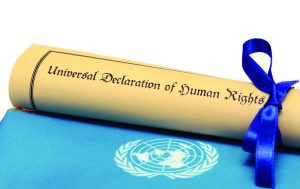
The U.S. government is committed to working with democracies that share similar ideals around the world to defend the fundamental principles of the Universal Declaration of Human Rights.
“Freedom is synonymous with the supremacy of human rights everywhere. We express our support for those who fight to obtain or maintain these rights,” Roosevelt concluded in his speech.
Source: www.share.america.gov