



GOD IS GAÚCHO
“In the pampas of Rio Grande, in the land where I was born
Sways the mischievous minuano wind just like a boy…
It stirs up a fuss wherever it goes and doesn’t even disguise
That it really loves it here…
There are those who look and are enchanted by the dance of the leaves
That, somewhat content, are led by the wind…
Oh! Fierce minuano when I catch myself distracted
I travel on your back to wherever the eye can reach…
I know it is here in my beloved querência
That one day I will rest…
At the border, missions or mountains… in the pampa or in the capital
There isn’t a single soul who doesn’t proudly boast
The pride of our people from the countryside to the coast,
Gaúcho is not an outsider, they know well where they were born
No matter how much they roam the world,
There is only one place that the gaúcho calls his own,
Where the loose reins of the wind bring back the echoes of time
Grazes the fields, shapes the trees…
Like a song whispered in the creator’s rhythm
There are those who look and think…
God is gaúcho, yes sir!”
Poet and Gaúcha Writer, Inoema Nunes Jahnke is from Pelotas, a city in the south of the state of Rio Grande do Sul. Author of acclaimed poems such as “Pride of the Gaúcho” and “Compassion for Life,” she published her first book in 2008, now with a collection of over 500 poems. With a poetic vision of social impact, she stands out in contemporary and regionalist aspects.
The history of the occupation and settlement of the Continent of Saint Peter of Rio Grande do Sul is marked by the border issue. A boundary region between two empires: the Spanish, based in Buenos Aires on the Río de la Plata, and the Portuguese, with Rio de Janeiro as a springboard city. According to the Treaty of Tordesillas of 1493, the line that separated the two Catholic kingdoms passed, in its southern extension, off the coast of the current state of Santa Catarina.
Theoretically, the region that would become part of Rio Grande do Sul belonged to the Spanish. Portugal, in turn, always sought to establish its true border and the extreme limit of its Empire in South America, not an abstract line, but the left bank of the Río de la Plata. All conflicts between Brazil and its neighbors of the Plata stemmed from these two antagonistic views on what the true landmarks separating them were.
A Hot Border
Rio Grande do Sul has been, since its inception – unlike other Brazilian states – a “hot border,” that is, a place of military dispute, wars, and diplomatic arrangements, a conflict-ridden area that extended from the late 17th century to the 19th century, meaning, for almost two centuries. This situation has only recently begun to reverse thanks to Mercosur, which aims for economic integration and no longer political rivalry.
Missões
It is believed that the Jesuit priests crossed the Uruguay River around 1626, with Father Roque Gonzales being martyred in 1628. In their occupation, they adopted the alternation of yerba mate cultivation with livestock to harmonize with the sedentary and nomadic habits of the Guaraní. In 1637, the bandeirante Raposo Tavares destroyed the reductions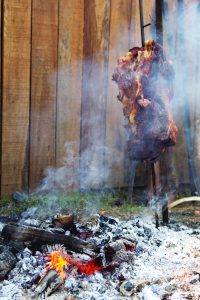
located between the Taquari and Caí rivers, forcing the Jesuits to retreat to the banks of the Uruguay. From then on, the cattle, of no interest to the predatory bandeirantes and Indian capturers, spread out, becoming “chimarrão” cattle, wild, forming the Vacarias do Mar and the Vacarias dos Pinhais. The true peak of the Missions occurs between 1720-56, when the 7 Peoples of the Missions (S. Nicolau, S. Ângelo, S. Luiz, S. Lourenço, S. João Velho, S. Miguel, S. Borja) were structured, until their destruction during the Guaranitic Wars, initiated by the Luso-Spanish expedition of 1756, with chief Sepé Tiaraju as its main defender. The “golden age” of the missions was possible because the bandeirantes became miners in Minas Gerais, and later, drovers and breeders of cattle and mules, ceasing to disturb them with their Indian hunting expeditions. The Missions passed under Portuguese control by the Treaty of Madrid, 1750, but effectively the missionary region was only occupied in 1801.
Portuguese Authorities
With the founding of the city of Colônia do Sacramento on the banks of the Río de la Plata, opposite Buenos Aires, in 1680, a rivalry of a century and a half began between the Portuguese and Spanish Empires for possession of the mouth and banks of the Río de la Plata. A conflict, permeated by wars and treaties, that would continue even after the independence of Argentina and Brazil, until 1828, with the recognition of the autonomy of the Republic of Uruguay. To better support their colonial base, on the eastern banks of the Río de la Plata, the Portuguese, commanded by Brigadier Silva Paes, founded Rio Grande in 1737. And to assert their definitive presence, they distributed estâncias among the Portuguese officers who were discharged, along the line that extended from Rio Grande to the banks of the Uruguay River.
Açorianos
Continuing the occupation through colonization, the Portuguese subsequently brought from the Azores the “numbered couples,” who received land in the region of Lagoa dos Patos, rivers Guaíba and Jacuí, populating Porto Alegre, Triunfo, and Cachoeira. Initially, the Açorianos dedicated themselves to agriculture (wheat cultivation), but abandoned it in 1820 to turn to livestock, taking advantage of the growth of the charque industry, established around 1780 around Pelotas and later Santo Amaro and Triunfo. The year 1756 marks the founding of Porto Alegre as a village. With the Castilian invasion of 1763, the capital ceased to be Rio Grande, which remained in their hands for 13
years, moving to Viamão and then, definitively, to Porto Alegre. With the expansion of the charqueadas, there was an importation of slave labor, heavily concentrated in the Pelotas area, later spreading inland.
Germans
They arrived starting in 1824 and were settled in the old Feitoria do Linho Cânhamo, on the banks of the Rio dos Sinos. Some were brought as mercenaries to fight in the Cisplatina War, but most were farmers who received small plots of land in “lines” and “paths” along the Vale dos Sinos and on the slopes of the Serra. They practiced the so-called “colonial economy,” handicrafts, and small industry, having Porto Alegre as their main market. They were forbidden to have slaves.
Italians
For the Italians, who arrived in 1875, the less accessible lands of the high Serra were reserved, having as a settlement nucleus the “fundos de Nova Palmira.” They settled in Conde d’Eu and D. Isabel. They dedicated themselves to timber extraction, viticulture, and handicrafts. Their impressive demographic growth in this century caused them to move to the central and eastern regions of the state.
Economic Activities
The Jesuit missions and soon after the formation of the estâncias of lagunenses and vicentinos (Paulistas moving from the North) were responsible for introducing livestock in RGS. The estância corresponded to the abandonment of predatory activities carried out by wild people of the field who indiscriminately slaughtered animals just to extract their hides and sell them to smugglers. Agriculture in these early days was confined to the planting of yerba mate.
With the discovery of gold and diamond mines in Minas Gerais and the
[caption id="attachment_12432" align="alignleft" width="200"]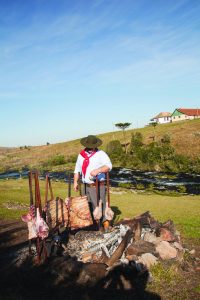 Photo: shutterstock-Caio Pederneiras[/caption>
high prices that food began to reach in mining regions, livestock became a highly profitable activity. With the mines, the first large internal Brazilian market was formed to which RGS would attach itself, being one of the economic reasons for the tension between separatism and nationalism, which persists to this day in our state. In the late 18th century, with the establishment of charqueadas, a much broader market opened up. It was no longer just cattle (bovine and mule) being exported as before. It became possible, henceforth, to aim for markets beyond the Center and Northeast of Brazil, even to the Caribbean and southern states of the USA, because charque was the basic food of slaves. The food of slaves, in turn, was paid for with… slaves. The arrival of waves of Africans to RGS was a result of the expansion of the processed and salted meat industry, which spread through Pelotas and the shores of Lagoa dos Patos and the Jacuí.
With the arrival of Açorianos, starting in 1752, agriculture took on new momentum with wheat plantations around Rio Grande, expanding to other areas of Azorean colonization, until it was destroyed by the rust plague around 1820 and the lack of government support. The Açorianos then became primarily cattle ranchers and charqueadores. A more diversified agriculture and livestock (pigs and poultry) would only arrive with the formation of German and Italian colonies, between 1824 and 1875, as they also brought industrial techniques that allowed laying the foundations of small industries in tanning, metallurgy, and viticulture. Livestock took on new momentum with the establishment of foreign slaughterhouses, Armour and Swift, in 1917, making it possible to export canned and refrigerated meats to the Center of the Country. The success of the so-called “colonial economy” is due to the abundant distribution of land made among the settlers, forming not only a dynamic multicultural productive center but also becoming a growing consumer market.
Rio Grande do Sul (XVII-XIX)
The occupation of the territory of Rio Grande do Sul dates back approximately 12,000 years, when giant animals survived on the food of
the extremely cold desert environment. The first men to step on this soil came from Asia in pilgrimages that passed through the north and center
[caption id="attachment_12434" align="alignright" width="200"]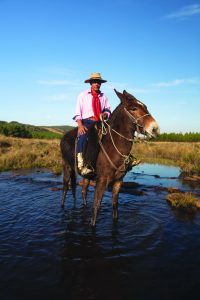 Photo: shutterstock-Caio Pederneiras[/caption>
of the vast American continent.
Small groups, who survived by hunting, fishing, and gathering, left their mark on the rocky shelters at the edge of the Plateau and at the confluence of the streams of the Uruguay River – among them the Ijui River – consolidating the first paleoindigenous traditions of Rio Grande do Sul. From 6 to 6 thousand years ago, a long period of climatic transformations defined the emergence of new human groups and the disappearance of some animal species. Humidity and temperature reached their peak, creating a humid tropical landscape. The glaciers melted and the rivers became torrential, the seas rose reaching the lagoons. The subtropical forest invaded the fields and the pine forests retreated to the higher parts of the Plateau. With abundant vegetation and food, the groups expanded and began to occupy the entire territory that encompasses the southern cone.
It is at the end of this period that the Tupi-Guaranis left the Peruvian Amazon towards the Mamoré Valley, initiating the cycle of the largest pilgrimages known in the history of our continent. In 500 BC, driven by semi-nomadic agriculture, canoeing, a warrior nature, and mainly in search of Ivy Mara Ey – the Land without Evils, part of the Guaranis descended the Madeira River and occupied the Brazilian Amazon, while others followed the course of the Jiparaná, populating the Plata Basin, and subsequently populating the Atlantic coast, until closing the circle and reconnecting, in the 17th century, with their relatives in the Amazon. The Tupi-Guarani linguistic trunk, which extended from the Caribbean to the southernmost tip of America, was, at that time, along with the Arabic language, the most spoken on the land.
In the area of present-day Rio Grande do Sul, the Guaranis occupied the fertile lands of the Uruguay River to the coast, imposing their culture and way of being. They lived in villages, were horticulturists, knew pottery and polished stone. They developed the cultivation of many native plants – both edible and medicinal.
[caption id="attachment_12438" align="alignleft" width="199"]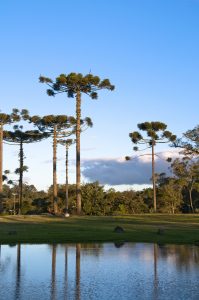 Photo: shutterstock/Vitoriano Junior
Among the contributions they left for the gaúcho people are linguistic terms, including names of rivers, localities, and fauna and flora, folklore with its legends, songs, and games; the cultivation of numerous plants; some dietary habits such as barbecue and chimarrão; the paths that gave rise to current roads, etc.
It was alongside these indigenous communities that the Jesuits developed the project of spiritual conquest, in the service of the Spanish Crown. The Jesuit Missions represented one of the forms of colonization in America. The encounter of two differentiated cultures, the Guaraní and the European, gave rise to a new way of being, the missioneiro.
The disputes and political interests between Portugal and Spain determined the Guaranitic wars, the expulsion of the Jesuits from America, and the decline of the Missions. The mission Indians gradually abandoned the villages, dispersing throughout the Plata territory. The forest reclaimed the abandoned cities.
The Gaúcho
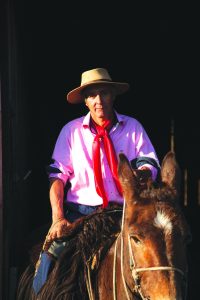
The gaúcho is the characteristic type of the countryside. It is the name given to the man of the field in the pampas region and, by extension, to those born in Rio Grande do Sul. The term gaúcho generalized from 1800. Until then, those born in this state were called continentinos or riograndenses.
The gaúcho emerged from the miscegenation between the Indian, the Spanish, and the Portuguese, who lived freely tending to cattle in the gaúcho pampa. Therefore, he became a skilled horseman, a lasso handler, and a boleadeira. The gaúcho was free, without a boss and without law. In the past, gaúchos were not well regarded. Defects were pointed out to them, such as: thieves, irresponsible men, scoundrels, disruptors of peace.
With the establishment of cattle farms and the modification of the work structure, the gaúcho lost his nomadic habits. Integrated into rural society as a specialized worker, he became the peon of the estâncias.
After the Farroupilha Revolution, the gaúcho began to be considered a worthy, brave, fearless, and patriotic man.
The gaúcho is defined by literature as machista, proud, irreverent, warrior, and legitimate. Among us, a gaúcho is one who lives from pastoral work.
The gaúcho of today is the result of the contributions of the Indian, the black, the Portuguese, the Spanish, the German, the Italian, and many other peoples who came here to build Rio Grande. Therefore, gradually the term gaúcho began to identify the children of Rio Grande do Sul. The gaúcho people greatly value their traditions, exalt the courage and bravery of their ancestors, sing their attachment to the land, their love of freedom, thus motivating the emergence of a gauchesca literature.
The traditional dish is barbecue and rice with meat, chimarrão is the preferred drink, becoming a symbol of hospitality and friendship.