



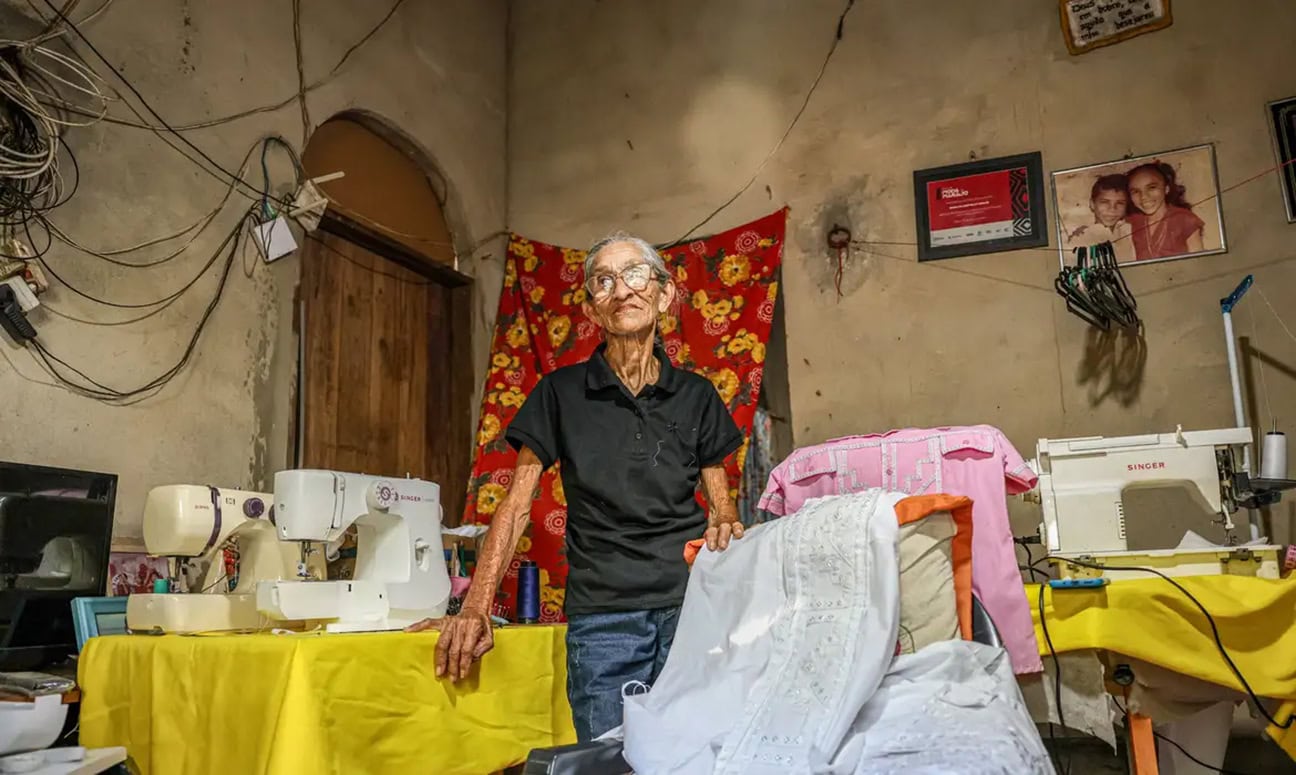
In a small house, with walls still roughcast, lives and works Dona Cruz, 77 years old. The simple life in Soure, a municipality on Marajó Island, in Pará, contrasts with the type of clothing she makes every day: a Marajoara gala outfit.
The piece, usually a button-up shirt, is aimed at special occasions, like parties. Depending on the complexity, it can take from one to three days to produce. Each one is handmade in cotton fabric, and has ribbons embroidered with thread that follow patterns inspired by ancient indigenous ceramics.
Among frequent consumers are political authorities and ranchers. After the state governor, Helder Barbalho (MDB), wore the outfit made by Dona Cruz at the Amazon Summit in 2023, demand for the garment grew.
The seamstress works on commission and sends products via Correios to various places across the country, such as Brasília, Recife, Rio de Janeiro, and São Paulo.
Such repercussion has yet to translate into significant improvement in Dona Cruz’s living conditions, as financial gains remain modest.
“Generally, what I earn from selling the shirts goes toward buying new materials. That way, when a customer comes, I always have something available. I work independently, without loans. And my retirement money covers household expenses,” explains the seamstress.
“The price of each garment depends on the size. Whether it has short or long sleeves, small or large. So, it can cost between 290 and 410 reais.” The clear benefit has been the chance to stay active and gain new knowledge.
“I worked as a school inspector and then retired. When I became a widow, to keep from being idle, I devoted myself to the shirts. It’s good for keeping the mind occupied and not dwelling on other things, right?” says the seamstress.
Among the few supports Dona Cruz has received is an industrial sewing machine, through a partnership between Soure city hall and the state government.
Additionally, she received guidance from the Brazilian Service of Support for Micro and Small Enterprises (Sebrae), as part of the Marajó Fashion Hub program. She learned about pricing and sales strategies, improving product presentation (such as using proper packaging), and accessing new markets.
“The Marajó Fashion Hub has transformed participants’ lives by creating income opportunities, reviving traditional knowledge, and boosting the self-esteem of the women involved. By professionalizing production, encouraging entrepreneurship, and connecting these artisans and seamstresses to new markets, the Hub promotes productive inclusion, economic autonomy, and cultural appreciation,” says Renata Rodrigues, Sebrae manager in Marajó.
At the end of October, Dona Cruz will share her knowledge with others on the island. She will teach a Marajoara shirt-making course through Sebrae, helping preserve an embroidery technique mastered by few. Her teacher, known as Baiano, died of covid-19 during the pandemic. Of his ten students, only Dona Cruz completed the course.
Tradition and Livelihood
From ancestral ceramics to the contemporary runway, Marajoara art takes on new forms through the hands of quilombola Rosilda Angelim, 56, an artisan and seamstress from Salvaterra, a municipality on Marajó Island.
Before living off her art, she worked as a teacher and public servant. After losing her job, she faced financial hardship and depression until discovering sewing as a new opportunity.
“It was like a push. I started sewing about 30 years ago, but 16 years ago I truly found myself in Marajoara motifs,” recounts the artisan.
“My goal is to promote my culture. I want the world to know Marajó.”
Today, Rosilda leads an atelier with six people, producing clothing and accessories that blend fashion and Amazonian identity. Her creations are sold in Belém stores and attract buyers from other parts of the country.
Sustainability is central to the work. The atelier uses 100% cotton fabrics and repurposes scraps.
“Nothing goes to waste. Leftovers are donated to women who make rugs and other crafts. It’s good for the environment and helps families,” explains Rosilda.
With the 30th United Nations Climate Change Conference (COP30) approaching in Belém, production is expected to ramp up.
“We have to believe the COP will bring good things. Not just for the climate, but for culture overall—our cuisine, crafts, biojewelry. We’re banking on it and preparing more pieces for the period. Sure, my goal is to make money—I won’t be hypocritical—but I also want to showcase my culture to everyone,” says the artisan.
Authorial Brand
French teacher turned seamstress and entrepreneur. That’s the story of Glauciane Pinheiro, 40, who joined an industrial sewing course “without ever touching a machine.” The project targeted experienced participants, but spots opened for beginners—and that’s how she gained the skill.
“I was unemployed, going through a tough emotional time. I signed up to distract myself, but ended up finding my calling in sewing,” recalls Glauciane.
From there, her interest in printing and collection design grew. With her husband’s support—he gifted her two machines—she set up a small atelier in her bedroom and launched the Mang Marajó brand.
The entrepreneur produces clothes with original prints and embroideries, some made by local families and outsourced groups. Today, she sees local tourism as a real growth opportunity.
“Since COP30 preparations began, the city has changed. More bustle, more tourists. I get visitors daily, even evenings or Sundays,” reports Glauciane.
“We believe tourism can sustain Marajó. And I want to make a living from culture and art.”
Those making a living from fashion on Marajó share hope that November marks a turning point for the sector in Pará, with greater visibility and public investment.
“Key challenges remain: limited access to modern equipment, ongoing technical training, sales channels, and financing. To advance these women, we must strengthen institutional partnerships, expand market access (digital and physical), invest in entrepreneurship training, and secure public policies to support identity-driven local development,” explains Sebrae director Renata Rodrigues.
Source: Agência Brasil