



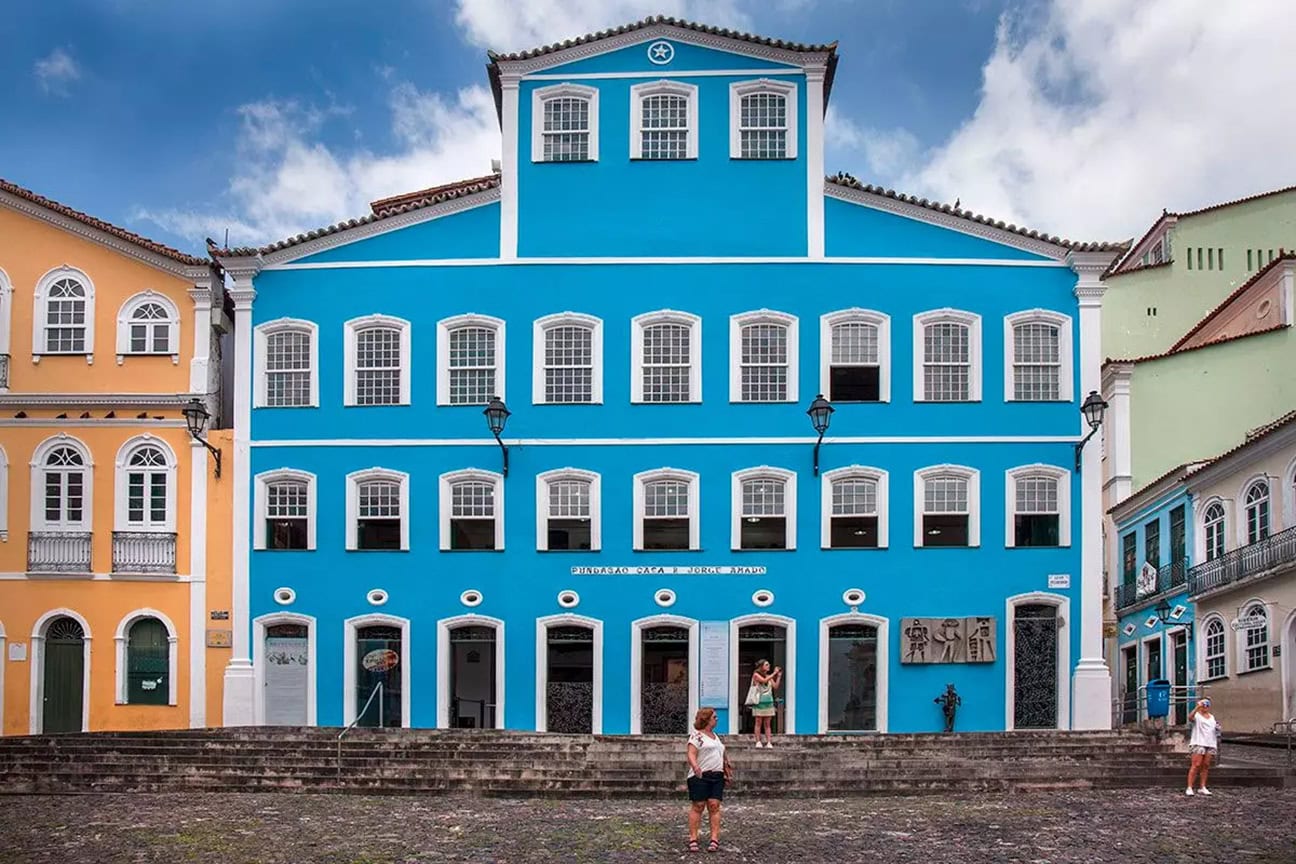
In the heart of Pelourinho, there is an imposing blue colonial mansion that has housed a great treasure of Brazilian culture for 37 years: the collection of the writer couple Jorge Amado and Zélia Gattai. This is where the Jorge Amado House Foundation is located, created to preserve and study the bibliographic and artistic collections of the writer, but he never wanted it to be just a museum.
“What I want is for this house to reflect the meaning of life in Bahia and for that to be the feeling of its existence, and for it to be a meeting place for cultural exchange between Bahia and other places, as well as research and study,” said Jorge Amado.
After nine months of its largest renovation, the Jorge Amado House Foundation reopened in December 2024.
The cultural institution underwent the most significant restoration since its inauguration on March 7, 1987. Its headquarters, which comprised the houses numbered 49 and 51 — the well-known Blue and Yellow Houses in Largo do Pelourinho — has now been connected to another building, number 47, called Casa Branca. With the renovation, new exhibition spaces were created. Additionally, the location has become more accessible, modern, and secure, with the installation of a new and modern fire prevention and monitoring system.
Who is Jorge Amado?
Jorge Amado (born August 10, 1912, in Bahia, Brazil—died August 6, 2001) was a Brazilian novelist whose stories about life in the eastern Brazilian state of Bahia gained international acclaim.
Amado grew up on a cocoa plantation, Auricídia, and was educated at a Jesuit school in Salvador and studied law at the Federal University of Rio de Janeiro. He published his first novel at the age of 19. Three of his early works deal with cocoa plantations, emphasizing the exploitation and misery of migrant blacks, mulattos, and poor whites who harvest the crop, often expressing communist solutions to social problems.
Amado became a journalist in 1930, and his literary career paralleled a career in radical politics that elected him to the Constituent Assembly as a federal deputy representing the Communist Party of Brazil in 1946.
He was imprisoned as early as 1935 and periodically exiled for his leftist activities, and many of his books were banned in Brazil and Portugal. He continued to produce novels with ease, most of them picaresque and irreverent tales of urban Bahian life, especially of the racially mixed lower classes. “Gabriela, Cravo e Canela” (1958; Gabriela, Clove and Cinnamon) and “Dona Flor e Seus Dois Maridos” (1966; Dona Flor and Her Two Husbands; film, 1978) both preserve Amado’s political attitude in their satire. His later works include “Tenda dos Milagres” (1969; Tent of Miracles), “Tiêta do Agreste” (1977; Tieta, the Goat Girl), “Tocaia Grande” (1984; Show Down), and “O Sumiço da Santa” (1993; The War of the Saints). Amado published his memoirs, “Navegação de Cabotagem” (“Coastal Navigation”), in 1992.
Sources: Agência Brasil and Britannica