



The Bahian influencer Dai Cruz, who died after battling the genetic skin disease Epidermolysis Bullosa, has become a character in a Turma da Mônica comic in a special edition of the magazine. The initiative came from the Ong Jardim das Borboletas, which provides assistance to people with the disease throughout Brazil.
Dai Cruz died in February 2024, at the age of 31. Dai Cruz was from Jequié, in southwestern Bahia, and used her social media to share her daily care routine; she had over 2 million followers on social media. In the special comic, Dai’s character, who bears the same name as the influencer, will be a new neighbor to the gang.
The president of Ong Jardim das Borboletas, Aline Teixeira, celebrated the achievement. “This tribute helps transform society’s view of the ‘butterfly children’,” she said. The visibility of the comic magazine and the public’s affection for the Turma da Mônica characters can help reduce prejudice, discrimination, and bullying against those with the disease.
In the special comic edition, the character Dai, who has the same name as the Bahian influencer, moves to the Limoeiro neighborhood and meets Cebolinha, Cascão, Mônica, and Magali. Because of the bandages the girl wears on her arms, they initially think she suffered some accident.
After being questioned by her new friends, Dai explains that she has Epidermolysis Bullosa and asks her parents for help to explain more about the disease.
“People with EB are affectionately called butterflies because their skin is as fragile as a butterfly’s wings,” explains one passage in the comic.
The comic will explain to children about the disease and its care, such as being careful with people who have the disease, the regulated diet for those who have it, and will serve to 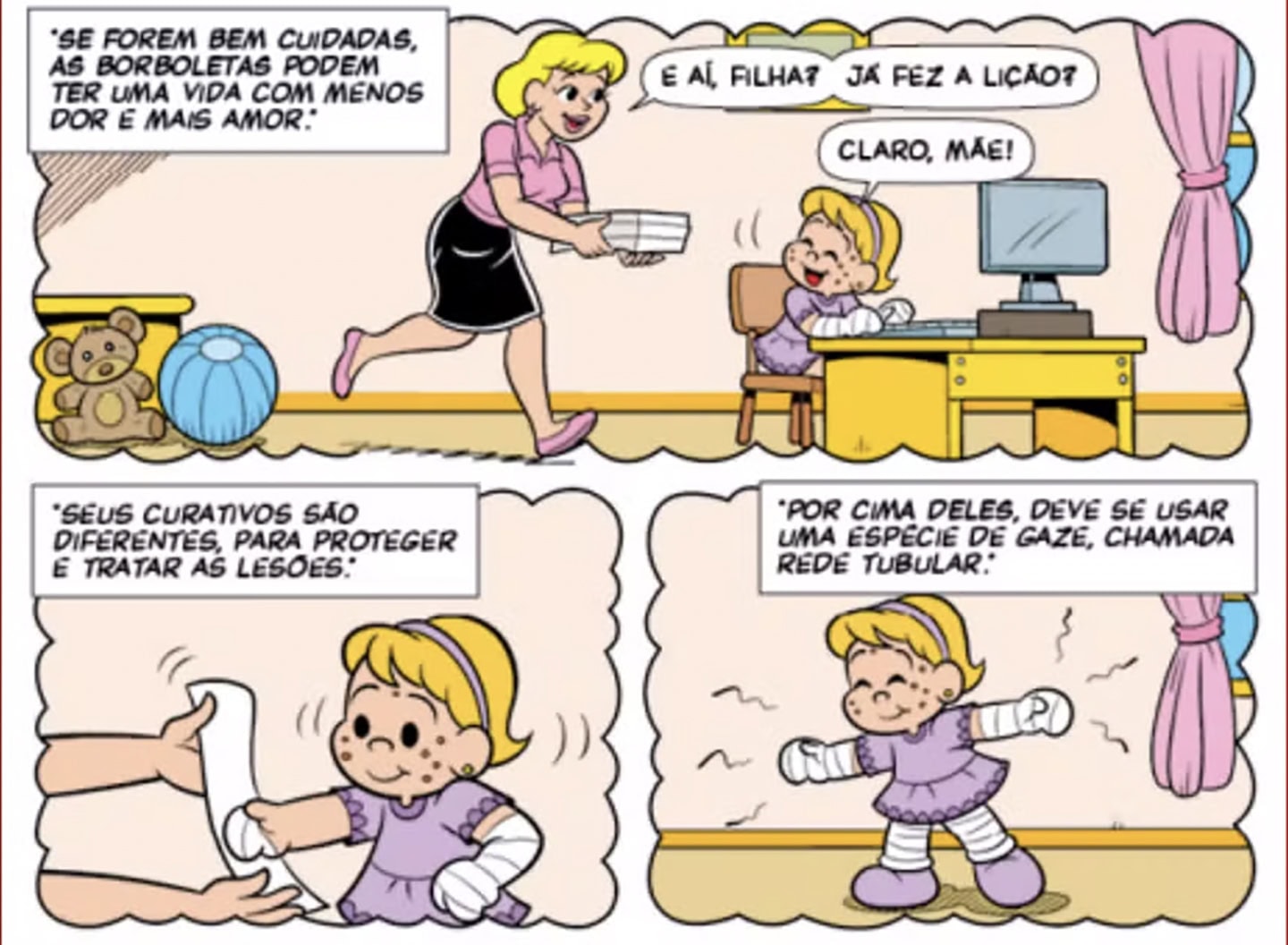 remind that the disease is not contagious.
The special magazine edition, produced in partnership with the Instituto Maurício de Souza, also had sponsorship from Nestlé Health Science, Mölnlycke Health Care, Programa EBA, TegraPharma, and Vitae Saúde.
ONG Jardim das Borboletas
Created in 2017, the Ong Jardim das Borboletas aims to provide assistance to people with Epidermolysis Bullosa (EB) and other rare skin diseases throughout Brazil, improving quality of life and promoting social inclusion.
Currently, the institution serves more than 100 people throughout Brazil, including 26 in Minas Gerais, 27 in São Paulo, 19 in Maranhão, and 11 in Bahia.
The organization’s name is associated with the fragility of the skin of people with the disease and the fragility of butterflies’ wings.
The organization’s headquarters is located in Caculé, Bahia, as is the administration and social assistance, nursing, nutrition, psychological, and legal services.
What is Epidermolysis Bullosa (EB)
Epidermolysis Bullosa (EB) is a group of genetic and hereditary diseases characterized by skin and mucous membrane fragility, with blister and wound formation in response to minor friction or trauma. It is a rare disease but can have a significant impact on the quality of life of those affected.
EB is caused by genetic mutations that affect the proteins that bind the skin layers. These proteins are responsible for maintaining skin integrity, and in EB, this bond is compromised, resulting in blisters and wounds.
There are different types of EB, with varying degrees of severity and clinical characteristics, but there are four main types: Simplex EB (EBS), Junctional EB (EBJ), Dystrophic EB (EBD), and Kindler EB (EBK). EBS is the most common and mild, while EBJ is more severe and appears at birth. EBD can vary in severity and affects other organs besides the skin. EBK is rare and can be confused with other subtypes.
EB can manifest from birth, with blisters and wounds in areas of greater friction, such as hands and feet. The blisters can rupture easily, forming wounds that take a long time to heal. It can cause intense pain, feeding difficulties, joint impairment, risk of infections, and, in severe cases, risk of skin cancer. There is no cure for EB, but treatment focuses on supportive care, such as skin protection, wound care, infection prevention, and pain management.
Epidermolysis Bullosa (EB) can have a significant impact on the quality of life of those affected, who must deal with pain, wounds, and physical limitations. It is a complex and challenging disease that requires multidisciplinary care and support. Research continues to seek new forms of treatment and prevention, with the goal of improving patients’ quality of life.