



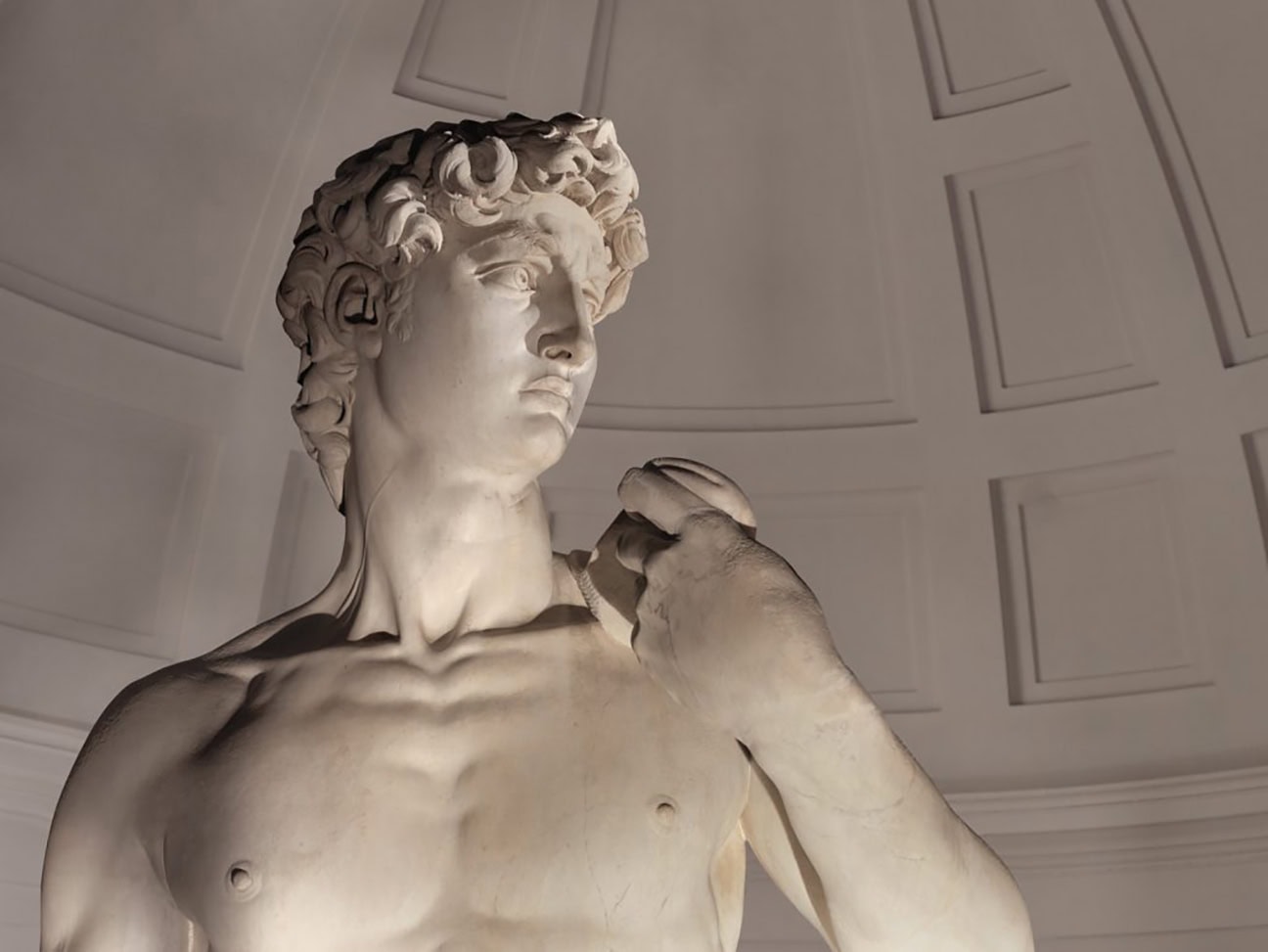
On September 8, 1504, in front of the Palazzo della Signoria, Florence received a gift for eternity. A twenty-six-year-old young man named Michelangelo Buonarroti gifted the republic with a sculpture that would cease to be mere stone to become a universal language: David. There stood the human body raised in its maximum moral tension, ready to face the giant—not just any enemy, but Goliath, the Philistine colossus described in the Bible, symbol of brute force and arrogance.
The context in which this work was born is as revealing as the sculpture itself. Florence lived amid unstable republics, the memory of the expulsion of the Medici, and the constant threat of foreign powers. The people wanted symbols, and Michelangelo offered not a crowned king, but a nude and alert young man, with a gaze that pierced through centuries. David, the biblical character who defeated Goliath with a sling—a simple weapon, a strip of leather or cloth used to hurl stones at high speed—was transfigured into an archetype of citizenship. It was the courage of youth facing an outsized world.
The Renaissance found an incomparable synthesis in “David.” It brought together the rediscovery of the human body, the exaltation of reason, and faith in individual liberty. For Western culture, few works have spoken so powerfully to the future: every throbbing vein, every muscle in contrapposto—the classical pose of balance between tension and rest—every calculated gaze became an allegory of civic courage.
Experts highlight the uniqueness of the piece: it is not the moment of victory that Michelangelo depicts, but the instant before the battle. The Carrara marble becomes skin, tension, and silence. What impresses is not only the anatomical perfection, but the contained energy, the suspended breath before the fatal act.
It is no coincidence that artists of later generations were captivated by the grandeur of the Florentine colossus. Auguste Rodin stated: “In David lies the secret of sculpture: eternity in the instant.” Pablo Picasso said that “no one has ever surpassed Michelangelo’s petrified youth.” Henry Moore added: “Every curve of David’s body is a lesson in balance between the human and the divine.”
Michelangelo, born in Caprese in 1475, was already renowned in Rome and Florence when, in 1501, he accepted the challenge of working a block of marble considered “impossible.” Other sculptors had failed there. At just twenty-six years old, he created a monumental body, 5.17 meters tall, weighing 5.5 tons of beauty and wonder. His life, marked by precocious genius, personal dramas, and obsession with form, found its most perfect embodiment in “David.”
Today, the original is no longer exposed to the elements in the Piazza della Signoria. Since 1873, it has rested in the Galleria dell’Accademia in Florence. I was there in 1998 and will never forget the impact: walking down the corridor, spotting the upright figure at the far end, feeling every detail that emerges from the marble as if it were breathing. A visual spectacle where perfection and spirituality intertwine. The Carrara marble, cold to the touch, is human warmth to the eyes. And today marks 521 years since David was presented to the public, reminding us how art remains a witness to human greatness.
But “David” is also an invitation to reflect on the universality of the human condition expressed in various arts. If Michelangelo found his synthesis in sculpture, in classical music Beethoven, with his Ninth Symphony, erected a sonic monument to the ideal of universal fraternity; in painting, Leonardo da Vinci, with “The Last Supper,” inscribed the tension of the human before transcendence; in literature, Tolstoy, with “War and Peace,” revealed humanity’s fate amid overwhelming historical forces; in architecture, Antoni Gaudí, with the Sagrada Família, opened space for stone and light to become collective prayer. Each of these expressions is a “David” in itself, a call to human greatness against the forces that diminish it.
In sacred literature, we also find luminous equivalents. The Sermon on the Mount, by Jesus Christ (4 B.C.–33 A.D.), is a literary milestone that condenses ethics and wisdom in precise words. Its timeless power inspires reflection, shapes behaviors, and guides humanity with universal clarity and depth. Similarly, Hidden Words, revealed by Bahá’u’lláh (1817–1892), is a unique spiritual creation, distilling the essence of past revelations into unified light. Active and urgent, this work reorients minds, edifies souls, and regenerates humanity with its transformative power.
And here arises the question that echoes through the centuries: what if the antennas of the race, the great artists and artisans of the era, had been continuously encouraged to create works that highlighted the finest human feelings? If the arts had been called not only to immortalize battles, military heroes, and monuments of power, but to refine the human species? Perhaps today we would have a humanity more attuned to understanding among peoples and cultures, more committed to inclusive policies, more focused on cultivating delicacy rather than brutality.
“David” shows us that this is possible. That from cold marble can be born a living gaze; that from apparent fragility can emerge the strength of courage; that from art can come not only beauty, but also the most urgent lesson: we are capable of being greater than the giants that oppress us.
Source: www.brasil247.com by Washington Araújo, Journalist, writer, and professor. Master’s in Cinema and psychoanalyst. Researcher in AI and social networks, hosts the podcast 1844 on Spotify.