



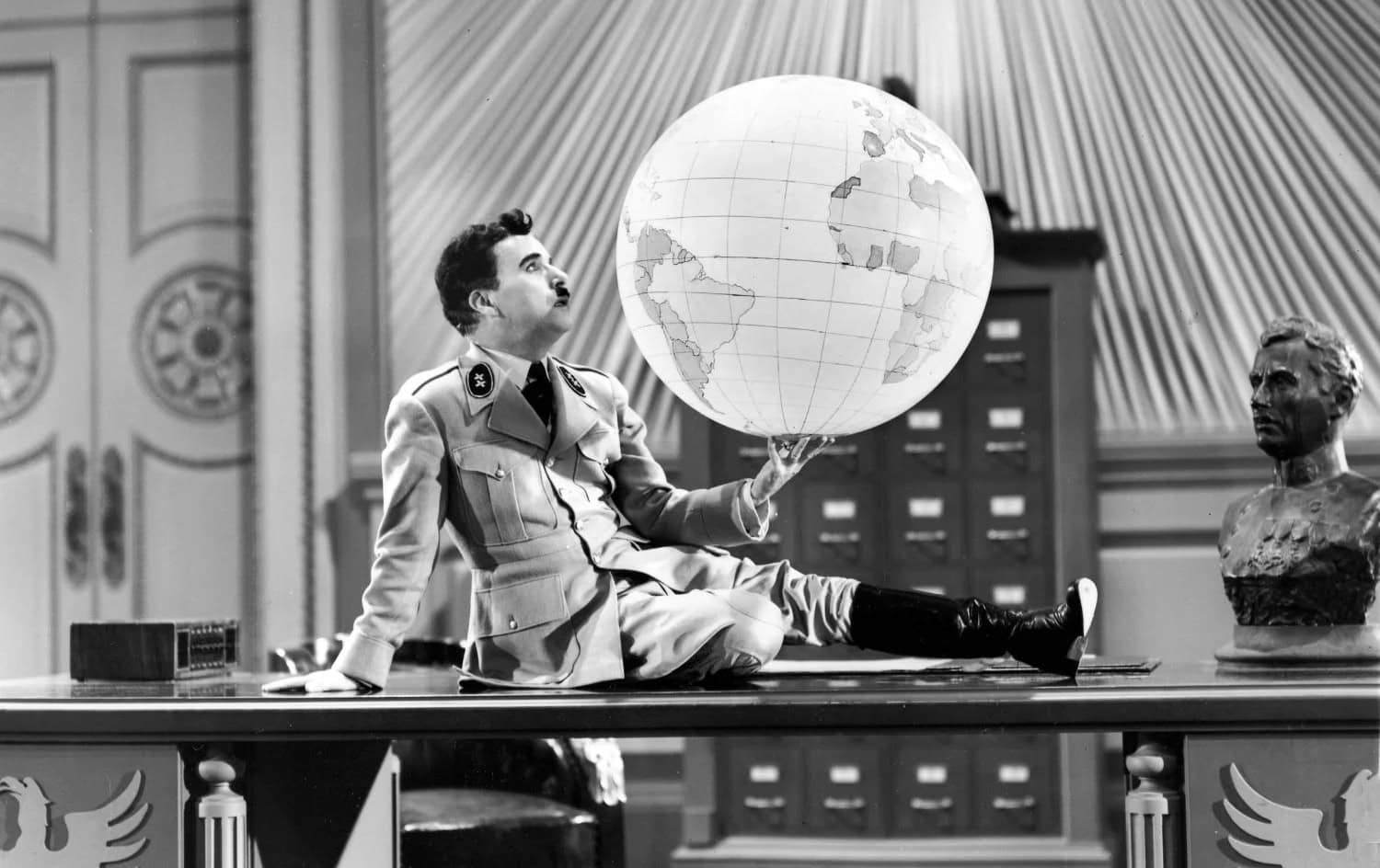
Hollywood studios didn’t want Charlie Chaplin to make The Great Dictator. When he started writing the script in 1938, the US hadn’t yet entered World War II. In fact, they still maintained friendly diplomatic relations with Nazi Germany, plus many lucrative business deals.
So Chaplin financed The Great Dictator with his own money. He took advantage of his astonishing resemblance to Adolf Hitler by portraying an obvious parody of the Nazi leader, named Adenoid Hynkel, in the film. But the similarities went further, as noted in the 2002 documentary The Tramp and the Dictator.
“Charlie Chaplin, the Little Tramp, and Adolf Hitler, the leader of Germany, had more in common than just a mustache,” says the narrator. “They were born in the same week of the same month of the same year. Some years before Chaplin became famous as the Tramp, Hitler was a tramp. Both were outsiders who left their homeland to conquer the world. They became the most loved and most hated men of their time.”
In The Great Dictator, Chaplin also portrayed another character: a sympathetic Jewish barber who is mistaken for the hateful Hynkel and who, at the end of the film, delivers an incredibly moving speech.
“Sorry, but I don’t want to be emperor,” he gently informs an assembly of Hynkel’s army and advisors. “I don’t want to rule or conquer anyone. I’d like to help everyone, if possible. Jew, gentile, black man, white. We all want to help each other. Human beings are like that. We want to live by the happiness of each other, not by the misery of each other.”
Never before in this film had the greatest star of silent cinema spoken out loud on screen.
“Greed has poisoned the souls of men,” he continues, “barricaded the world with hate, marched us goose-stepping into misery and bloodshed. We have developed speed, but we have shut ourselves in.”
Later, Charlie Chaplin said he hoped that speaking from the heart might even help end the war.
“Machines that give abundance have left us in want,” he says in the speech. “Our knowledge has made us cynical, our cleverness hard and unkind. We think too much and feel too little. More than machinery, we need humanity. More than cleverness, we need kindness and gentleness. Without these qualities, life will be violent and all will be lost.”
Some critics found the speech overly sentimental. Chaplin’s film also provoked the ire of right-wing politicians and powerful figures in Washington, including Senator Joe McCarthy and J. Edgar Hoover, who wrongly accused him of being a communist sympathizer. The FBI eventually compiled a 1,900-page file on him.
The film was indeed subversive, and impressively so, said science fiction legend Ray Bradbury, interviewed in the documentary The Tramp and the Dictator before his death in 2012.
“Comedy is the greatest form of attacking any totalitarian regime. They can’t stand it,” said Bradbury. “At the end of the speech, [Chaplin] dares to remind that you don’t have to keep killing. You don’t have to be totalitarian. You can deal with the worst people in the world. Somehow, you must.”
Chaplin ended his speech with an appeal to the humanity of all those facing war. “Let us fight for a world of reason,” he implored. “A world where science and progress will lead to the happiness of all men. Soldiers, in the name of democracy, let us all unite!”
The Great Dictator was released years before the world learned the extent of the Nazis’ crimes against humanity. Later, Chaplin said he never would have made a comedy about Hitler if he had known. But, 85 years after its premiere, his film remains a testament to how art can oppose tyranny and how powerfully it can combat it.
Source: npr.org by Neda Ulaby