



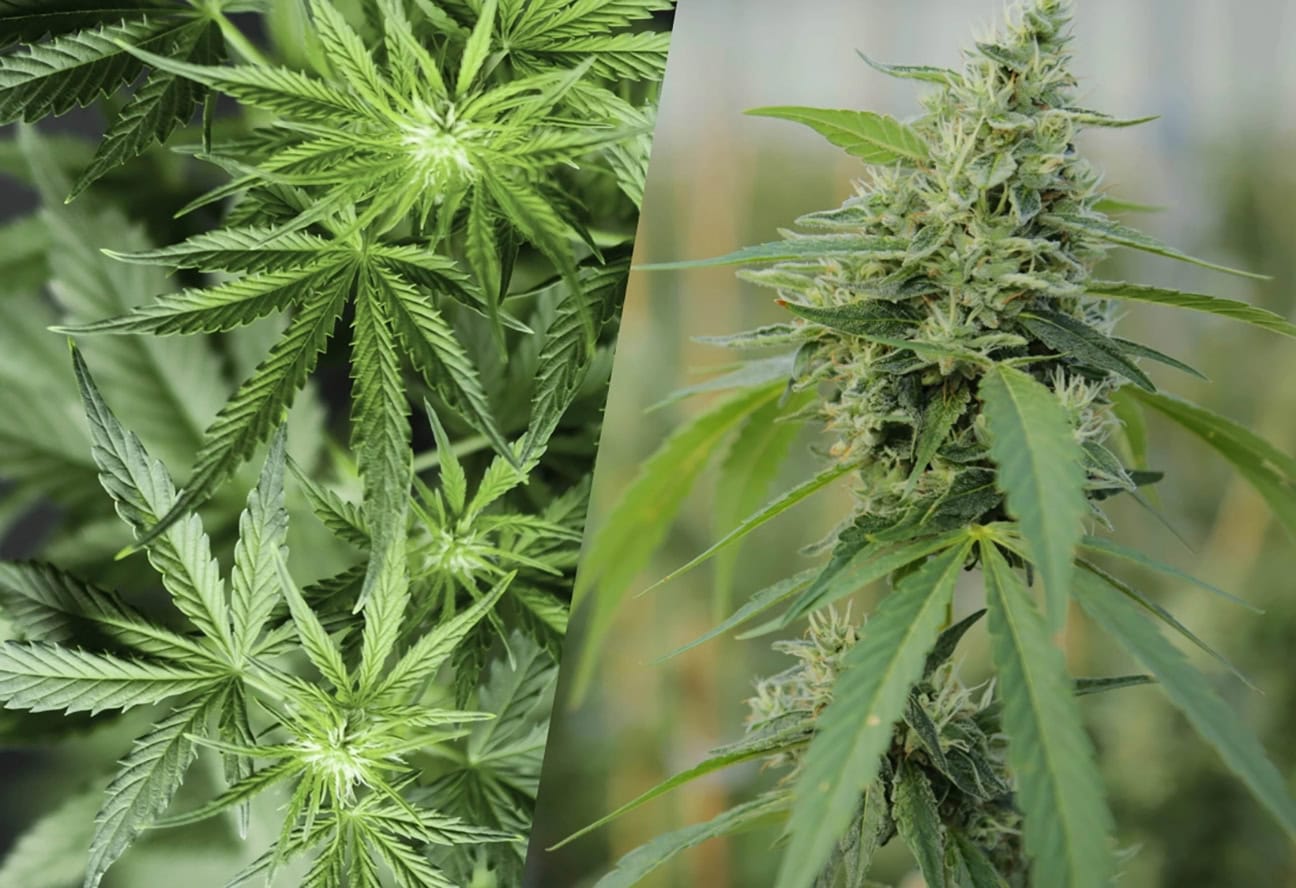
Is it hemp, cannabis, or marijuana?
That depends on who is discussing the enigmatic plant that is legal in some forms (for now), but faces new restrictions in other forms this fall.
The confusion doesn’t surprise Nick Johnson, author of the book Grass Roots, which examines the history of the cannabis plant and its use both as an industrial material and as a drug.
“It’s one of the world’s oldest domesticated crops,” says Johnson about cannabis. “And it’s also incredibly cryptic. We still don’t understand everything about its biology and why it does what it does, how it creates the compounds and molecules it creates.”
Cannabis “has more than 480 constituents,” according to the Drug Enforcement Administration, but US regulators focus on just one: THC, the compound linked to the drug’s famous psychoactive effects.
Federal laws define legal hemp differently from illegal marijuana based on their THC levels. As long as a plant contains less than 0.3% of a form of THC (with a much stricter limit coming into effect later this year), it is considered hemp, not marijuana. And while marijuana is in the process of being reclassified as a Schedule III drug instead of the more restricted Schedule I, hemp is not a controlled substance.
Despite different policies, qualities, and uses, the plants are more similar than different.
“Botanically speaking, both hemp and marijuana belong to a single species: Cannabis sativa,” says Kelly Vining, associate professor at Oregon State University who studies hemp genomics. In general, says Vining, taxonomists consider hemp and marijuana subspecies of Cannabis sativa.
But legal definitions of hemp are in heated dispute in Congress and across the United States. A new federal law will drastically limit the amount of THC (and similar compounds) in final products instead of focusing on plants — aiming to close a loophole in the 2018 Farm Bill that generated a multibillion-dollar industry of intoxicating beverages.
Critics say this new law should be revised, warning of calamitous effects on THC beverage manufacturers and companies that use other cannabinoids — compounds found in cannabis — like CBD, or cannabidiol.
The changing definitions are just the latest twists for hemp, an ancient cash crop that was later banned. Here’s a brief guide to its history:
Hemp was once an important US crop
A staple crop in the colonial era and early America, hemp was used to produce everything from ropes and sails used on ships to the clothes that enslaved people wore, as well as twine for cotton bales and other goods they produced.
“Hemp was cultivated in New England as early as 1629,” according to a hemp history published by S.S. Boyce in 1900.
Colonies like Virginia rewarded farmers for growing hemp and penalized those who didn’t, he noted.
There was one thing hemp wasn’t used for, says Johnson, author of Grass Roots.
“No one smoked marijuana in George Washington’s time,” he says, aiming to clarify a common misconception. “They grew hemp. They didn’t smoke it, didn’t drink it. They didn’t use it for psychoactive purposes.”
The origin of “cannabis as a drug”
Indigenous peoples in North and South America did not use cannabis as a drug before colonizers like Britain and Spain introduced those forms of the plant, according to Johnson. Varieties of the plant bred for mind-altering uses began much earlier and on another continent: in the Hindu Kush mountains, in Afghanistan.
Compared to the tall hemp plant valued for its long, strong fibers, this Asian version of cannabis was short and bushy and was valued for other reasons. To protect itself from intense solar radiation at high altitudes, says Johnson, the plant evolved a “sunscreen” for its flowers: the THC resin that coats the buds.
The British found the plant in India, where locals had been growing cannabis for psychoactive purposes for thousands of years. The spread of the cultivar to the Western Hemisphere got a boost from an event that might seem unlikely: when Britain abolished slavery in the Caribbean in 1834, it brought indentured Indian workers to work on Caribbean plantations.
“You start having free or formerly enslaved Black populations mixing with the new populations of indentured servants,” says Johnson. “The Rastafarian tradition has its roots there.”
The new variety of cannabis spread to the mainland, along with its status as a drug or medicine for pain relief and other uses. In 1851, a cannabis extract was listed in the Pharmacopoeia of the United States, a reference used by doctors and pharmacists.
Despite their distinct evolutions, cannabis plants use a mechanism to create much-discussed cannabinoids like THC and CBD, says horticulture professor Vining.
“Both are synthesized by the same biosynthetic pathway” in the plants, she says. “There are different enzymes that convert precursor molecules into downstream molecules that are cannabinoids, including THC and CBD.”
But not every cannabis plant can produce high levels of these cannabinoids. Farmers have bred hemp for centuries, notes Vining, selecting plants that offer large size and strong fibers — not THC or other cannabinoids.
The beginning of the US crackdown on cannabis
The first widely recorded cannabis ban in the US came in 1915, in El Paso, Texas, despite concerns from doctors and pharmacists who cited its medicinal use. The El Paso Herald reported: “It is produced by the principal drug manufacturers of the country and is frequently prescribed, as it is a valuable sedative.”
Federal regulation of cannabis began with the Marihuana Tax Act of 1937, mirroring a shift in terminology from “cannabis” to “marijuana” that is widely attributed to authorities’ aims to link cannabis to racial and ethnic groups, portraying marijuana as a plague among Mexicans and Blacks.
Even tighter restrictions on cannabis in the US came in the early 1970s, when President Richard Nixon approved adding it to the Schedule I drug list, like heroin, which have no accepted medical use and high abuse potential.
Nixon did this “against the unanimous recommendation of his drug commission that called for decriminalization,” as NPR’s Cokie Roberts reported in 2019. “Later, his advisor, John Ehrlichman, said Nixon wanted to target anti-war protesters who smoked marijuana and disrupt Black neighborhoods with criminalization.”
While other Schedule I drugs are known to carry fatal risks due to overdoses, says the Drug Enforcement Administration, “No deaths from marijuana overdose have been reported.”
A new US definition of hemp is on the way
As President Trump’s rescheduling order suggests, public opinion on marijuana has softened across political lines since the 1970s. Many states have legalized recreational or medical marijuana, and cannabinoids like CBD have gained recognition from the Food and Drug Administration and others for their therapeutic properties. But researchers say the federal marijuana ban makes it hard to study potential health risks and benefits, even as its use spreads.
The 2018 Farm Bill was an emblem of this changing conversation, as politicians sought to differentiate between hemp and marijuana. These changes also give political cover to legislators to discuss easing regulations, says Adam Smith, executive director of the Marijuana Policy Project, a legalization advocacy group.
“We’re not really for marijuana, but we won’t stop this other thing that’s different,” says Smith about the political calculus. “But it’s not different, right? It’s all cannabinoids.”
The new stricter rules regulating cannabis — and defining hemp — are scheduled to take effect in November. At that point, a final product containing more than 0.4 milligrams of any form of THC or “any other cannabinoid that has similar effects” will not be considered hemp — and therefore will be illegal.
Hemp beverage companies, which have built an increasingly mainstream market since the 2018 Farm Bill allowed some THC-derived hemp products, say the change would ban currently available low- or moderate-potency beverages, from 2 to 10 milligrams of THC per container. And other hemp companies say the new law would also effectively ban some products with non-intoxicating cannabinoids like CBD if they have residual amounts of THC.
Beyond the THC debate, Vining of Oregon State University says easing hemp rules has helped pave the way for studying more uses of the plant, from its nutritious seeds to its fibers, which can be used in “hempcrete,” a building material.
“There are many uses beyond drug use for Cannabis sativa,” she says. “And they have been used throughout human history.”
Source: npr.org by Bill Chappell