



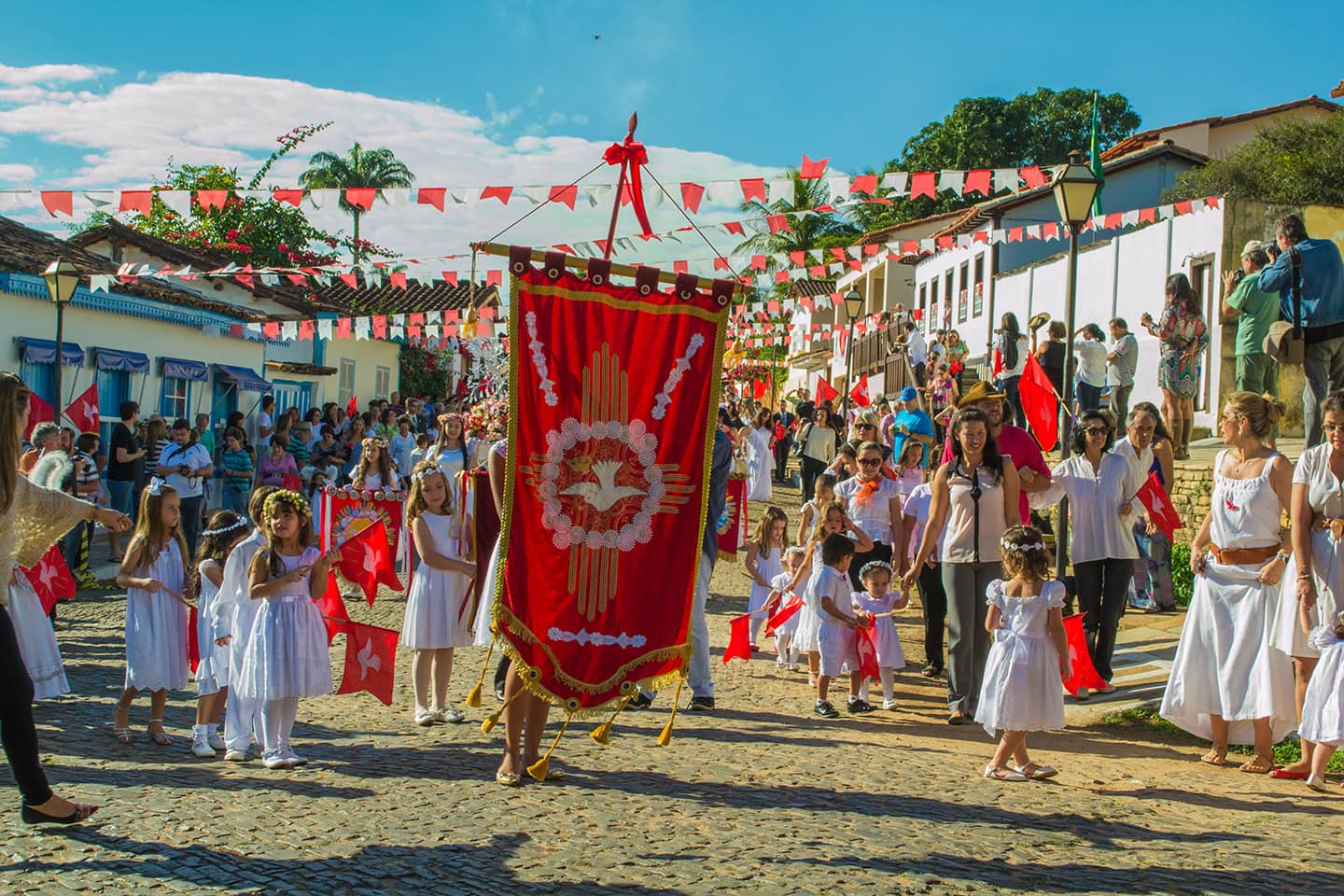
Welcome to the Feast of the Divine Holy Spirit, one of the most popular cultural and religious events in Brazil. Amid ancestral rituals and religiosity, this celebration unites believers and tourists in a journey of devotion and tradition.
As part of the Catholic tradition, this festival is based on the belief that Jesus Christ revealed the Holy Spirit, one of the three persons of the Trinity, who, according to belief, descended from heaven upon the Apostles and the Virgin Mary fifty days after Easter. This popular festival originated from the promise that Queen Isabel of Portugal made to the Holy Spirit, asking for peace to reign in her country. In the early celebrations, pilgrims carried a copy of the crown of the empire, whose main symbol was the dove. The faith of the Portuguese spread widely to various Brazilian cities during the colonial period and became deeply rooted in several regions, each incorporating its unique characteristics. It is an event that transcends the religious, involving music, dance, gastronomy, and symbolic acts that reflect Brazil’s cultural diversity.
The symbolism of this festival is very diverse, with the main symbols being the insignia of the Holy Spirit (crown, scepter, and mitre), which symbolize the responsibility and commitment of the feast to worship; the dove, which represents the Holy Spirit itself, peace, love, and humility; and the flag of the Divine, which is the symbol that initiates the festivities. After Lent, the red flag with the dove design visits the homes of the community, and the faithful kiss its fabric as a way to demonstrate their faith.
When and where does it take place?
The Feast of the Divine Holy Spirit occurs at different times of the year, varying according to local traditions. Its historical roots are present in various regions, such as the celebrations in Alcântara, Maranhão, Paraty, Rio de Janeiro, São João Del-rei, Minas Gerais, and São Luiz do Paraitinga, São Paulo. In Pirenópolis, one of the largest celebrations in the country, in the state of Goiás, the feast usually takes place between May and June, 50 days after Easter, becoming a notable tradition in the local calendar. The historic streets and colonial architecture of the city provide a charming backdrop for this vibrant celebration.
Activities
Cavalhadas
These are celebrations that occur during the Feast of the Divine, representing the battles between Moors and Christians, with dawn celebrations, masked participants, and theatrical presentations. In the religious part of the festival, there are novenas, masses, and processions. The most famous takes place in Pirenópolis, a historic city in the state of Goiás, attracting many tourists for over 200 years.
Crowning and Emperors
The highlight of the festivities in Pirenópolis is the coronation ceremony of the emperor, a major event that mobilizes the community. The processions through the historic streets create a visual and emotional spectacle.
Novenas and Processions
The novenas and processions in Pirenópolis gain a special atmosphere, with the fervent participation of local residents and visitors. Prayers and songs echo through the streets, creating a unique spiritual connection.
Source: Visit Brazil