



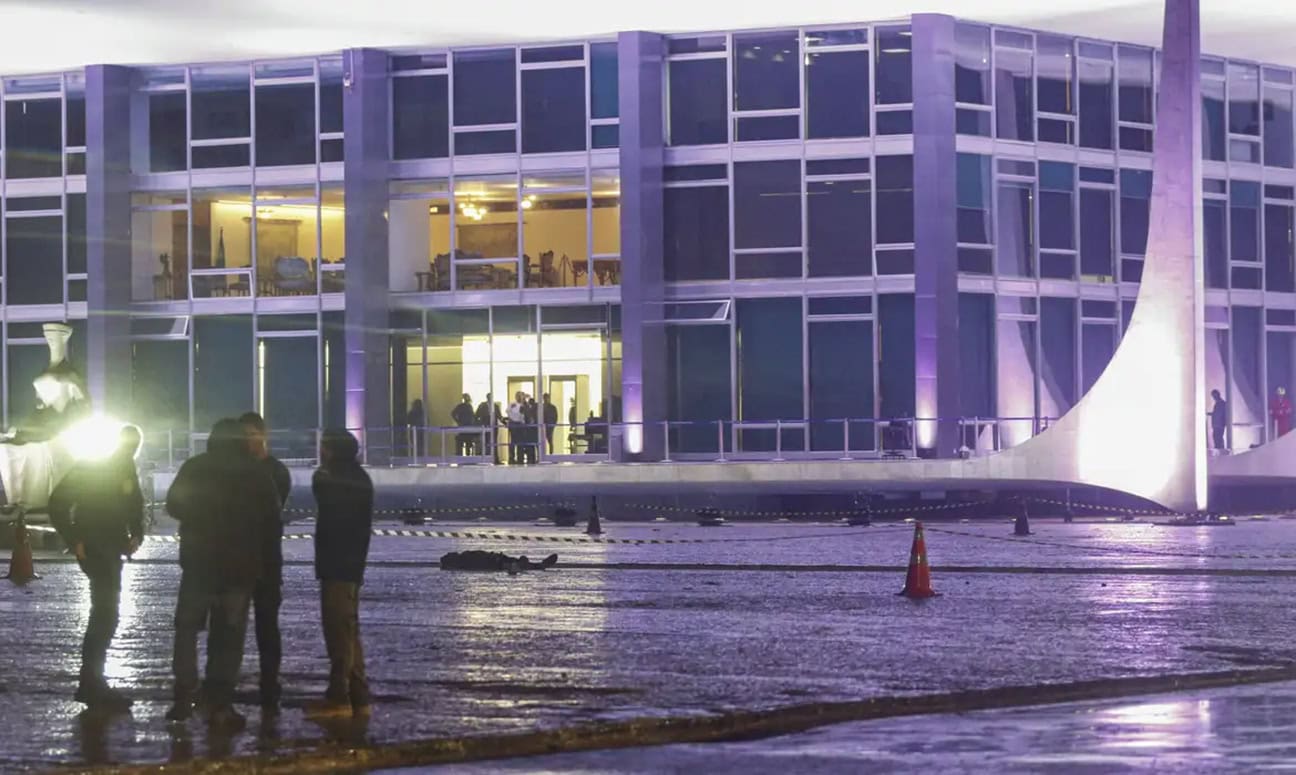
Two explosions occurred near the Supreme Federal Court on Wednesday night (13), leading to the evacuation of the area and killing one person, the attacker. According to authorities, no one else was injured.
The Brazilian police are considering the incident an act of terrorism.
“We understand that yesterday’s episode is not an isolated incident, but rather connected to several other actions that the Federal Police has been investigating recently,” said the director of the Federal Police.
The attacker, Francisco Wanderley Luiz, was a candidate for city councilor for the PL party, associated with former president Jair Bolsonaro, representing the city of Rio do Sul in the state of Santa Catarina in the 2020 elections.
Security camera footage from the STF shows Francisco throwing explosive devices towards a sculpture located in front of the Court building and then igniting another on his own body. Moments earlier, the man’s car also exploded in the parking lot near Annex IV of the Chamber of Deputies.
The police reported that explosive devices were found in the house rented by Francisco in Ceilândia, about 30 kilometers from downtown Brasília.
For STF Minister Alexandre de Moraes, the episode is a consequence of the political polarization that has taken over the country in recent years and what he called the “hate cabinet” set up during Jair Bolsonaro’s government.
“What happened yesterday is not an isolated incident. God willing, it is an isolated act, but in context, it is something that started back when the notorious ‘hate cabinet’ spread hate speech against institutions, the Judiciary, and especially the Supreme Federal Court. Against the ministers of the Supreme Federal Court and the families of the ministers. This grew, became larger, increasing the discredit of the institutions, resulting in January 8,” said the minister.
According to Moraes, the bombing attack committed by Francisco reinforces the need to eliminate any possibility of amnesty for those convicted for the attacks on January 8 against the headquarters of the Three Powers, as well as the need to regulate social media.
Source: The New York Times and Agência Brasil