



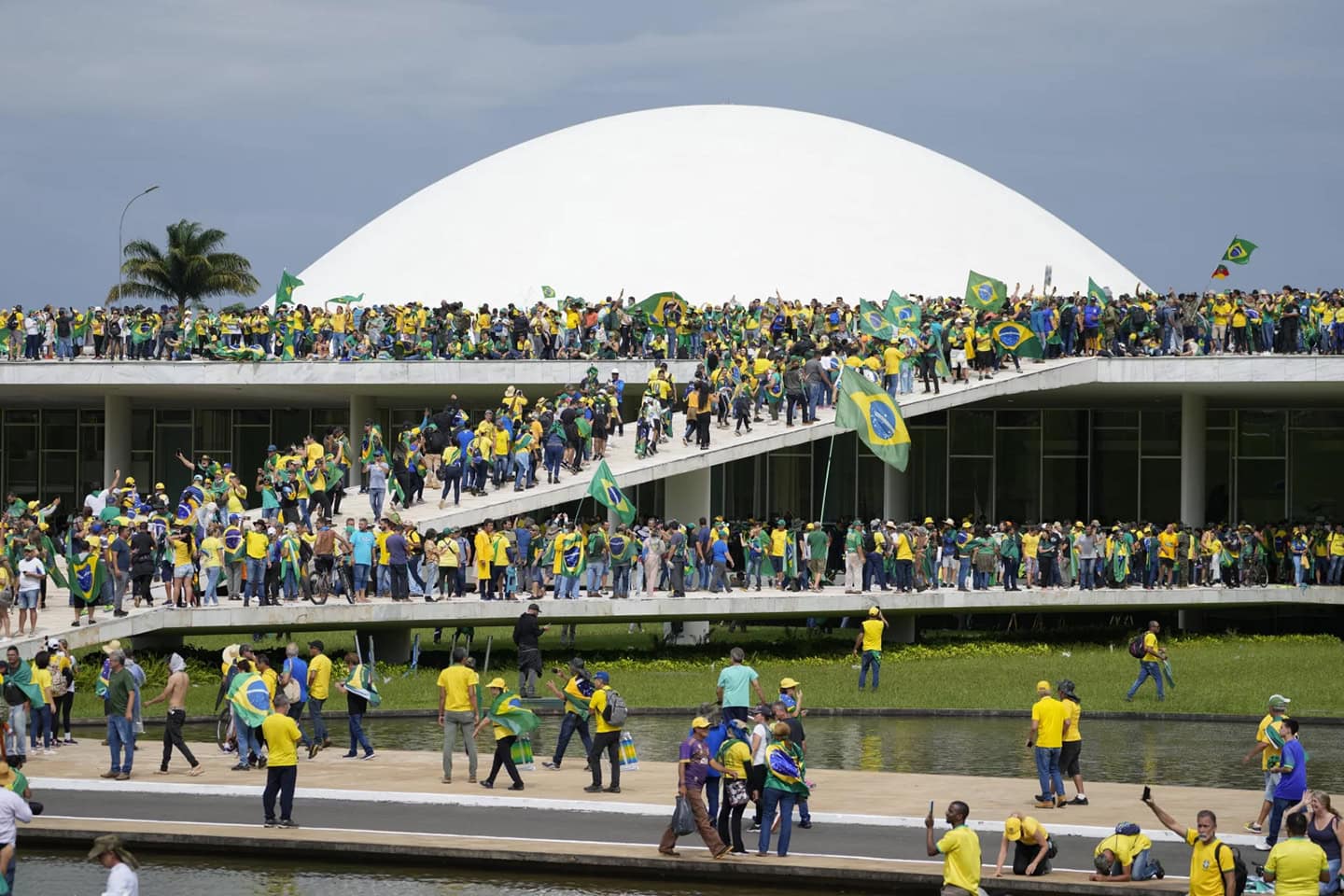
The final stage of former President Jair Bolsonaro’s trial is underway in Brazil — a historic debut, with the former leader accused of trying to overthrow democracy after his defeat in the 2022 elections.
Bolsonaro, 70, is accused of leading a broad criminal conspiracy to remain in power after his defeat to Luiz Inácio Lula da Silva. Brazil, the largest country in Latin America, returned to democracy just over 40 years ago after a brutal military dictatorship.
Prosecutors highlighted the role of military commanders who refused to support Bolsonaro’s alleged plan, helping to preserve constitutional order. Meanwhile, Brazil’s Supreme Federal Court is under intense scrutiny for its expanded powers and aggressive handling of the case.
Adding to the drama, US President Donald Trump — encouraged by Bolsonaro’s son, now living in the US — publicly condemned the trial. Trump called it a “witch hunt,” imposed 50% tariffs on Brazilian exports, and sanctioned several Supreme Court justices overseeing the case.
What are the charges?
Bolsonaro faces five charges brought by prosecutors and being judged by a panel of five Supreme Federal Court justices. The charges include attempting to violently end the Democratic Rule of Law, plotting a coup, and forming an armed criminal organization. There are two other charges related to damage to property and historic items during the January 8, 2023 riots by Bolsonaro supporters in government buildings in the capital Brasília.
The Attorney General of the Republic has been building the case against Bolsonaro for more than 18 months, based on evidence from more than half a dozen investigations. Prosecutors allege that Bolsonaro not only incited supporters to storm the capital but also led a group of at least four officials to remain in office. The alleged plan included plans to assassinate key political rivals, including current President Luiz Inácio Lula da Silva and Supreme Court Justice Alexandre de Moraes, who now oversees the case.
Also on trial are seven of Bolsonaro’s closest allies, including his former vice-presidential candidate, defense minister, and justice minister. His top former aide, Lieutenant Colonel Mauro Cid, struck a leniency deal with prosecutors, and his lawyers will speak first, followed by the others in alphabetical order by their clients’ names.
What is the evidence?
Prosecutors say they have volumes of evidence implicating Bolsonaro and the other defendants through seized documents, emails, social media communications, and cell phone calls.
Brazil’s top prosecutor, Paulo Gonet, argues that Bolsonaro was not just a passive observer but that the former president made “a conscious effort to create an environment conducive to violence and a coup.” He noted that the criminal organization led by Bolsonaro left an extensive trail of documents through “recordings, handwritten notes, digital files, spreadsheets, and electronic message exchanges.”
Some of the most damaging evidence, prosecutors say, comes from Bolsonaro’s trusted former aide Mauro Cid, who struck a leniency deal with the Attorney General of the Republic for a lighter sentence in exchange for his testimony.
Cid told investigators that Bolsonaro personally edited a draft decree — widely referred to as the “coup draft” — that outlined plans to annul the 2022 election results. The document called for the arrest of the Senate president and 3 Supreme Court justices to create a commission calling for new elections. Bolsonaro allegedly edited the document so that only Alexandre de Moraes — the justice now overseeing the trial — would be arrested.
Moraes has become a lightning rod for many on the right in Brazil and abroad who accuse him of judicial overreach not only in the Bolsonaro case but in others involving fake news dissemination, where he ordered the removal of social media accounts. He even clashed in a high-profile confrontation with Elon Musk over what he called disinformation being spread on the billionaire’s social media platform X.
What does Bolsonaro say?
Bolsonaro has long denied all charges and contests claims that he actively participated in a coup. He repeatedly points out that he wasn’t even in Brazil when his supporters stormed the capital. He left the country before President Lula took office and was living in Florida at the time.
He also denies any connection to an assassination plot. While he says he saw the “coup draft” document, he denies drafting or editing it.
He says any discussions about remaining in power that he may have participated in were just that, discussions, and always about how he could remain president legally and through constitutional means. He insists he did not try to enlist military support for a coup.
Bolsonaro’s lawyers also claim that Supreme Court Justice Moraes is biased against the former president, as is the federal police. They also say the leniency deal with the former leader’s trusted aide is unreliable and should be annulled.
Bolsonaro’s son, Eduardo Bolsonaro, a Brazilian congressman, urged US authorities to intervene on behalf of his father. Now based in the US, he has sought support from conservative allies, including many in Trump’s MAGA movement, to intervene for his father. In an interview with NPR, Eduardo Bolsonaro said his father is a victim of judicial abuse that has turned Brazil into an authoritarian dictatorship. “The only way we have to win this war against political persecution and censorship is with help from the Trump administration,” he said.
Why is Trump involved?
Bolsonaro’s presidential term (2019 – 2022) coincided with Trump’s first term in office, and the two conservatives enjoyed good relations. Trump stated that he relates to the “political persecution” that Bolsonaro now suffers from Lula’s leftist administration.
In July, Trump sent a letter to Brazilian authorities referencing the case against Bolsonaro as justification for imposing 50% tariffs on Brazilian exports to the US — one of the highest rates ever imposed on a country. On social media, Trump called the prosecution a “witch hunt” against a “good man” and promised to follow the trial closely.
Then, in a dramatic move, the US Treasury Department imposed one of its harshest sanctions on Justice Moraes under the Magnitsky Act, a measure typically used to punish foreign dictators and war criminals. The State Department then revoked US visas for multiple Brazilian high court judges. The ban also extends to their immediate family members. Only 3 of the 11 justices were spared from visa revocation.
What happens if Bolsonaro is convicted?
If convicted on the five charges, Bolsonaro and the other seven defendants face decades in prison. The most serious charges — plotting a coup and attempting to violently abolish the Democratic Rule of Law — each carry sentences of up to 12 years. The lesser charges of property and historic heritage damage carry 6 months to 3 years in prison. In total, Bolsonaro could be sentenced to more than 40 years in prison.
If convicted, Bolsonaro and the other defendants can appeal and have their case heard by the full Supreme Court. He is already barred from running in next year’s presidential election due to prior charges of spreading disinformation.
But Bolsonaro still has substantial political support in the country. There is talk of one of his sons or even his wife running in his place. And there is much hope among supporters that a strong win by an anointed successor next year could grant him a pardon and seek to remove Supreme Court justices involved in the case, especially lead judge Alexandre de Moraes.
What comes next?
The trial begins on Tuesday, September 2, with proceedings expected to last until September 12. The world — and especially the US — will be watching closely. A guilty verdict could trigger more US sanctions and deepen international tensions. Regardless of the outcome, the trial has the potential to reshape Brazil’s political landscape and send shockwaves far beyond Latin America.
Source: npr.org by Carrie Kahn