



In the past, women and girls were told what they should do to avoid street harassment — how they should dress, how they should or shouldn’t act, where they should walk. Recently, groups around the world are placing the responsibility for change where it belongs: on the perpetrators and the communities that tolerate them.
“The reason so many women and girls hear catcalls and are harassed every day has, contrary to popular belief, little to do with our appearance or how we are dressed,” said Yola Mzizi, founder of Catcalls of Chicago*. Instead, she says, it has everything to do with power, misogyny, and the desire of people to strip away the bodily autonomy of
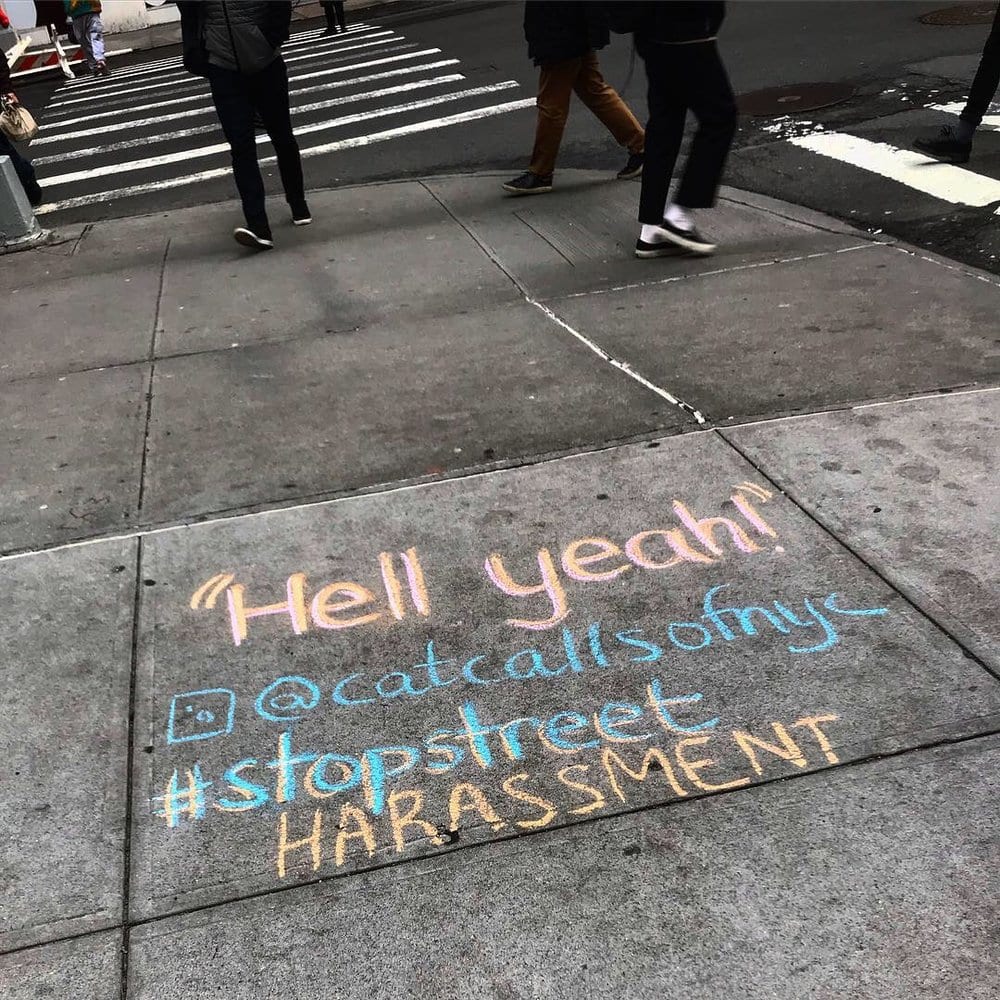 Photo: Catcalls of NY
women and girls.
Yola is one of many women around the world mobilizing to end street harassment through social media and grassroots campaigns that address the underlying causes of the problem.
Using Chalk
Catcalls of Chicago is part of Chalk Back — a social media movement started by Sophie Sandberg in New York — and one of 52 social media accounts worldwide virtually united to share experiences of street verbal sexual harassment, from Catcalls of Berlin to Catcalls of Bogotá.
By writing with chalk their experiences of verbal sexual harassment on the sidewalk where the harassment occurred, women in the movement hope to raise awareness in their communities about the problem.
“Accountability to me means calling something by its name,” says Karimot Odebode, founder of Catcalls of Nigeria*. “We can hold harassers and abusers accountable by having a law that protects everyone. A law in place that criminalizes street sexual harassment.”
Ending Harassment through Legislation
Two years ago, sisters Maya and Gemma Tutton started a national campaign, Our Streets Now*, to make verbal street sexual harassment illegal in England and Wales.
In England, two out of three girls and young women aged 14 to 21 have experienced street harassment, and one in three says it was when they were wearing school uniform, according to the UK division of the charity Plan International.
“I believe we can all agree that feeling safe is a basic requirement for living your life,” declares Maya Tutton*.
Empowering Thousands to Intervene
Women are not the only ones experiencing street harassment. Hollaback!*, an international online movement, has been encouraging women, LGBTQI+ community members, and people of color to report street harassment around the world through blogs and mobile apps since 2005.
With the ability to make community reports online, survivors of street harassment raise awareness about the extent of the street harassment problem in their cities.
The Hollaback! movement also offers educational programs in bystander intervention, so that when people witness street harassment, they can help safely interrupt the incident. In 2021, they empowered more people than ever — over 240,000 worldwide.
Preventing and responding to all forms of gender-based violence is the cornerstone of the U.S. government’s commitment to promoting democracy, human rights, and gender equality.
This year, the United States will release the first U.S. National Action Plan to End Gender-Based Violence.
Source: share.america.gov