



The Proclamation of the Brazilian Republic, also referred to in the History of Brazil as the Republican Coup or Coup of 1889, was a political-military coup that occurred on November 15, 1889, which established the presidential republican form of government in Brazil, ending the constitutional parliamentary monarchy of the Empire and, consequently, deposing the then head of state, Emperor D. Pedro II, who subsequently received orders to go into exile in Europe.
The proclamation took place at Praça da Aclamação (now Praça da República), in the city of Rio de Janeiro, then the capital of the Empire of Brazil, when a group of Brazilian army military personnel, led by Marshal Manuel Deodoro da Fonseca, deposed the emperor and assumed power in the country, instituting a provisional republican government that would become the First Brazilian Republic.
Background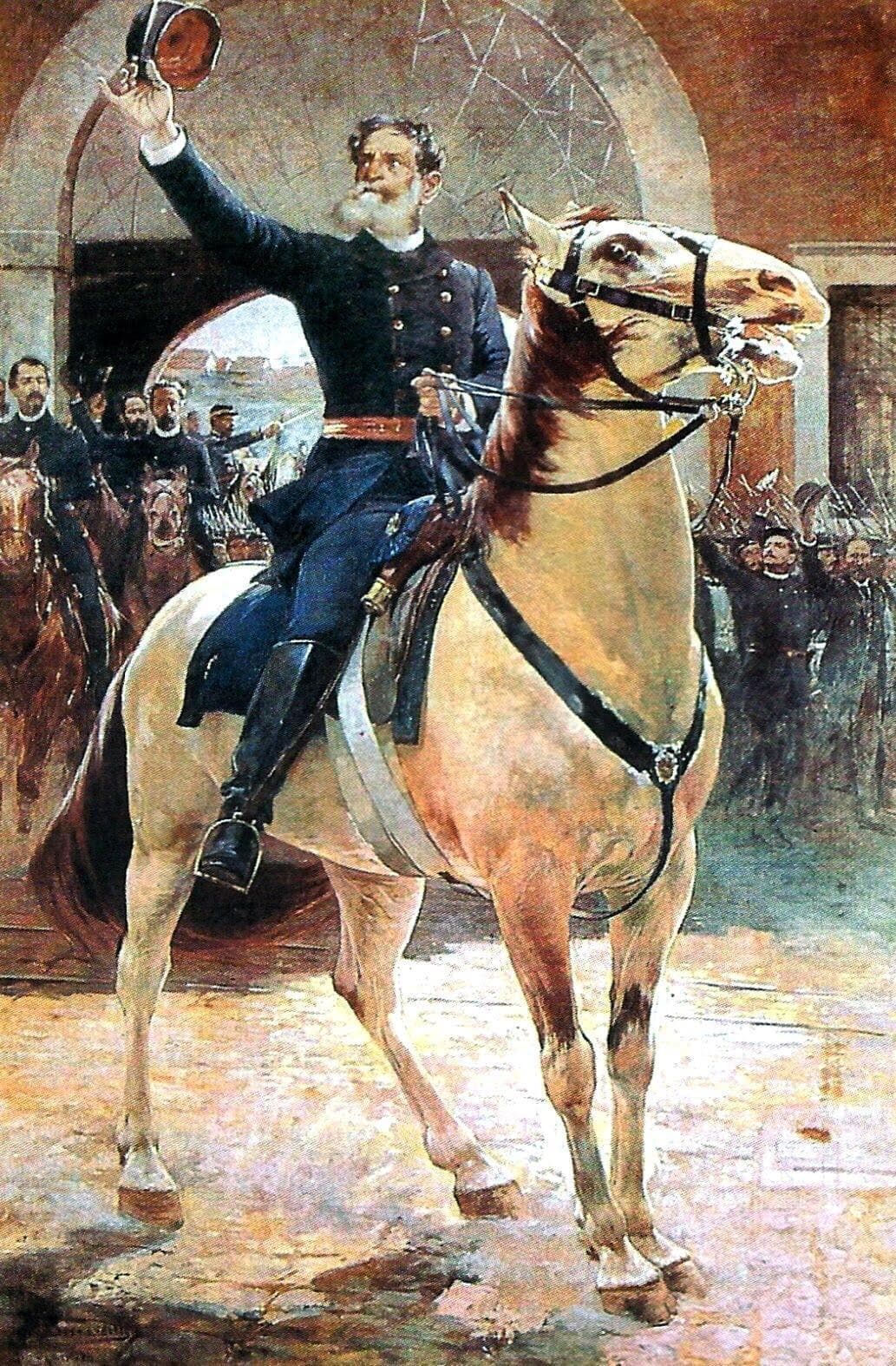 The movement of 1889 was not the first to attempt to establish a republic in Brazil, although it was the only successful one, and it is said to have had the support of the elites and the population in general:
• In 1789, the conspiracy known as Inconfidência Mineira sought not only independence but also the proclamation of a republic in the Captaincy of Minas Gerais, followed by political, economic, and social reforms;
• In 1817, during the Pernambucan Revolution — the only libertarian movement of the period of Portuguese domination that surpassed the conspiratorial phase and reached the revolutionary process of seizing power — the Republic was proclaimed for the first time in Brazil, and Pernambuco had a provisional government for 75 days;
• In 1824, Pernambuco and other provinces of northeastern Brazil (territories that once belonged to the Pernambuco province) created the independence movement known as the Confederation of Ecuador, also republican, considered the main reaction against the absolutist trend and the centralizing policy of the government of D. Pedro I;
• In 1839, in the wake of the Farroupilha Revolution, the Republic of Rio Grande and the Juliana Republic were proclaimed, respectively, in Rio Grande do Sul and Santa Catarina.
Brazil’s Politics in 1889
The imperial government, through the 37th and last ministerial cabinet — called the Ouro Preto Cabinet — under the command of the President of the Council of Ministers of the Empire, Afonso Celso de Assis Figueiredo, the Viscount of Ouro Preto, realizing the difficult political situation it was in, presented, in a last and desperate attempt to save the empire, to the General Chamber, the chamber of deputies, a program of political reforms which included, among others, the following measures: greater administrative autonomy for the provinces, freedom of voting, freedom of education, reduction of the prerogatives of the Council of State, and non-lifetime mandates for the Federal Senate. The proposals of the Viscount of Ouro Preto aimed to preserve the monarchical regime in the country but were vetoed by the majority of conservative deputies who controlled the General Chamber.
Monarchy Loses Prestige
Many factors led the Empire to lose the support of its economic, military, and social bases. From the conservative groups due to serious friction with the Catholic Church (in the “Religious Question”); due to the loss of political support from large landowners as a result of the abolition of slavery, which occurred in 1888, without compensation for slave owners.
From the progressive groups, there was criticism that the monarchy had maintained slavery in the country until very late. Progressives also criticized the lack of initiatives aimed at the country’s economic, political, or social development, the maintenance of a caste political regime, and censitary voting, that is, based on people’s annual income, the absence of a universal education system, high rates of illiteracy and poverty, and Brazil’s political distancing from all other countries on the continent, which were republican.
Thus, at the same time that imperial legitimacy declined, the republican proposal gained ground. However, it is important to note that the legitimacy of the Emperor was distinct from that of the imperial regime: While, on one hand, the population, in general, respected and liked D. Pedro II, on the other hand, they increasingly took less account of the empire itself. It was a common belief that there would not be a third reign, that is, the monarchy would not continue to exist after the death of D. Pedro II.
Economic Crisis
The economic crisis worsened due to the high financial expenses generated by the War of the Triple Alliance, covered by external capital. Brazilian loans rose from three million pounds sterling in 1871 to nearly 20 million in 1889.
Emperor D. Pedro II had no sons, only daughters. The throne would be occupied, after his death, by his eldest daughter, Princess Isabel, married to the Frenchman, Gastão de Orléans, Count d’Eu, which generated fear among part of the population that the country would be governed by a foreigner. The count was known for being arrogant, did not hear well, spoke with a French accent, and, in addition, owned tenements in Rio, for which he charged exorbitant rents from poor people. There was a fear that when Isabel ascended to the throne, he would become the de facto ruler of Brazil.
Abolitionist Question
The abolitionist question had been imposed since the abolition of the slave trade in 1850, finding strong resistance among the country’s traditional agrarian elites. In light of the measures adopted by the Empire for the gradual extinction 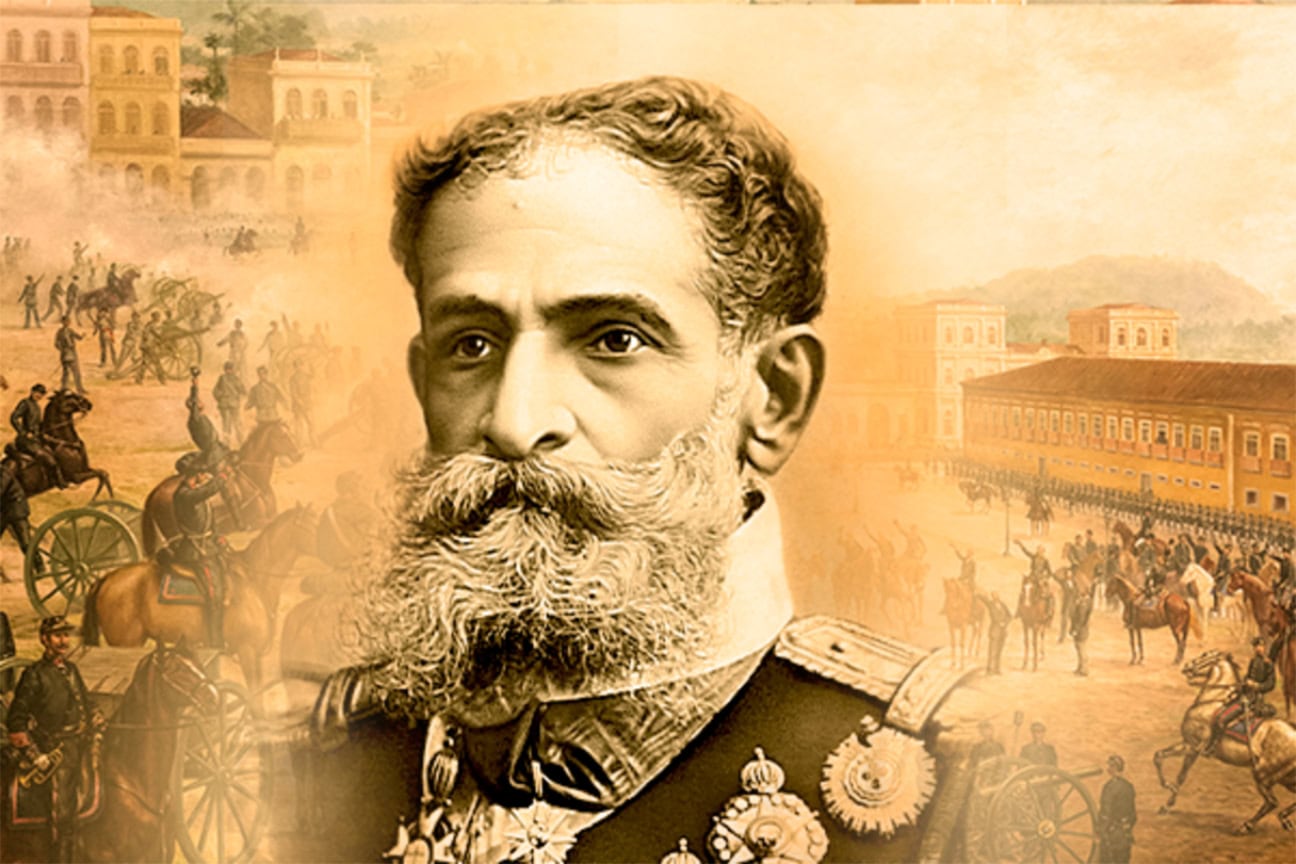 of the slave regime, due to the repercussions of the unsuccessful experience in the United States of the general liberation of slaves leading that country to civil war, these elites demanded from the State compensations proportional to the total price they had paid for the slaves to be freed by law. These compensations would be paid with external loans.
With the enactment of the Golden Law (1888), and by failing to compensate these large landowners, the empire lost its last pillar of support. Called “last-minute republicans” or Republicans of May 13, the former slave owners joined the republican cause, not out of sentiment but as a “revenge” against the monarchy.
In the view of progressives, the Empire of Brazil proved to be quite slow in solving the so-called “Servile Question,” which undoubtedly undermined its legitimacy over the years. Even the adherence of former slave owners, who were not compensated, to the republican cause, evidences how much the imperial regime was tied to slavery.
Thus, shortly after Princess Isabel signed the Golden Law, João Maurício Wanderley, Baron of Cotegipe, the only senator of the empire who voted against the abolition project, prophesied: “You have just redeemed a race and lost a throne!”
Religious Question
Since the colonial period, the Catholic Church had been subjected to the state. This remained after independence and meant that no order from the pope could take effect in Brazil without being previously approved by the emperor. It happened that in 1872 Vital Maria Gonçalves de Oliveira and Antônio de Macedo Costa, bishops of Olinda and Belém do Pará, decided to follow the orders of Pope Pius IX to exclude the Freemasons from the church on their own. As the Freemasons enjoyed a high level of influence in monarchical Brazil, the bull was not ratified.
The bishops refused to obey the emperor and were imprisoned. In 1875, thanks to the intervention of the Freemason Duke  of Caxias, the bishops were pardoned and released. However, the image of the empire deteriorated with the Catholic Church.
Military Question
The military had no decision-making autonomy over the defense of the territory, being subject to the orders of the emperor and the Cabinet of Ministers, formed by civilians, which took precedence over the orders of the generals. Thus, in the empire, most of the ministers of war were civilians.
The Brazilian Army military felt disrespected and undervalued. On one hand, the empire’s leaders were civilians, whose education was bachelor’s level, but resulted in highly paid and valued positions; on the other hand, the military had a more democratic selection and more technical training, but which resulted in neither professional valuation nor political, social, or economic recognition. Promotions in the military career were difficult to obtain and were based on personal criteria rather than merit and seniority.
The War of Paraguay, in addition to spreading republican ideals, highlighted to the military this devaluation of the professional career.
The Republicans and the Positivists
During the War of Paraguay, a greater interest in the republican ideal and Brazilian economic and social development began to develop among both military and summoned civilians.
Moreover, several groups were strongly influenced by Freemasonry (Deodoro da Fonseca was a Freemason, as was his entire ministry) and by the positivism of Auguste Comte, especially after 1881, when the Positivist Church of Brazil emerged. Its directors, Miguel Lemos and Raimundo T. Mendes, initiated a strong abolitionist and republican campaign.
The ideas of many republicans were conveyed by the newspaper A República. According to some researchers, the republicans were divided into two main currents:
• The evolutionists, who admitted that the proclamation of the Republic was inevitable, not justifying an armed struggle;
• The revolutionists, who defended the possibility of taking up arms to conquer it, with popular mobilization and social and economic reforms.
Although there were differences between each of these groups regarding political strategies for implementing the Republic and also regarding the substantive content of the regime to be instituted, the general idea, common to both groups, was that the Republic should be a progressive regime, opposed to the exhausted monarchy.
Military Coup and the Proclamation of the Republic
In Rio de Janeiro, republicans insisted that Marshal Deodoro da Fonseca lead the revolutionary movement that would replace the Monarchy with the Republic.
According to historical accounts, on November 15, 1889, commanding a few hundred soldiers moving through the streets of the city of Rio de Janeiro, Marshal Deodoro intended only to overthrow the then Chief of the Imperial Cabinet, the Viscount of Ouro Preto.
The military coup, which was scheduled for November 20, 1889, had to be brought forward, and in the early morning of November 15, Deodoro was willing to lead the movement of army troops that put an end to the monarchical regime in Brazil.
The conspirators went to Marshal Deodoro’s residence and convinced him to lead the movement. Crucial for Deodoro was knowing that the new President of the Council of Ministers of the Empire would be Gaspar Silveira Martins, an old rival. Deodoro and Silveira Martins had been enemies since the time when the marshal served in Rio Grande do Sul, when both competed for the attention of the Baroness of Triunfo, who, according to reports of the time, preferred Silveira Martins. Since then, Silveira Martins had not missed an opportunity to provoke Deodoro from the Senate podium, insinuating that he mismanaged funds and even questioning his effectiveness as a military man.
Moreover, Major Frederico Sólon de Sampaio Ribeiro had told Deodoro that a supposed arrest order against him had been issued.
Convinced that he would be arrested by the imperial government, Deodoro left his residence at dawn on November 15, crossed Campo de Santana, and on the other side of the park, called on the soldiers of the battalion stationed there, where the Palace of Duque de Caxias is located today, to rebel against the government. They offered a horse to the marshal, who mounted it, and, according to witnesses, took off his hat and proclaimed, “Long live the Republic!” He then dismounted, crossed the park again, and returned to his residence. The demonstration continued with a parade of troops down Rua Direita, now Rua 1.º de Março, to the Imperial Palace.
The rebels occupied the headquarters of Rio de Janeiro and then the Ministry of War. They deposed the ministerial cabinet and arrested its president, Afonso Celso de Assis Figueiredo, Viscount of Ouro Preto. At the Imperial Palace, the Viscount of Ouro Preto had tried to resist by asking the commander of the local detachment, General Floriano Peixoto, to confront the mutineers. The Viscount of Ouro Preto reminded Floriano Peixoto that he had faced much larger troops in the War of Paraguay. However, General Floriano Peixoto refused to obey the orders given by the Viscount of Ouro Preto and justified his insubordination, responding to the Viscount: “Yes, but there we had enemies in front of us, and here we are all Brazilians!”
Then, joining the republican movement, Floriano Peixoto arrested the government chief, Viscount of Ouro Preto.
It is said that Deodoro did not criticize Emperor D. Pedro II. Reports say it was a strategy to avoid bloodshed. It was known that Deodoro da Fonseca had Lieutenant Colonel Benjamin Constant on his side and at that moment also some civil republican leaders.
On the afternoon of the same day, November 15, the Republic was solemnly proclaimed at the Municipal Chamber of Rio de Janeiro.
At night, at the Municipal Chamber of the Neutral Municipality, Rio de Janeiro, José do Patrocínio drafted the official proclamation of the Republic of the United States of Brazil, approved without a vote. The text was sent to the printing houses of newspapers that supported the cause, and only the next day, November 16, was the change of the political regime in Brazil announced to the people.
Upon learning of the coup, the Emperor acknowledged the fall of the Ouro Preto Cabinet and sought to announce a new name to replace it. However, as nothing had been said about the Republic until then, the republicans spread the rumor that the Emperor had chosen Gaspar Silveira Martins to be the new head of government. Deodoro da Fonseca then convinced himself to join the republican cause. The Emperor was informed of this and, disillusioned, decided not to offer resistance.
On the following day, Major Frederico Sólon de Sampaio Ribeiro delivered to D. Pedro II a communication, informing him of the proclamation of the Republic and ordering his departure for Europe, in order to avoid political disturbances. The Brazilian imperial family went into exile in Europe, only being allowed to return to Brazil in the 1920s.
Controversies
With the proclamation of the Republic, “according to all probabilities,” Brazil would also end, thought the Portuguese writer Eça de Queirós at the end of the 19th century.
The sociologist Gilberto Freyre understood that Eça de Queirós was completely wrong: “A prophecy that in no way came true. And it did not come true because it lacked almost entirely sociological consistency; or was based only on a narrow parasociology, at most, political; and this almost entirely logical. Logical and from the cabinet: not even intuitive in its prophetic boldness […] The “intimate heart” of Brazilians in the period that followed the proclamation of the republic, if examined closely […] would show that there was a national unity among the people of Brazil, from North to South of the country, already so strong, regarding beliefs, customs, feelings, games, and toys of that same people, almost all of them of patriarchal, Catholic, and Iberian formation in the predominance of their characteristics, that it would not be with the simple and superficial change of political regime that that set of values and constants would suddenly disintegrate!”