



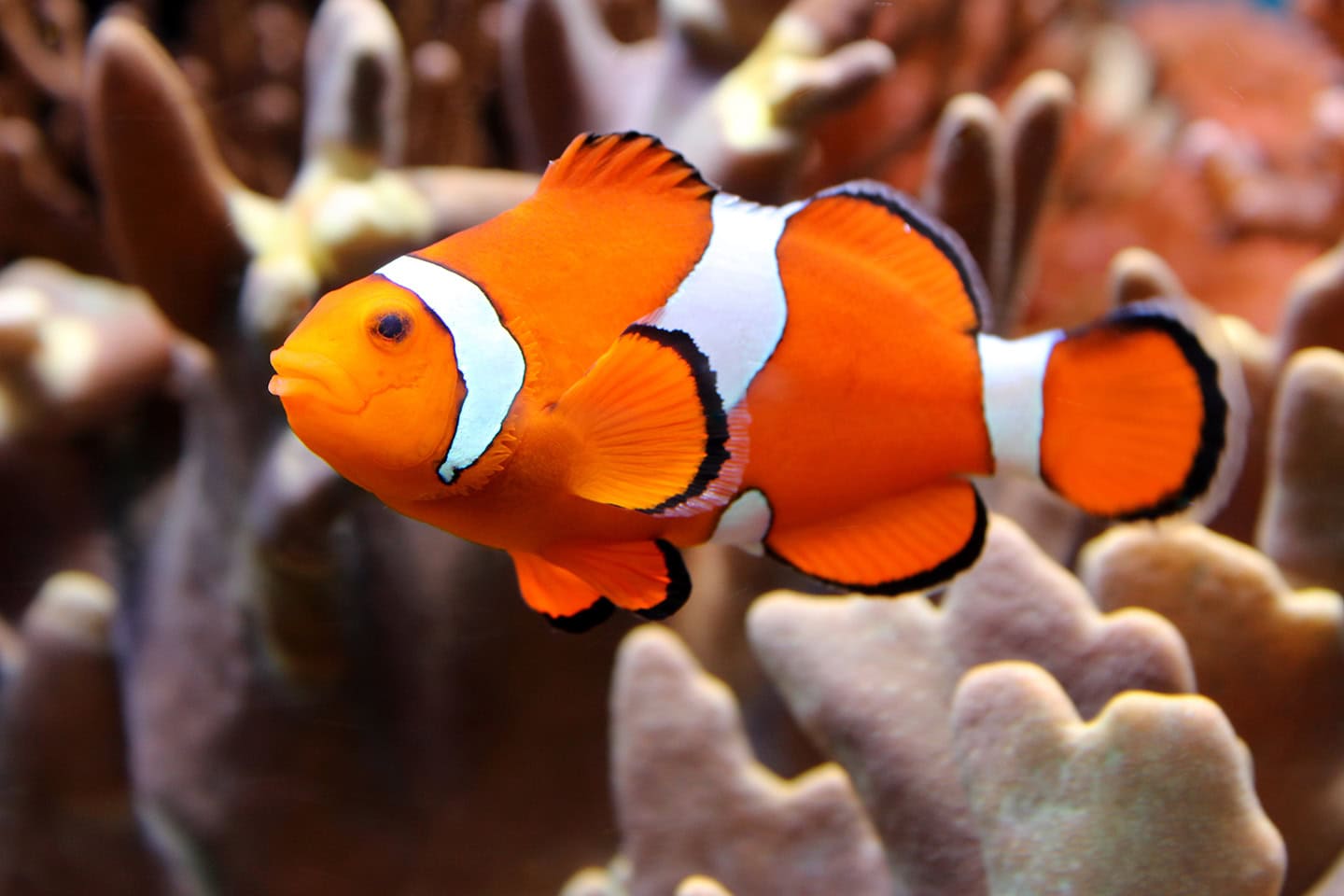
In the Disney movie Finding Nemo, the clownfish Marlin worries that his son Nemo might have suffered an injury and asks him to count how many stripes he has. Nemo gets the answer right — three.
But in another species, the tomato clownfish, all but one of those stripes disappear as the young fish mature.
Now, in an article published in PLOS Biology, researchers present a set of experiments that appear to explain what triggers the change in appearance — both environmentally and genetically. They say that the tomato clownfish, in response to an unpredictable world, seems capable of flexibly adjusting when it loses its stripes based on signals from other fish and its habitat.
In particular, the presence of a pair of adult tomato clownfish in a real anemone accelerates the fading of the stripes, suggesting that the young fish can alter their physical appearance to help them find a position (or a fin) in the local social hierarchy.
A Small Fish with a Big Personality
The adult tomato clownfish lives among the tentacles of bubble anemones in the western Pacific Ocean. It’s an impressive little creature, “especially the females, they have a darker red color, like tomato,” says Laurie Mitchell, marine biologist at the Okinawa Institute of Science and Technology. “The male is much smaller and tends to have a lighter coloration.”
What all adults share, however, is “a single white stripe on the head,” says Mitchell.
But tomato clownfish juveniles, who are only a few weeks old, have two to three white stripes — one on the head, one on the body, and sometimes one on the tail. At least, that’s how they start when they first settle in an anemone and enter the strictly enforced pecking order of the older tomato clownfish already present.
“It’s the beginning of their socialization,” says Mitchell. “It’s when they first interact with others of the same species to form a functional social hierarchy.”
If they don’t integrate properly, the adults bite the young fish severely or expel them from the anemone, which is “certain death,” says Mitchell.
The young fish that successfully join an anemone end up losing all the stripes except one — ending up, in the end, with just the white stripe on the head.
“The timing of this loss is really plastic,” he says. “It’s highly variable,” happening at some point between about one and 12 months of age.
Mitchell knew from other work that a different species of clownfish (the classic Nemo variety) uses the amount of white coloration to identify members of its own species — and increase its aggression accordingly. He wondered if the color change in the tomato clownfish could also be a form of social signal. So, he and his colleagues decided to investigate what led to the disappearance of those white bars — and what that might mean for the fish.
Four Tanks, One Unmistakable Conclusion
The first step was to raise tomato clownfish fry in the laboratory.
“They are quite fragile as larvae,” says Mitchell. “They are basically like human babies, very demanding.”
They eat only live zooplankton. They are also quite sensitive to light and water quality. It took time, but Mitchell succeeded.
Then, he carefully transferred the nearly three-week-old fish to one of several experimental tanks. The first had only water. The second contained water and a plastic anemone. In both of those tanks, 20 days later, the juvenile fish more or less looked the same — “the solid white bars still quite visible,” says Mitchell.
The third tank contained a live anemone. There, the white stripes faded only slightly after 20 days.
It was in the fourth tank — the one with a live anemone inhabited by a pair of adult clownfish — that things were different. The juveniles quickly began to lose all their stripes except the one on the head.
After those same 20 days, “they were almost completely invisible,” says Mitchell. “They had completely diffused into the surrounding reddish-orange skin.”
At 62 days of age (so, almost a month later), all the fish in the tanks with the live anemone alone had also lost all the stripes except the one on the head.
Mitchell found a series of changes in gene expression likely responsible for the color change, including those associated with cell death. The cells that produce the white coloration were “basically fragmenting, shrinking, and dying,” he says. And Mitchell discovered that hormones produced by the fish’s thyroid may have been responsible for triggering the change in gene expression.
Color Coding for Hierarchy
Here’s the dynamic that Mitchell believes sets the color change in motion: When young fish first arrive at an anemone in the wild, their small size and multiple stripes signal that they are not a threat to the pecking order.
“They are almost reclusive — they go between the tentacles,” he says. “But after that, there’s no need to maintain that multiple-bar form because, when it disappears, they have already integrated into the hierarchy, and the function has been fulfilled. Even being a low-ranking member, you are still a member.”
And with live anemones alone, perhaps “the juveniles become more territorial in what is perceived as a more optimal habitat,” says Mitchell. “So, you essentially get the same social pressure, but weaker.”
In summary, the tomato clownfish flexes when it loses its stripes to fit into its new social group.
“This is an incredibly interesting article,” says Theresa Rueger, coral reef ecologist at Newcastle University, who did not participate in the research. “You get the ecological side of the story, understanding how the fish live their lives. But you also get the mechanisms to understand how animals change these colors as they grow.”
She says this offers insights into biodiversity more broadly — and how coloration is both influenced by the social environment and used as a signal within it.
“What they really nail here is the mechanism,” says Peter Buston, marine evolutionary ecologist at Boston University, who also did not participate in the study. He reflects on the diversity of color changes among different clownfish species, including those that add stripes as they age instead of losing them. “It’s interesting to me that different social systems may have exploited this signaling potential in different ways,” he says.
In other words, clownfish of all stripes offer researchers a lot to learn — within a very colorful school.
Source: npr.org