



It’s easy to take for granted that modern humans can summon flames with the snap of a lighter or the turn of a stove knob—cooking food, lighting candles, or heating homes.
For much of our history, archaeologists believe, primitive humans could only use fire when it arose naturally, such as when lightning struck a tree. They could gather burning materials, transport them, and keep them alight. But they couldn’t start a fire on their own.
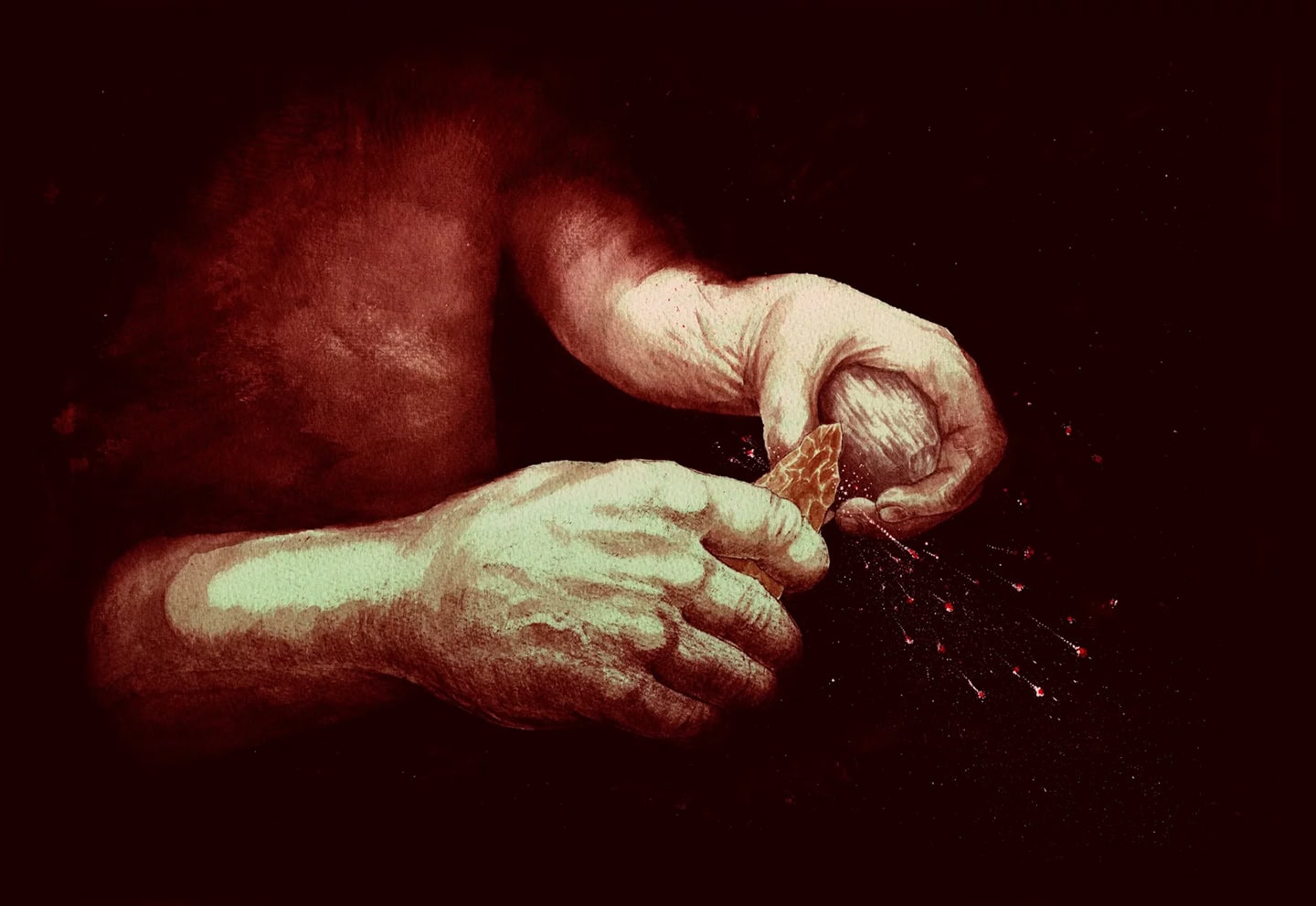
At some point, somewhere, that changed. A primitive human discovered that by rubbing two sticks together or striking certain types of stones against each other at the right angle with the right force, they too could create fire.
Archaeologists have long wondered when this discovery occurred. A new study, published in the journal Nature, provides the oldest evidence to date from a site in eastern Britain.
“This is a 400,000-year-old site where we have the oldest evidence of [humans] making fire—not just in Britain or Europe—but anywhere else in the world,” said Nick Ashton, an archaeologist at The British Museum and one of the study’s authors.
The discovery suggests that primitive humans produced fire more than 350,000 years earlier than previously known.
“For me, personally, it’s the most exciting discovery of my 40-year career,” Ashton said.
What makes the site so unique is that Ashton and his colleagues found the raw materials for making fire—fragments of iron pyrite next to fire-cracked flint hand axes in what appears to be a hearth. A geological analysis revealed that pyrite is incredibly rare in the area, suggesting that primitive humans brought it to the site with the intention of using it to start fires.
“As far as we know, we don’t know of any other uses for pyrite besides making sparks with flint to start fires,” said Dennis Sandgathe, an archaeologist at Simon Fraser University who did not participate in the new study. “And of all the dozens and dozens of sites from Eurasia to Africa that we’ve excavated and that have fire residues, no one had discovered a piece of pyrite before.”
The ability to make fire, archaeologists agree, is one of the most important discoveries in human history. It allowed primitive humans to ward off predators, extract more nutrients from food, and settle in inhospitable climates.
 The ability to sit around a campfire at night would also have been a catalyst for social and behavioral evolution.
“Having fire provides that kind of intense socialization time after dark,” said Rob Davis, an archaeologist at The British Museum and a co-author of the study. “And that will be really important for other developments, like the development of language, the development of narratives, early belief systems. And those could have played a critical role in maintaining social relationships over greater distances or within more complex social groups.”
Davis and his co-authors don’t know the identity of the people who used the site. But less than 100 miles to the south, archaeologists found fragments of a skull from the same period that could belong to a Neanderthal. “So we assume that the fires at [the site of the new study] were being made by primitive Neanderthals,” said Chris Stringer, an anthropologist at the Natural History Museum in the UK and one of the study’s co-authors.
It’s possible that other primitive humans, including Homo sapiens, also had the ability to make fires, Stringer said. But it’s hard to say with any degree of certainty.
Sandgathe, who has been investigating the use of fire by primitive humans for decades, said the discovery is very significant but cautioned that it should not be used to make broad generalizations about the use of fire by primitive humans.
Modern humans have long assumed that the discovery of how to make fire was such an important technology that, once found, it would spread rapidly across the Old World like, well, wildfire—and from then on everyone everywhere would use it.
“Now we realize that was too simplistic,” he said. The most likely scenario, according to Sandgathe, is that different groups of primitive humans accidentally discovered how to make fire at different times. The knowledge may have spread or may have been lost.
“It’s not a linear story,” he said. “It’s a complex story of many advances and setbacks, here and there—and many millennia when no one knew how to make fire until it was rediscovered.”
Source: npr.org by Nathan Rott