



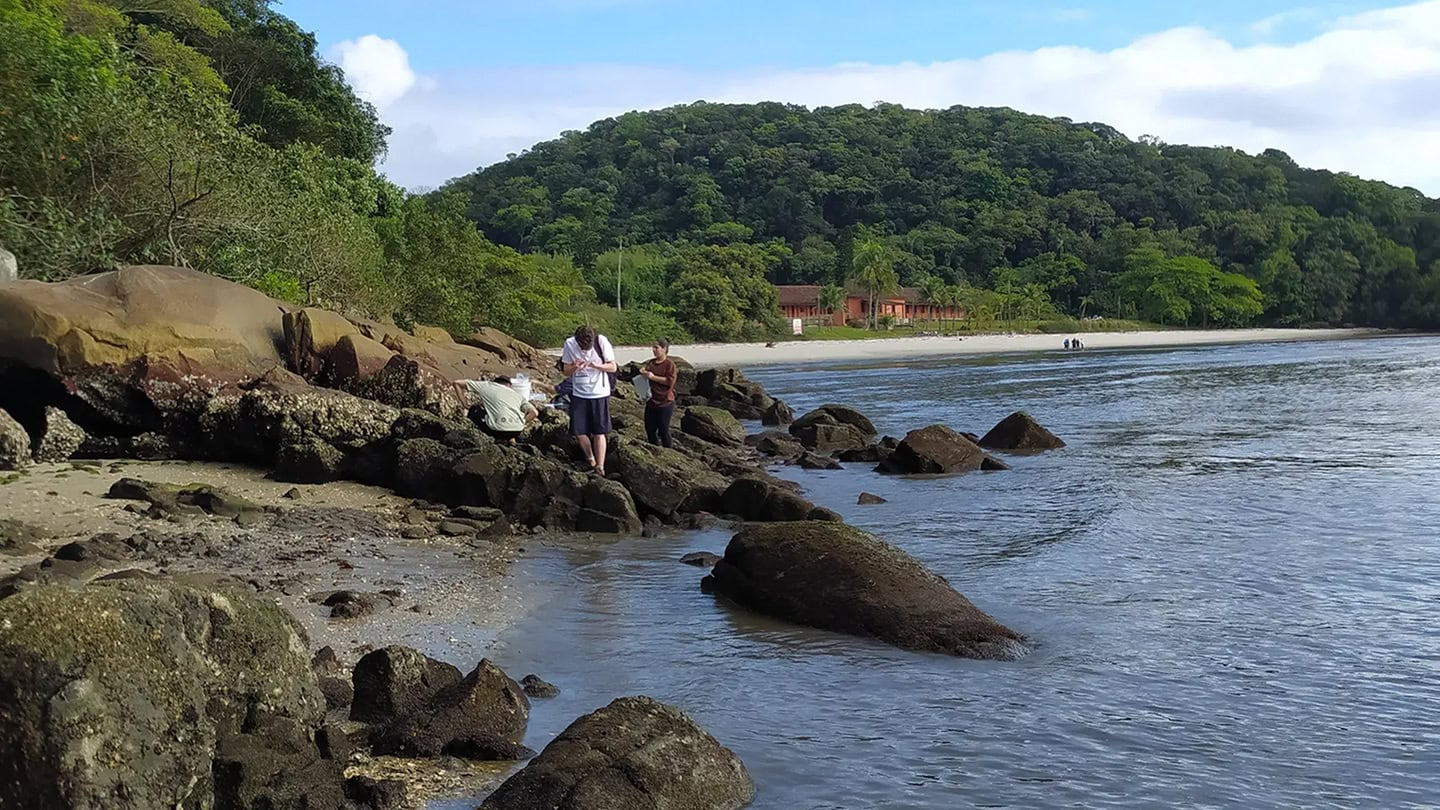
While the 2025 United Nations Climate Change Conference (COP30) gathered researchers and world leaders in Belém (PA) to discuss mitigation and adaptation strategies, local initiatives show how science and communities can work together on the front lines of environmental conservation. On the coast of Paraná, the Marés de Mudança project, developed by the Fundação de Apoio ao Desenvolvimento da Universidade Estadual do Paraná (FUNESPAR), with support from the Programa de Biodiversidade Litorânea do Paraná (BLP), is an example of this integration.
Executed in the Paranaguá Estuarine Complex (CEP), one of the country’s most ecologically important areas, the project identifies and assesses how non-native benthic species — organisms that live on the seafloor, such as mollusks and crustaceans — behave in a scenario of warming waters and altered environmental conditions, evaluating the impacts on port activities, local communities, and Conservation Units (UCs).
According to the project coordinator, biologist Rafael Metri, a professor at the Universidade Estadual do Paraná (UNESPAR), the research is aligned with the United Nations Decade of Ocean Science, aiming to raise awareness about the importance of the oceans and mobilize public and private actors, as well as civil society organizations (CSOs), in actions that promote the health and sustainability of the seas.
“Pesquisamos a biodiversidade de organismos bênticos, especialmente em costas rochosas e substratos artificiais. Esses organismos refletem com precisão as condições ambientais e, quando o cenário muda, algumas espécies mais tolerantes acabam prevalecendo”, explica.
According to the biologist, introduced species tend to be more resistant to environmental variations. “In impacted areas, where native biodiversity is compromised, they establish more easily. We have already observed an increase in marine heatwaves and their influence on the abundance of native and invasive species”, he adds.
The Paraná coast, recognized by the United Nations Educational, Scientific and Cultural Organization (UNESCO) as a World Natural Heritage site, hosts the most preserved remnants of the Atlantic Forest in the country, vast mangrove areas, and traditional communities that directly depend on marine resources. In light of this, climate change and the presence of invasive species threaten both biodiversity and the local economy.
“Any activity that affects the vulnerability of communities and ecosystems needs to be carefully evaluated. In a port region with high vessel traffic, bioinvasion is an impact that must be monitored”, emphasizes Metri. “The ecosystem services of rocky reefs are essential for maintaining biodiversity, fishery resources, and ecological cycles. But these services are threatened by warming waters and acidification, aspects that we seek to understand better”, the researcher adds.
Main Impacts
Among the observed impacts are direct damages to artisanal fishing, with invasive species competing with natives and altering the ecological balance. Non-native oysters and crabs have affected fishermen’s income and required adaptations in traditional practices.
The hooded oyster (Saccostrea cuccullata) has dominated mangrove and coastal areas, replacing native oysters used for consumption and trade. Smaller and with an inferior flavor, it is harder to open and can cause injuries due to the sharp edge of its shell. The invasive blue crab (Charybdis helleri), meanwhile, competes with native species captured by traditional communities. There are also records of non-native bryozoans, which tangle in nets, reduce fishing efficiency, and increase fishermen’s effort.
These reports were collected in conversations with local fishermen and restaurants, within a citizen science process led by the Marés de Mudança project team. In addition to generating a database on non-native marine species, the project promotes environmental education and citizen science, involving communities and institutions such as the Federal Public Prosecutor’s Office (MPF), the Paraná Public Prosecutor’s Office (MPPR), the Chico Mendes Institute for Biodiversity Conservation (ICMBio), the Water and Earth Institute (IAT), and universities such as the Universidade Estadual do Paraná (UNESPAR), the Federal Institute of Paraná (IFPR), the Federal University of Paraná (UFPR), and the University Center for Studies and Research on Disasters (CEPED).
“We have research groups, environmental managers, and communities working together for a healthy marine environment. In port regions, this interdisciplinarity is essential and, amid climate change, even more urgent”, affirms Metri.
Port environmental licensing processes have incorporated diagnostics and non-native species monitoring programs, driven by the joint action of academia, environmental agencies, and the Public Prosecutor’s Office. According to Metri, “the project shows how science, management, and communities can work together for coastal conservation and adaptation to climate change. Conserving coastal zones requires joint action, promoting resilience and sustainability”, he emphasizes.
The Program Boosted Research
Lasting two years with an investment of over R$ 640,000 from the Programa de Biodiversidade Litorânea do Paraná, the project adopts an interdisciplinary approach including collection, species characterization, and participatory mapping, enabling more accurate monitoring and understanding of their spread.
The collected information will be compiled into a public database, fostering collaboration between institutions and communities. Awareness materials are also being developed to educate the public on the importance of managing invasive species, contributing to the conservation of coastal ecosystems and the enhancement of environmental management tools, such as management plans and protected area councils.
About the Programa de Biodiversidade Litorânea do Paraná
Created in 2021, the Programa de Biodiversidade Litorânea do Paraná promotes conservation, research, and the responsible use of natural resources, strengthening Conservation Units and driving sustainable development along the Paraná coast. Funded by the Judicial Conduct Adjustment Term (TAJ) signed after the 2001 oil spill, the Program turned an environmental liability into a historic investment in conservation: over R$ 110 million will be allocated to strategic initiatives over ten years.
The Program’s governance is shared among civil society organizations, higher education institutions, and the Chico Mendes Institute for Biodiversity Conservation (ICMBio), with oversight by the Federal Public Prosecutor’s Office and the Paraná Public Prosecutor’s Office. Financial and operational management of the Program is handled by the Brazilian Biodiversity Fund (FUNBIO). To learn more, visit www.biodiversidadelitoralpr.com.br.
Source: brasil247.com