



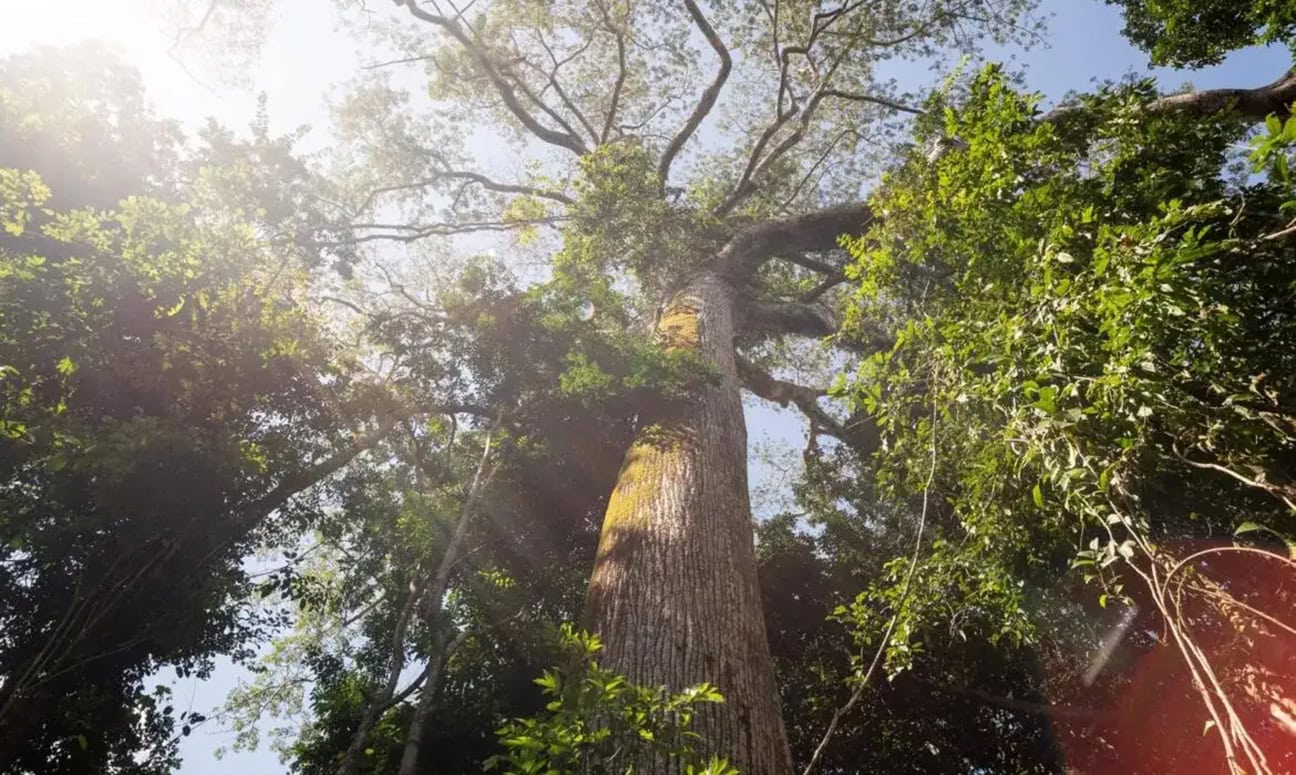
A huge capacity to capture carbon dioxide, a vital role in rain distribution, and the ability to record Amazon cycles – these are some of the services provided by the giant trees of northern Brazil, especially the angelim-vermelho – Dinizia excelsa – a species that can grow over 80 meters tall.
The presence of their specimens in the Amazon forest was recently documented. The first giant trees were found in 2019. In 2022, an 88.5-meter-tall angelim-vermelho tree – equivalent to a 30-story building – was revealed as Brazil’s tallest tree, located in the municipality of Almeirim, in the state of Pará.
In total, 20 specimens over 70 meters tall were spotted in an area stretching along the Jari River, on the border between the states of Pará and Amapá. The scientist who made the discovery immediately began studies to better understand the conditions that led to their growth and assess their full potential.
Studies
“These trees are nearly double the average height of Amazonian species, which are around 40 to 50 meters. We’re talking about trees that absorb double the carbon and, therefore, can contribute double to climate regulation,” said Diego Armando Silva, a researcher at the Federal Institute of Amapá.
The studies are still ongoing, but some theories are already promising. “A single tree of this type can represent 80% of the biomass in a hectare around it,” he highlighted.
This estimate implies that a single individual with these characteristics may be able to absorb 80% of the carbon dioxide from the entire studied area. However, Silva explained that additional studies are needed to assess whether these trees also emit large volumes of carbon dioxide and how much they contribute to capturing and releasing water into the atmosphere, as well as to confirm their age.
“We were in contact with a group of researchers interested in the age of cedars, a species with clear growth rings, around the angelim trees. They found that they are about 260 years old. Based on that, we estimate that these angelim-vermelho trees are 400 to 500 years old,” he stated.
Threat
Despite holding answers to many questions about the Amazon biome, these centuries-old trees may be threatened by climate change. And as they are scattered over a large area, each occupies a territory with a different level of protection.
While the tallest is in Pará, the second – at 85.4 meters tall – is in Laranjal do Jari, in the neighboring state of Amapá. “Even though Amapá is a state notoriously covered by protected areas, we have two striking circumstances. The first is that many giant trees are outside conservation units, and the second is that commercial exploitation of angelim-vermelho is permitted,” said Ângela Kuczach, executive director of the NGO Rede Pro-Unidades de Conservação.
Protection
The NGO led by Kuczach is part of a campaign titled Proteja Árvores Gigantes, promoted by the institute O Mundo Que Queremos (“The World We Want”), in partnership with environmental organizations and researchers. The movement, according to her, works to mobilize society and pressure public authorities for greater protection, so that future generations can know these specimens.
“Brazil’s tallest angelim-vermelho tree today is the third tallest tree in the world. When it was discovered, it was located in a state forest, the Flota do Paru, which is a conservation unit that allows timber extraction. That’s what this category is for, forest management,” Ângela recalled.
The mobilization resulted in the creation of the Parque Ambiental Estadual das Árvores Gigantes da Amazônia in September 2024 – a full protection conservation unit with 560 hectares. The new territorial classification, she added, is a major advance, but by itself does not keep the giant trees out of danger.
“We’re talking about an area with a lot of mining around it. The region is seriously threatened by deforestation and land grabbing,” she observed.
Process
According to Nilson Pinto, president of the Pará State Institute of Forest Development and Biodiversity, efforts to finalize the park are underway. “We launched a public call for people, entities, authorities, and residents to qualify to join its management council. We’re in that process now. This is essential because it’s up to the council to approve the management plan, prepared by our institute with support from the Fundação Amazônia Sustentável,” he said.
The institute is a state autarchy responsible for managing conservation units in Pará. According to Nilson Pinto, surveillance in the Floresta do Paru and its surroundings already plays a strong protective role.
“The state forest of Pará is really well preserved. What we have there, which is normal in a state forest – basically intended for forest management – is a number of companies doing forest management under our supervision and very little deforestation, very little indeed,” he declared.
The difficult access to the giant trees’ location adds extra protection to the specimens, he continued.
Solutions
Ângela Kuczach believes protection must be intensified and science used to find new ways to reduce the number of giant trees felled outside the identified territory. “We might have the biggest giant tree of all still to be discovered, and it may already be threatened because it could be outside a conservation unit,” she argued.
Researcher Diego Armando Silva advocated advancing research and monitoring to protect the already known giant trees and locate new ones. “The first steps are creating a management committee and a management plan, which could include a visitation plan for the trees, environmental education, research, and data management, so we can also receive researchers from all over Brazil and the world,” he concluded.
Source: Agência Brasil