



It’s a crowded night at the McDonald Observatory, where dozens of people crowd around high-powered telescopes as a storm advances to the east.
Local residents and visitors from across the country come here to experience a vanishing and free natural resource: some of the darkest night skies in the world.
From the top of the observatory in the Davis Mountains, in Far West Texas — about 6,800 feet above sea level —, it’s possible to see how far the desert stretches and the night sky seems almost within reach. Under the starry canopy of this night, couples embrace, heads tilted to the sky, and children hop from telescope to telescope to glimpse the celestial spectacle.
“It’s simply amazing to look up and see all these different constellations,” said Maya Howitt. The girl is here with her parents, Emma and Cameron Howitt, and the three take turns looking through a telescope pointed at a pair of stars in the “handle” of the Big Dipper. “I feel like I’m in a dream every time I look up here.”
About 75,000 people attend the observatory’s “star parties” throughout the year and enjoy the skies famous for their darkness in the region.
“It makes me feel kind of small — not insignificant, but small, just part of this whole cosmos we live in,” said Cameron Howitt.
Recent studies show that the night sky in North America is getting brighter every year — on average, researchers say, you can see about 10% fewer stars than the previous year. But the Big Bend area in Texas has resisted the glow of light that erases starry nights.
In recent years, astronomers and conservationists in the region have worked with cities and counties on lighting ordinances to reduce light pollution. They also convinced oil and gas operators in the nearby Permian Basin — a major source of light pollution — to adopt dark-sky-friendly lighting on drilling rigs and gas plants.
In the spring of 2022, this region was designated a “dark sky reserve,” which means not only is the sky dark, but there are policies in place to help preserve the night sky.
“An entire celestial basin”
And the reserve here, called Greater Big Bend International Dark Sky Reserve, is the largest of its kind in the world. The reserve is a 15,000-square-mile expanse across the entire Big Bend area and a strip of northern Mexico — an area larger than Massachusetts.
“We’re protecting an entire celestial basin,” said Stephen Hummel, the dark skies coordinator at the McDonald Observatory, managed by the University of Texas. “You can stand in the middle, and in all directions as far as the eye can see to the horizon, it’s still part of the dark sky reserve.”
Hummel said the reason it’s important for the observatory to preserve the night sky is straightforward: You can’t study the stars if you can’t see them.
“If we completely lose the night sky, it’s like losing the equivalent of a natural history museum full of information,” said Hummel, who grew up in the Dallas-Fort Worth area under what he calls a “light-polluted sky”.
“If we can’t preserve the dark skies here, it’s the end. There’s really nowhere else to go on Earth now to be sure we’ll have a good view of the night sky.”
And that “good view” isn’t just an advantage for research, but dark skies are important for the local economy and crucial for the environment and wildlife as well.
But despite all the benefits, protecting the dark sky isn’t without obstacles.
Amber Harrison, of DarkSky International, a U.S.-based nonprofit, said some people believe that having a dark sky means having no light at all.
“We’re not talking about turning off the lights,” said Harrison, who lives in one of the darkest pockets of the reserve. “Lighting isn’t bad; it’s how we use it.”
That means here you’ll see lights with an amber hue and hooded fixtures that keep the light on the ground, which, along with other efforts, goes a long way toward maintaining the darkness of the night sky.
A Starry Way of Life
At a star party in Alpine, Texas, local musicians sing loudly while eager stargazers, like Jodie Kramer, spread blankets over the crunchy desert grass.
This region, from Alpine and Fort Davis to Marfa and Terlingua, prides itself on its designation as a dark sky reserve. The courthouse in Alpine is equipped with fixtures that mitigate light pollution. Murals on the city’s main artery depict wildlife resting under the comfort of a dark sky. In Marfa, people can borrow telescopes from the public library, and it’s not uncommon for people to drive rural roads for their own stargazing.
“The dark sky is something not everyone gets the chance to experience,” said Kramer, who has attended “multiple star parties”.
The region’s starry skies are what drew Kramer and her husband, Alan, to this remote area.
The two are from the Houston area, where Jodie Kramer said “you can barely see the stars”.
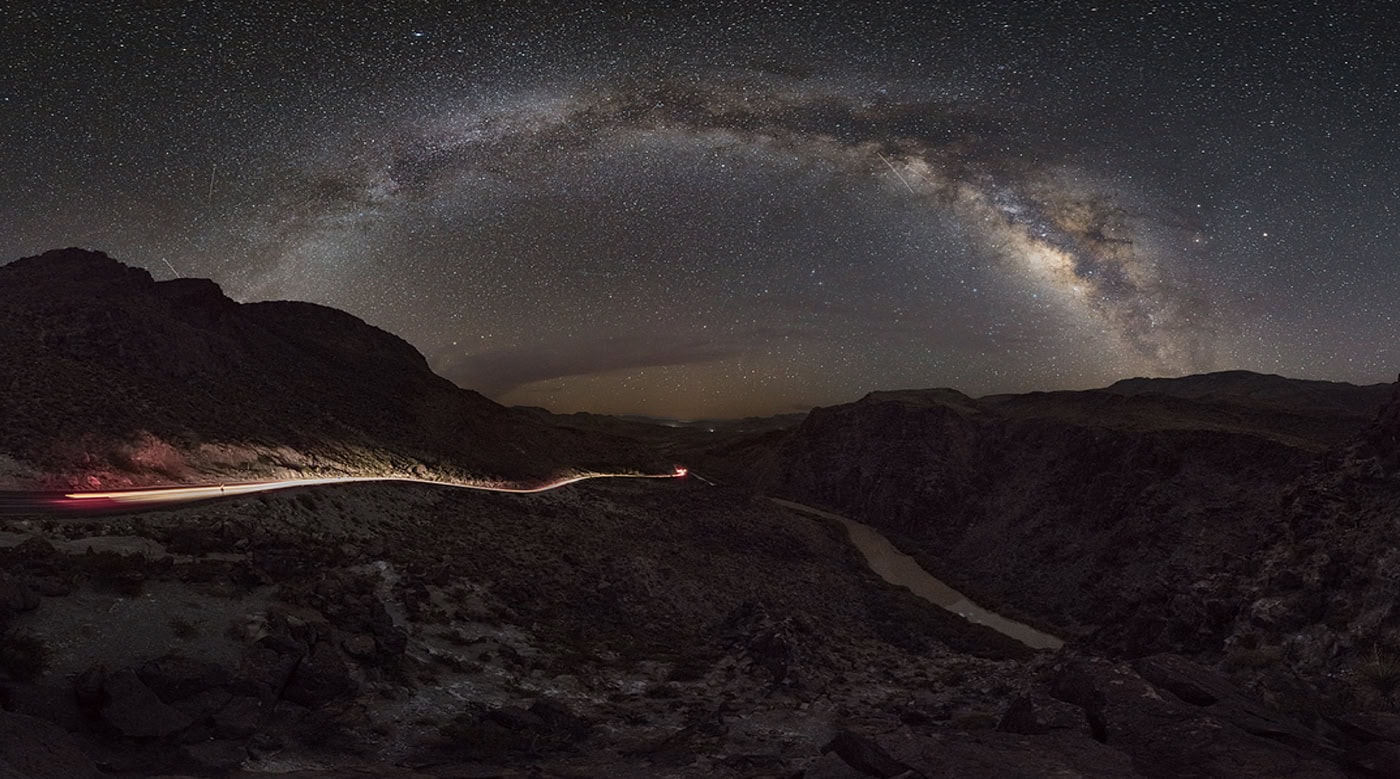
After a vacation in Big Bend, they fell in love with the area, and now they can regularly see celestial wonders like the Milky Way from the front yard of their home in Fort Davis.
“We came here because it’s our happy place; there’s something magical about it,” said Jodie Kramer. “I mean, there’s nothing like it.”
Source: npr.org by Carlos Morales