



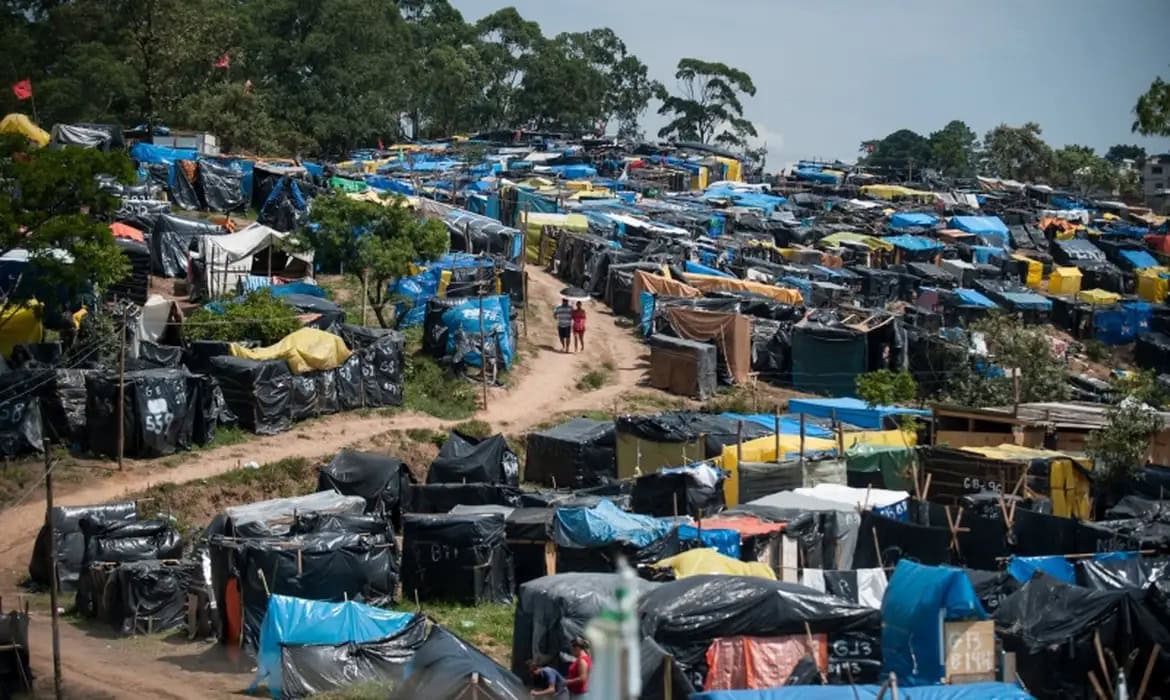
A groundbreaking survey by the National Campaign for the End of Forced Evictions, released on Wednesday (August 14), reveals that more than 1.5 million Brazilians have suffered forced evictions or removals between October 2022 and July 2024. This represents a 70% increase, as 898,916 people were affected by these actions until October 2022.
The mapping compiles collective cases of forced removals, in which individuals and entire communities were evicted from their homes. It encompasses not only judicial actions but also administrative processes initiated by public authorities.
The increase during this period, explained Raquel Ludermir, Advocacy Manager at Habitat for Humanity Brazil, may be linked to the fact that during the COVID-19 pandemic, the Supreme Federal Court determined the suspension of evictions and repossessions aimed at vulnerable families. This measure was in effect until the end of October 2022. “Until then, many cases were suspended due to this order from the Supreme Federal Court. After its revocation, evictions were once again legally permitted. What we are witnessing now is a significant increase that reflects the resumption of these eviction and repossession cases, in general,” she said in an interview with Agência Brasil and TV Brasil.
Another factor that may have contributed to this increase, Ludermir explained, is the rise in the cost of living after the pandemic. “We know that during the pandemic, many people were pushed into poverty, and the cost of living skyrocketed. As a result, it is likely that many people have turned to occupations,” she noted.
Profile
The Brazilian housing crisis is deeply intertwined with issues of class, gender, and race, the survey revealed. The vast majority of those affected self-identify as black or brown (66.3%), are women (62.6%), and earn up to two minimum wages (74.5%). “We are talking about predominantly low-income individuals, highly vulnerable from a socioeconomic perspective. They are also mostly black and, in many cases, headed by women. There is a historical debt in the country to meet the housing needs of this population,” she added.
“We know that although housing is a constitutional right and a human right, we still live in a country where at least 6 million people face housing deficits, and another 26 million live in inadequate conditions. The survey indicates only the tip of the iceberg of a historical problem in Brazil. We are talking here about housing, the issue of land struggle, and how this is linked to issues of poverty and intersectionalities,” said Raquel Ludermir.
Repossession and Major Works
According to Ludermir, these forced removals or evictions are primarily motivated by repossession disputes, in which conflicts arise between the person claiming ownership of the property or land and the families occupying those locations.
The second main reason is forced evictions promoted by public authorities, mainly for large infrastructure projects. “These evictions may be related to major infrastructure projects, such as transportation, drainage, or sewage systems, as well as smaller-scale projects that supposedly benefit the population but often result in unintended displacement effects,” she explained.
As the Brazilian government resumes major projects under its Growth Acceleration Program (PAC), Ludermir argues that it is crucial to rethink their impact on the most vulnerable populations. “We must remain vigilant to ensure that these projects do not have an even more negative effect on the vulnerable population,” she said. “Public works should not exacerbate the housing deficit or housing problems in the country, as this would only benefit one sector of development,” she concluded.
Source: Agência Brasil