



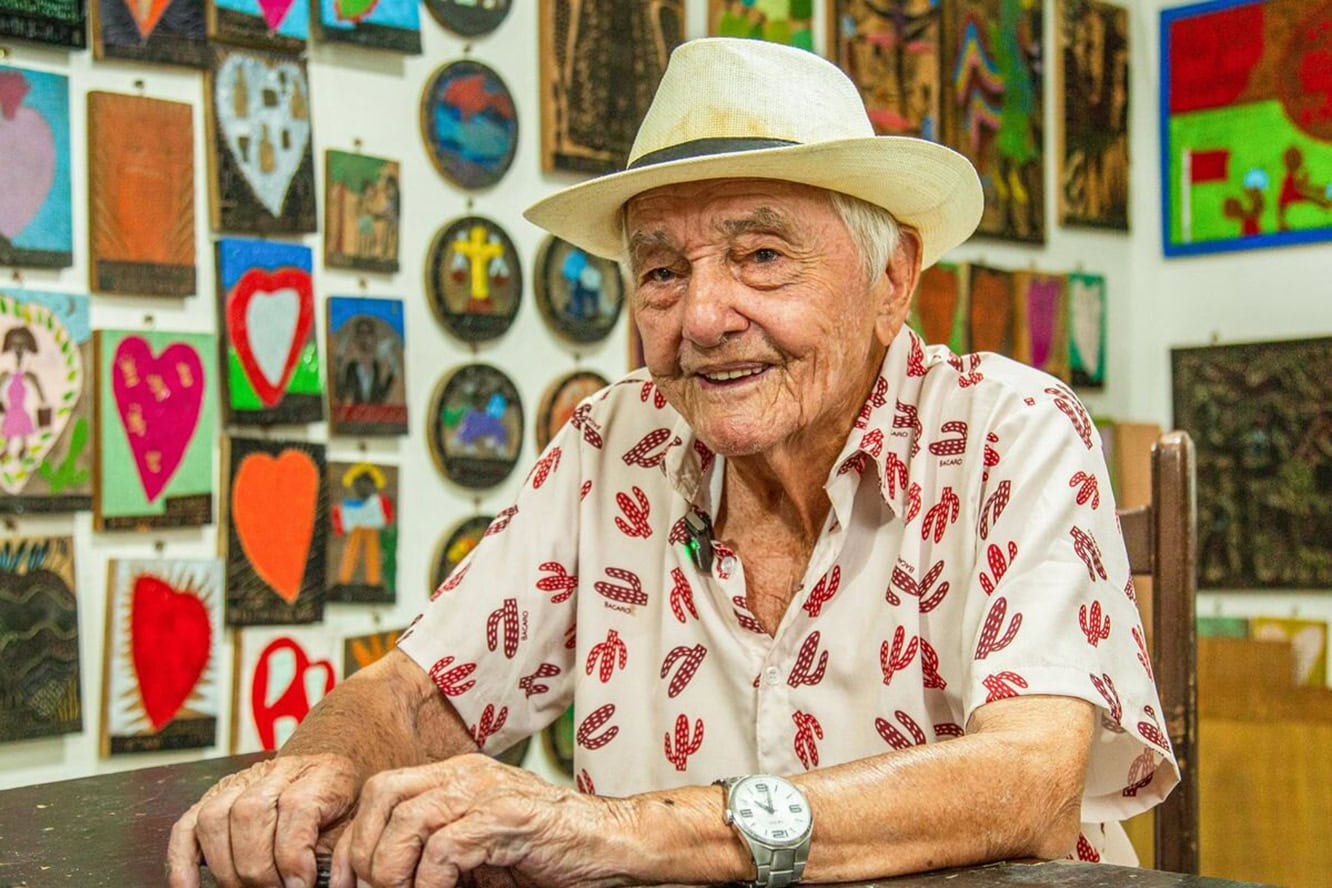
The Pontal Museum in Rio de Janeiro is hosting “O Sol do Sertão (The Hinterland Sun)”, a retrospective of the renowned master of Brazilian woodcut J. Borges. This unprecedented exhibition showcases his entire career, featuring works from private and public collections.
According to Lucas Van de Beuque, the curator and executive director of the exhibition, the museum conducted extensive research on the collections and archives of the 88-year-old artist throughout Brazil. “Our goal is to present to the public his entire trajectory, from the initial studies of cordel literature to his most recent works, such as the Sagrada Família, donated to Pope Francis last year by President Lula, representing Brazilian popular art, and O Coração na Mão, a recent and highly acclaimed piece,” Van de Beuque told Agência Brasil.
The curator emphasized that J. Borges is among the leading living artists in Brazil today. “His works are exhibited from the Louvre Museum in Paris, France, to various museums across Brazil and private collections. His exhibitions span the United States, France, Germany, Switzerland, Italy, Venezuela, and Cuba, reflecting a distinguished career.”
The artist and poet José Francisco Borges was born in 1935 in the village of Bezerros, in the state of Pernambuco, in Northeast Brazil. Borges was the most well-known folk artist in Brazil working in the medium of woodcut, and his work has been exhibited worldwide. However, he came from a long tradition of folk poets/artists who publish their own work in the form of small cheap booklets (usually about 15 cm by 23 cm) or pamphlets written in verse, known as folhetos. They are also known as ‘literatura de cordel’ for the way sellers offer them in the market, hanging from a string.
Borges’ work has been exhibited throughout Brazil, as well as in Paris, Zurich, Buenos Aires, Germany, and the United States. The Louvre, the Smithsonian, and the Museum of International Folk Art in Santa Fe have showcased works by Borges.
The artist has received numerous awards, including the Order of Cultural Merit, a UNESCO (United Nations Educational, Scientific and Cultural Organization) award in the Educational/Cultural Action category, and the distinction of Living Heritage of Pernambuco. His art has illustrated book covers for renowned writers such as Eduardo Galeano and José Saramago, inspired documentaries, and was featured in the parade of the samba school Acadêmicos da Rocinha in 2018.
According to Lucas Van de Beuque, J. Borges is not only in tune with contemporary issues and public interests but also deeply committed to his artistic path and vision. “His dedication to the Northeast, to cordel literature, and to the traditional values of the region is profound and intrinsic to him,” emphasized Van de Beuque. “It is not just a passing interest; it reflects a strong and enduring way of life.”
So far, there has never been an exhibition covering the entire career of J. Borges. The curator highlights a pivotal moment: the artist’s first woodcut in 1964, created for the cover of his second piece of cordel literature. “That was when the name ‘J. Borges’ was born, as his full name (José Francisco Borges) did not fit on the woodcut. This story is also displayed in the exhibition,” he added.
The exhibition occupies a significant portion of the Pontal Museum, covering the main gallery, two mezzanine galleries, the lobby, and a 24-square-meter panel. It features 200 works of art, a mini-documentary about the life and work of the artist, a timeline, and a collection of 50 matrices demonstrating the woodcut creation process. The exhibition will run until March 25, 2025.
Source: Agência Brasil and Indigo Arts Gallery