



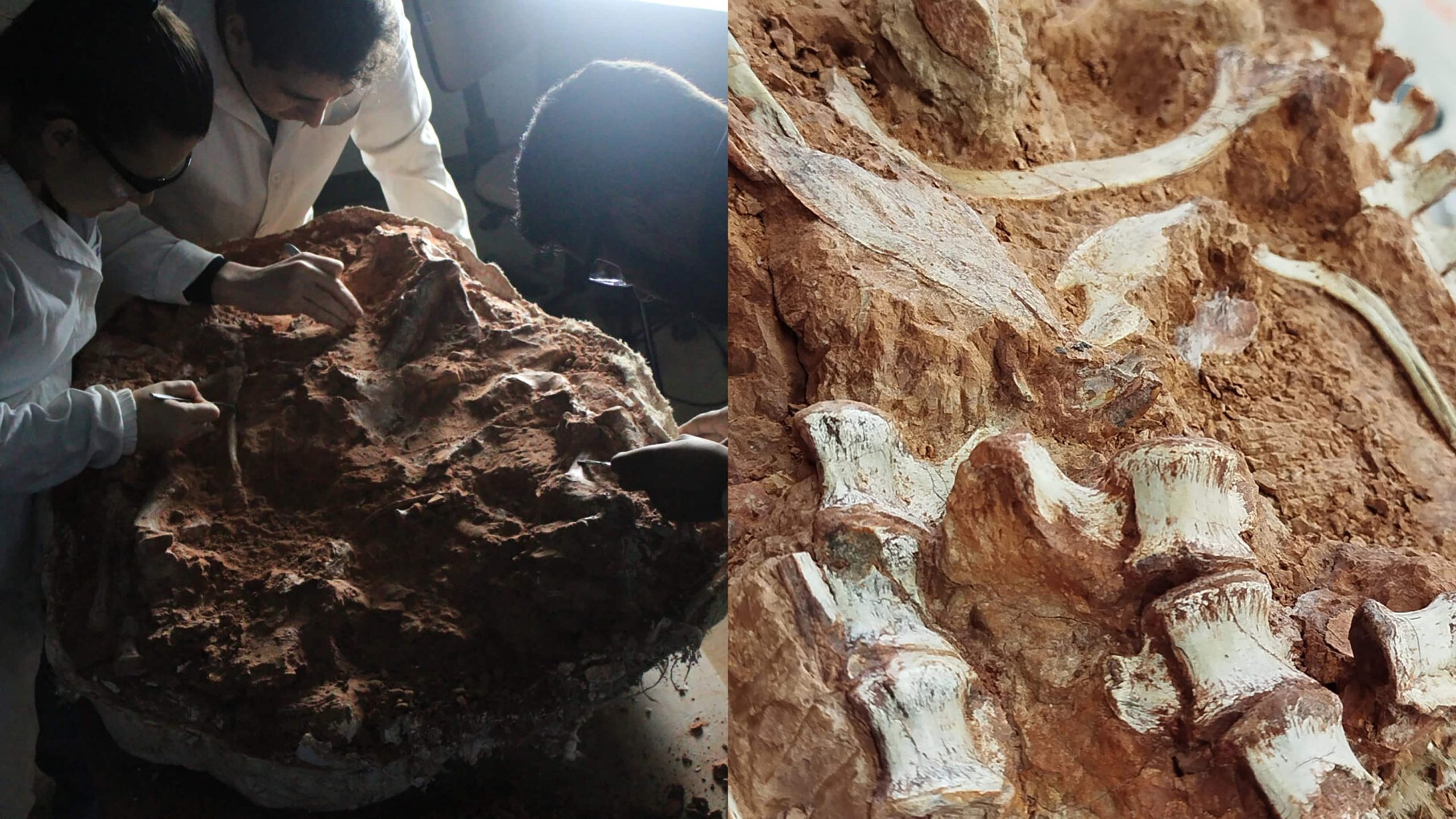
Researchers in Rio Grande do Sul, Brazil, made a significant discovery for paleontology. In May, after heavy rains that brought floods and destruction to Southern Brazil, specialists found a nearly complete fossil of a dinosaur from the Herrerasauridae group, which lived during the Triassic Period, estimated to be 233 million years old.
“It is one of the oldest in the world. It is already important for the role it will likely play in helping us understand the origin of dinosaurs. Furthermore, it is almost completely preserved. The material will provide a lot of anatomical information,” said UFSM paleontologist Rodrigo Müller to Agência Brasil.
“It is a carnivorous, bipedal animal, so it walked on its hind legs and probably had its hands free to handle prey. We cannot say it reached its maximum size. Although it was 2.5 m long, some individuals of this group could reach five or six meters. Perhaps it could have grown more if it had lived longer,” he stated.
The animal is expected to be incorporated into the collection of the Paleontological Research Support Center of the Fourth Colony (Cappa) at the Federal University of Santa Maria (UFSM), which, the researcher added, is one of the most important centers in the world for studying the origin of dinosaurs.
“Here we have the main specimens in the world. This material will come as a great addition and help us understand these early dinosaurs. It is interesting that it is a predatory dinosaur. It brings new data from this first wave of dinosaurs that occupied the top of the food chain at the time of the origin of dinosaurs,” he noted.
Müller led the Cappa team that scoured the site in São João do Polêsine, where the fossil was discovered. “It was already a paleontological site. There has been work there for at least two decades, but the rains accelerated erosion and exposed more material,” he said.
“The rain helps us all year round, as it exposes fossils through natural erosion. However, when the precipitation is high, as it was this time, the exposed material ends up being destroyed, sometimes during the event itself. If it rains a lot, small materials sometimes get lost before we can reach them, which is why we are now rushing to rescue all the materials that have been exposed,” he stated.
The region where the fossil was sighted is considered rich in paleontological material, with outcrops of Triassic rocks, and abundant in fossils of vertebrates, invertebrates, and plants, as well as ichnofossils.
Source: Agência Brasil