



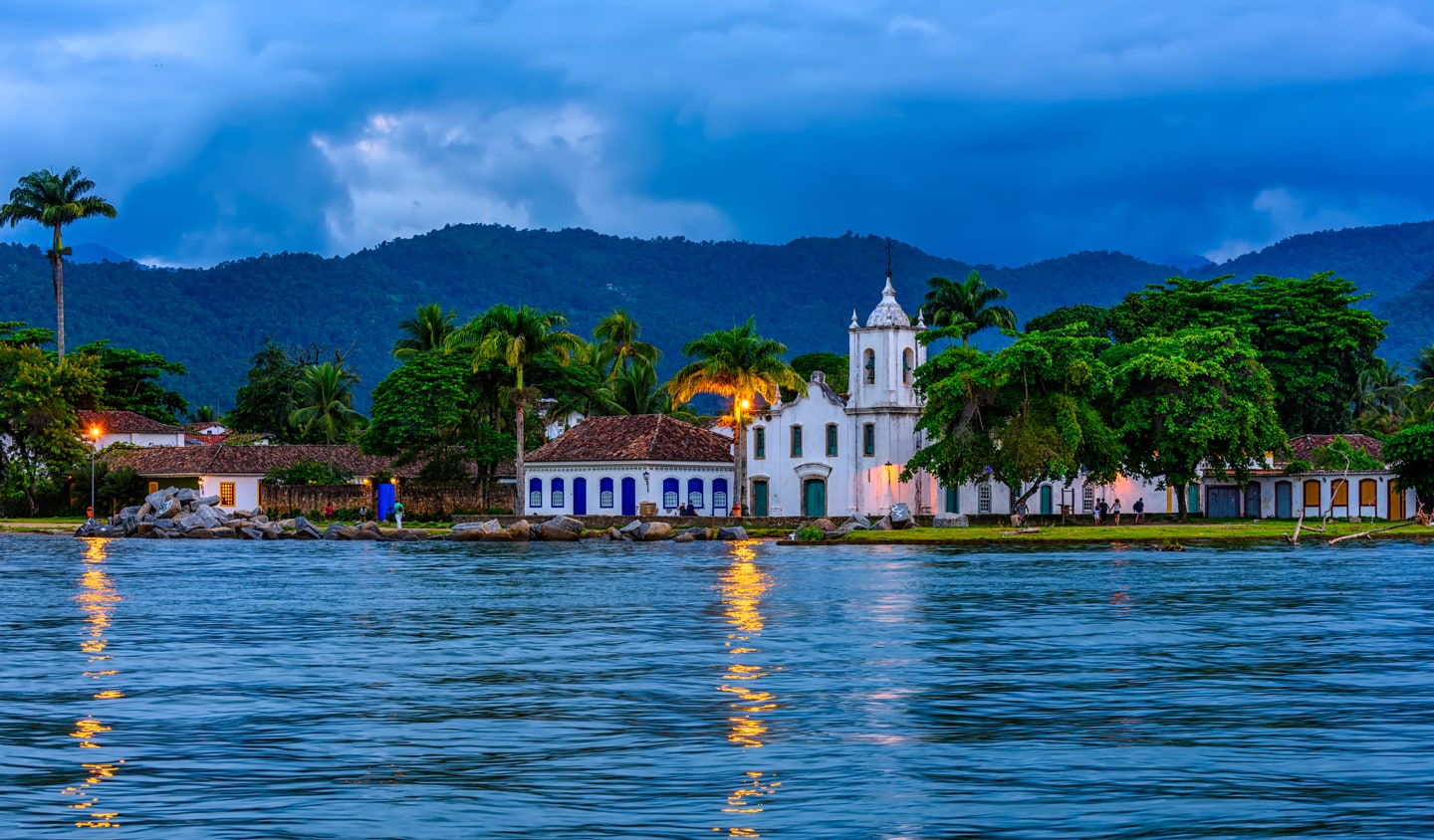
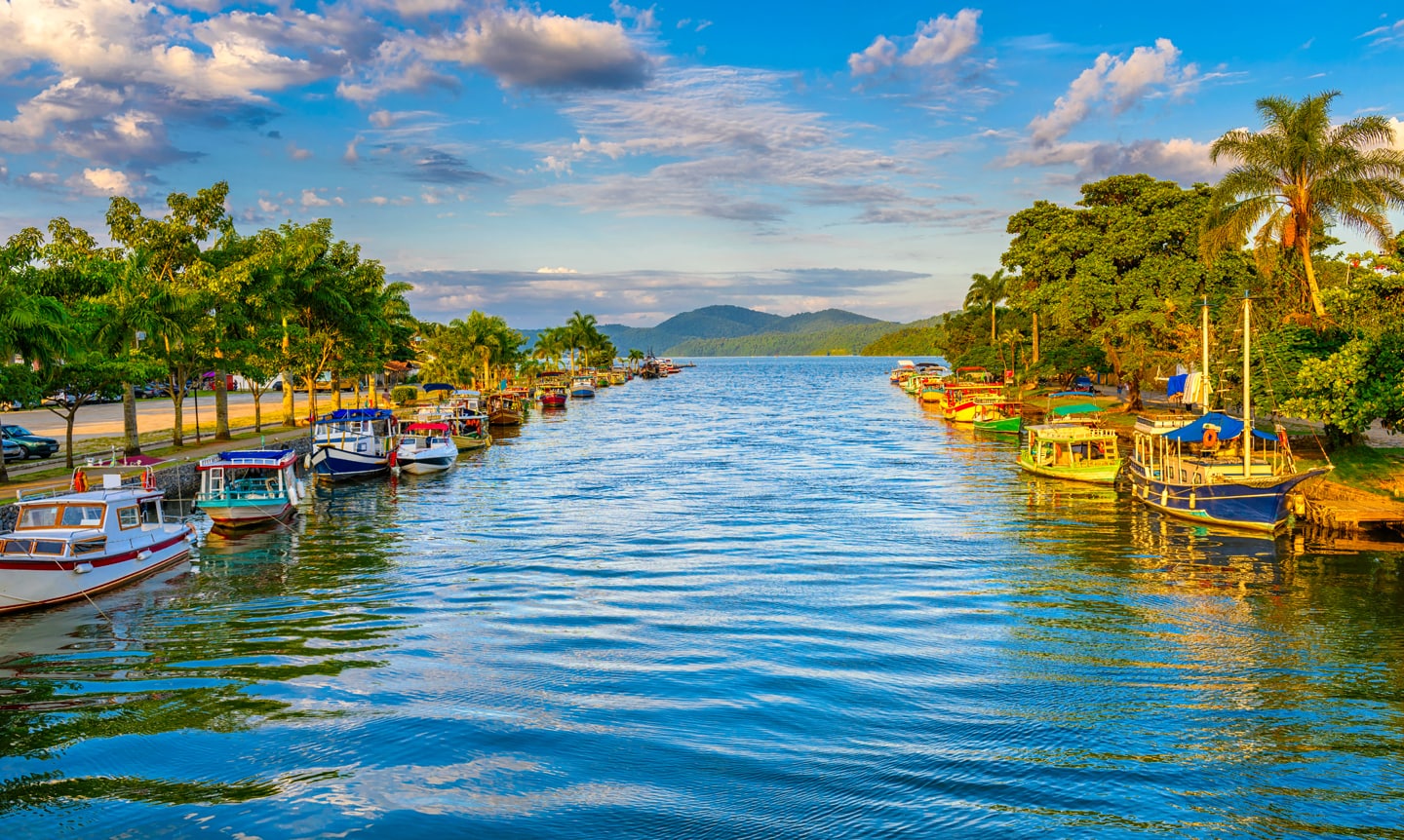
The city is located in the Bay of Ilha Grande, which is dotted with many tropical islands. Behind the city, tropical forests, mountains, and waterfalls rise. It is the southernmost and westernmost city in the state of Rio de Janeiro.
Paraty is listed by IPHAN as a National Historical Heritage. More than 80% of its territory is protected by conservation units:
• Cairuçu Environmental Protection Area, where the village of Trindade is located;
• Tamoios Ecological Station;
• Serra da Bocaina National Park;
• Paraty Bay, Paraty Mirim & Saco do Mamanguá Environmental Protection Area;
• Juatinga Ecological Reserve.
Nearby is the Serra do Mar State Park of São Paulo. The municipality also includes an indigenous village and an Afro-Brazilian quilombo settlement.
The village of Paraty was founded in 1597. It was formally established as a village by Portuguese colonists in 1667, in a region populated by the Guaianás Indians.
The Guaianás people who lived where the city now stands called the entire area “Paraty”. In the Tupi language, “Paraty” means “river of fish”. Even today, the Brazilian mullet still returns to spawn in the rivers that flow into the Bay of Paraty. When the region was colonized by the Portuguese, they adopted the Guaianás name for their new city.
After the discovery of the richest gold mines in the world in 1696 in the mountains of Minas Gerais, Paraty became a port for gold export to Rio de Janeiro and then to Portugal. The subsequent gold rush led to the construction of the “Gold Trail”, a 1200-kilometer road, paved in steep areas with large stones, that connected Paraty to Diamantina via Ouro Preto and Tiradentes. It was used not only to transport gold to Paraty but also to carry supplies, miners, and African slaves in mule trains through the mountains to the gold mining areas and vice versa. Two sections of the Gold Trail were excavated near Paraty and are now a tourist destination for hiking.
The Gold Trail fell into disuse due to pirate attacks on gold-laden vessels bound for Rio de Janeiro, which frequented the islands and coves of the Bay of Angra dos Reis. Eventually, a safer land route from Minas Gerais to Rio de Janeiro was created because of these pirate attacks. Finally, gold began to run out by the end of the 18th century, and Paraty entered a decline.
The Gold Trail was submitted for inclusion on the World Heritage List in 2004.
The city’s economic activity revived as a port for a new boom, the coffee trade from the Vale do Paraíba do Sul in the early 19th century, until a railway along the valley created cheaper transport to the port of Rio de Janeiro. Another small resurgence came in the late 19th century with the production of cachaça, a sugarcane distillate better known today as the base of Brazil’s most famous cocktail, the caipirinha. The name “Paraty” at that time became synonymous
with cachaça. Since then, Paraty has remained off the mainstream, which explains why it has not changed for centuries, until a paved road was built from Rio de Janeiro to Santos, near São Paulo, in the 1970s. The city then began a new cycle of activity, transforming a nearly abandoned small village, living off very limited economic activities, mainly fishing and agriculture (bananas, cassava, sugarcane), into a tourist destination.
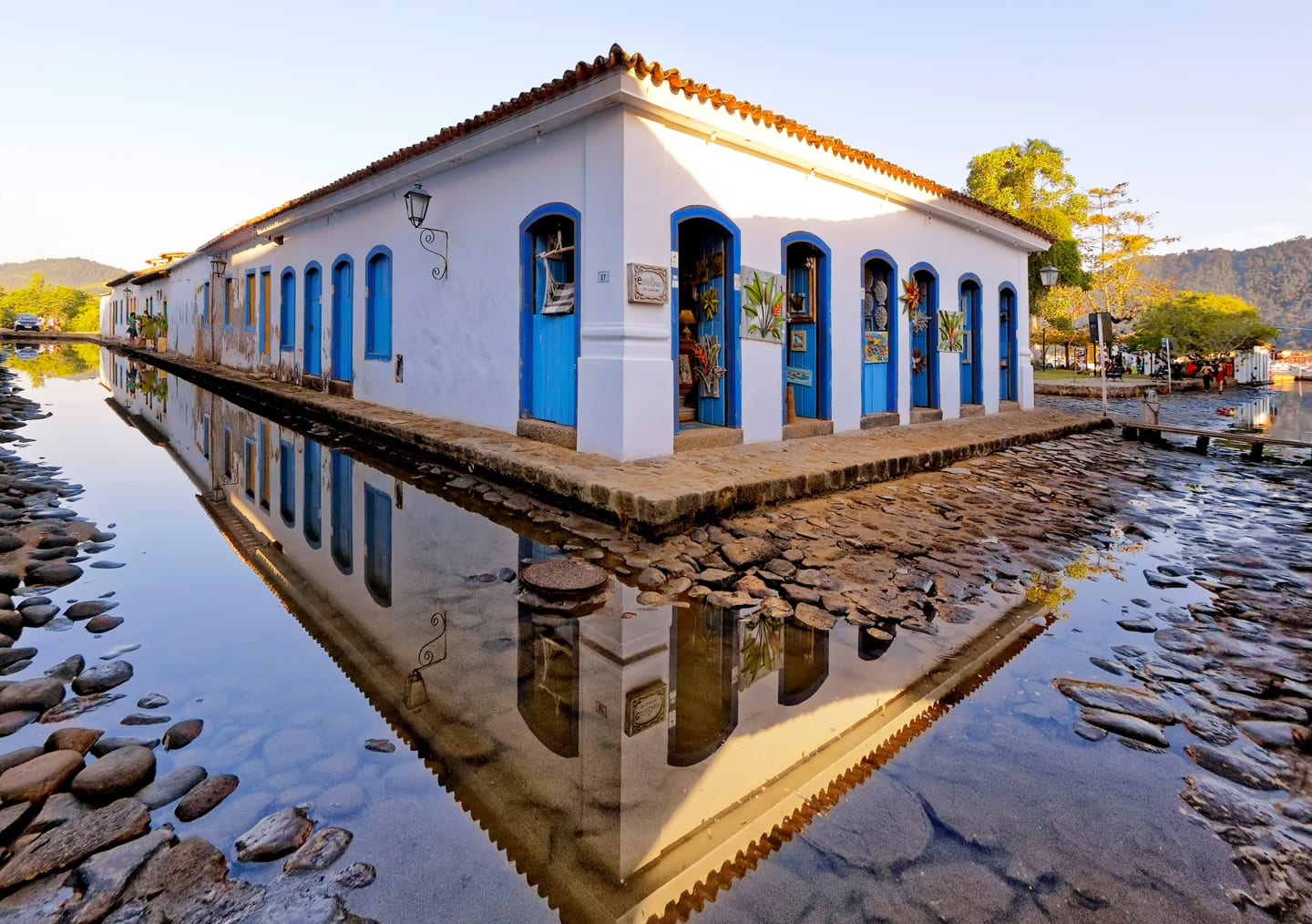
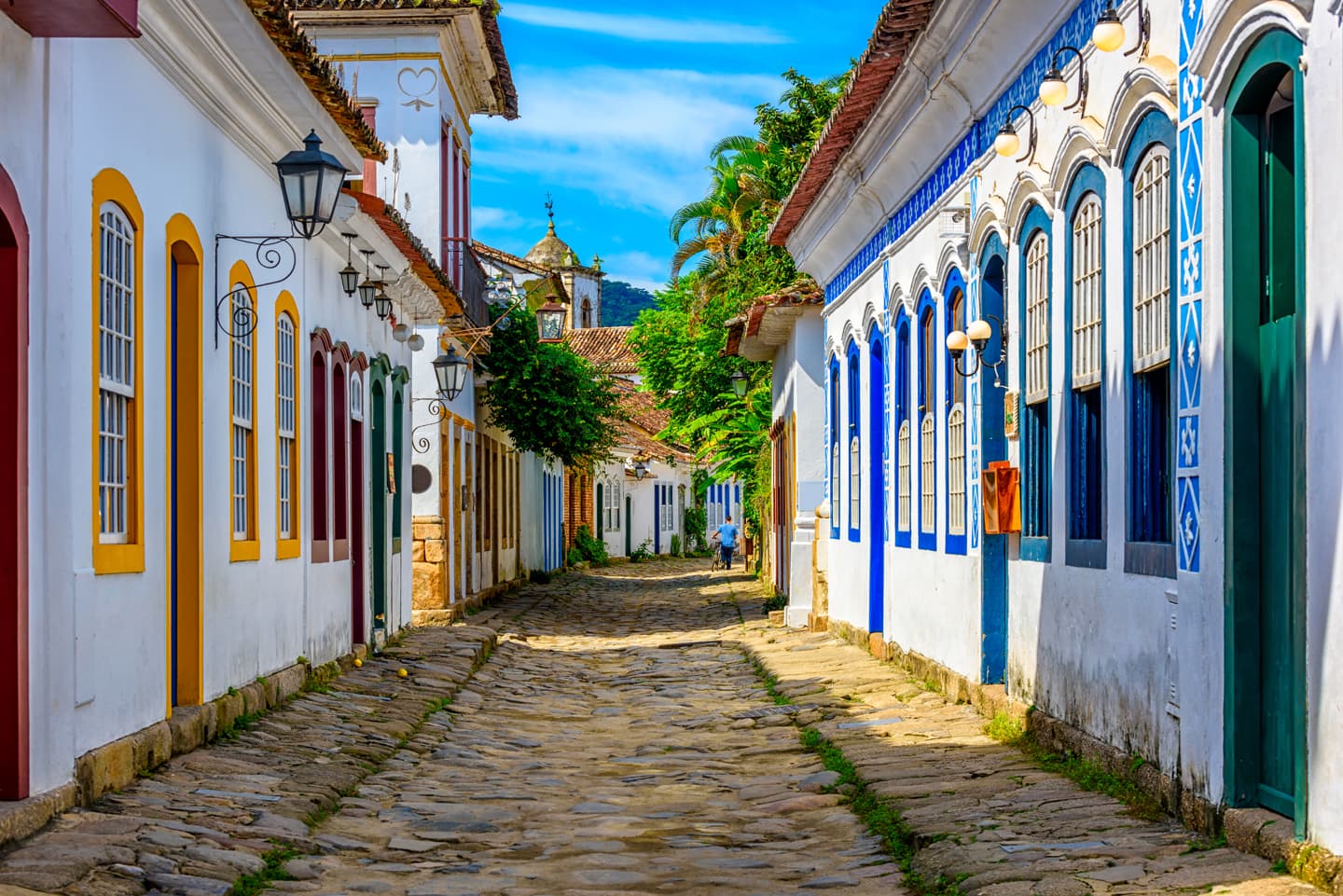
Paraty is known for its cobblestone streets throughout the Historic Center District. Cars or trucks are not allowed in this part of the city, only pedestrian or bicycle traffic. Motor vehicles are only permitted in the Historic District on Wednesdays for deliveries. Horses and carts are a very common sight in Paraty and are often used throughout the city.
Paraty has managed to maintain many of its historic buildings. Much of the city’s architecture has not changed in 250 years or more.
There are four important historic baroque churches in Paraty:
• Santa Rita Chapel is the oldest church in Paraty. It was completed in 1722. This was the church for freed and manumitted slaves, former slaves. It currently houses the Museum of Sacred Art.
• Our Lady of the Rosary & Saint Benedict Church was built and used by the African slaves of Paraty. It dates back to 1725. Every year, during the first week of December, the festivities of Saint Benedict are held at this church.
• Our Lady of Sorrows Chapel dates back to 1800. It was mainly used by the wealthy women of society. The construction was overseen by the vicar, Fr. Antonio Xavier da Silva Braga.
• Our Lady of Remedies Church is the largest church in Paraty. It occupies more than an entire block. Its construction began in 1646 when a woman named Maria Jácome de Melo donated the land for the construction of the village of Paraty, but required two conditions: the first was the construction of a chapel dedicated to Our Lady of Remedies and the second was that no one harm the Indians who lived in the area at that time. The church was completed in 1873.
There are two colonial forts in Paraty:
• Defensor Fort was built in 1703 and equipped with six cannons for the protection of the city’s important commercial warehouses. With the economic decline of the region mentioned, it fell into ruins until 1822, when it was rebuilt and dedicated to Emperor Dom Pedro I. Some historians believe that it was at the fort that the first nucleus of the village began, as the area around the fort is still called “Vila Velha”.
The Defensor Fort is one of seven fortifications built around the port of Paraty, two of which are in the city. All others built outside the city are now just ruins.
• Patitiba Fort, also known as Cadeia Velha, is a small structure that for a time was also used as a prison. It is located in the Santa Rita square, next to the church of the same name. Built in the early 18th century, the building was part of a larger Patitiba Fort, the other block built in the city for the defense of the port. In the 19th century, it was deactivated and now houses the local public library.
There are also many colorful colonial houses, many of which have been transformed into shops, inns (Brazilian bed-and-breakfasts), restaurants, and bars.
Once a month, when there is a full moon and the tide is high, the seawater rises above normal levels and floods the Historic Center District through special openings in the walls that separate the city from the port. The streets become flooded for a short time until the tide recedes.
There are many musical and cultural events, the most prominent of which is FLIP – the International Literary Festival of Paraty. The city is also known for its local festivals on Catholic holy dates, such as the Feast of the Divine Holy Spirit.
The Paraty Cultural House occupies a historic house originally built in 1754, opened to the public in 2004, and houses a permanent exhibition about local history and culture. In the Indigenous Culture Hall, visitors can see the “rugs” made of colored sawdust and flower petals used during the Corpus Christi festival in June. The largest is nearly 92 square feet. The “rug” is protected by glass so that visitors can step on it upon entering.
Source: wikipedia