



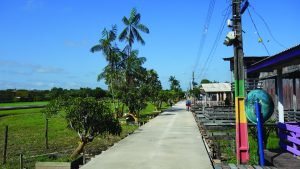
Afuá is a municipality in Pará that is located in Marajó, quite close to  Amapá. In the city of Afuá, there is no solid ground. The entire Afuá has been built on floodplain land, all on stilts. Additionally, Afuá is known for pitu, a shrimp that resembles a lobster. And let’s not forget about açaí, one of the tastiest in the state. Because of these characteristics, Afuá is one of the most picturesque tourist destinations in Pará. The Marajoara Venice. A city without streets, only rivers, stilts, and colorful houses.
Afuá is a Brazilian municipality in the state of Pará, belonging to the Marajó Mesoregion. It has an estimated population of 37,398 inhabitants. Due to its proximity to the capital of Amapá (about 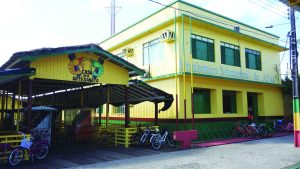 90km), it suffers direct influence from the state of Amapá, being a six-hour boat trip away.
The municipality has coastal vegetation, typical of the Amazon River region, with predominance of floodplains and igapós.
 There is the Charapucu State Park, a state conservation unit that encompasses about 65 thousand hectares of natural environments of great scenic beauty and well-preserved.
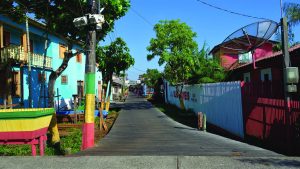
Since the streets of Afuá are all made of wood, there are no cars or motorcycles in the city. Everyone rides bicycles. There are even bicilâncias, 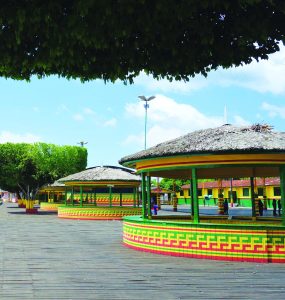 bicitaxis, and fire truck bicycles. It’s either bicycle or boat.
A while ago, a new resident brought a motorcycle to Afuá. The population threw the motorcycle into the river.
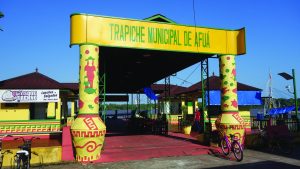
Afuá has a low HDI, which does not prevent the population from being extremely inventive and courageous. The city looks like it came out of a fairy tale. The colors of the houses and the architecture are unique in Brazil.
 It is local, that is, it has a strong connection to the rivers (through fishing, leisure, and use as a means of transportation), with nearby locations, in contrast to vertical cities, the corporate cities, which are born to meet external demands.
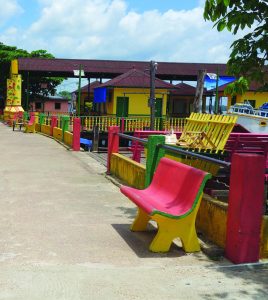 Small, until the 2000s, it had around 10 thousand inhabitants (urban).
Locally defined as “Marajoara Venice” or “Amazonian Venice,” as the city rises above the waters, gradually on floodplain land, creating a beautiful structure on stilts. Because of this characteristic, the circulation of automobiles in the city is prohibited, making it pleasant and beautiful.
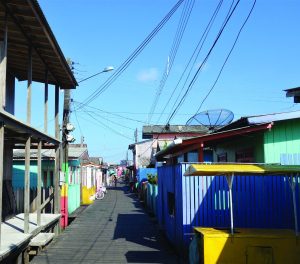 The municipality of Afuá, on the island of Marajó, is on the list of the 10 most beautiful small towns in the world alongside Spello (Italy), Giethoorn (Netherlands), Hoi An (Vietnam), Hallstatt (Austria), Colônia do Sacramento (Uruguay), Chefchaouen (Morocco), Ljubljana (Slovenia), and Alaçati (Turkey). With its colorful houses and streets on stilts, as well as the completely car-free traffic, it is a major highlight for those visiting the city.
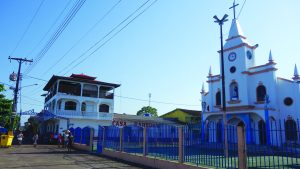 Many people are unaware of this gem in the North, but here we have a city built on stilts, wooden structures that support an entire community above a river. With no access for cars, the residents of the Amsterdam of the Tropics only walk or ride bicycles. Colorful buildings amidst typical Amazonian vegetation are an
 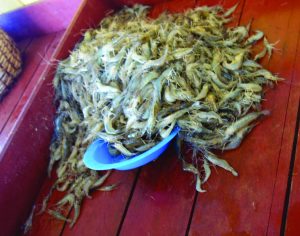 extra charm of the destination near the Island of Marajó. And, of course, the regional cuisine cannot be left out of the trip. In July, the Shrimp Festival is celebrated, with fresh shrimp straight from the freshwater to the delicious dishes that only the northerners know how to make.
History
 The current municipality of Afuá began around 1845, when Micaela Arcanja Ferreira settled there, occupying a piece of land that she named Santo Antônio.
Being a suitable location for a port and a stopping point in the Amazon estuary, in 1869, there was already a 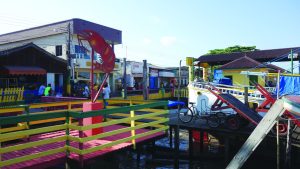 population nucleus formed of various shacks around the site.
In 1870, Micaela donated land for the formation of the chapel, which goes from the igarapé boundary on the Marajó River, down the Afuá River, to the Igarapé Jaranduba, on the Cajuuna River. With this initiative, Mariano Cândido 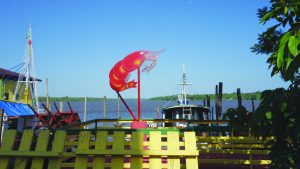 de Almeida, along with other local residents, began the construction of the Church of Our Lady of the Conception of Afuá, completing it in 1871.
Due to the ease of acquiring land lots, the settlement that was formed quickly developed and was elevated to a parish in 1874, which was extinguished twice until 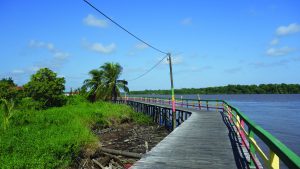 it regained its status in 1889.
With the republic, in 1890, Afuá obtained the status of a village and municipality, but it was only in 1896 that it became a municipality.
Photos provided by Romulo Ferreira/www.flickr.com