



Thanksgiving Day, known in Portuguese as Dia de Ação de Graças, is a holiday celebrated primarily in the United States, Canada, and the Caribbean islands, observed as a day of gratitude to God, with prayers and feasts, for the good events that occurred during the year.
The Thanksgiving Day was celebrated on the 4th Thursday of November in the New England region, in the form of Christian festivals to thank for the good harvests made during the year. For this reason, Thanksgiving Day is celebrated in autumn (in the northern hemisphere), after the harvest has been gathered.
 Photo: www.freeimages.com-blueringmedia
Over time, the main objective became to remember and express gratitude for everything that happened in the past year. The name Thanksgiving comes from the combination of the word “thank you/gratitude” with the verb “to give”.
The first one was celebrated in Plymouth, MA, by the colonists who founded the village in 1620. The following year, the colonists had a good corn harvest, and by order of the village governor, in honor of the progress of this crop, the feast was scheduled for early autumn of 1621. Men from Plymouth killed ducks and turkeys. About ninety Indians participated in the festival. Everyone ate outdoors at large tables. This year is emphasized for representing not only the first significant celebration on American soil but also for managing to unite English colonists and Native American peoples.
The holiday in the United States
The insertion of the celebration into the calendar was made in England by King Henry VIII when he created the Anglican religion and instituted its holidays. Over time, however, only the U.S. continued with the tradition. In the land of the Queen, preference is given to the Harvest Festival, which has a similar objective but celebrates the full moon closest to the autumn equinox.
For many years, Thanksgiving Day was not instituted as a national holiday, being observed as such in only certain states. In 1863, then-President Abraham Lincoln declared that every 4th Thursday of November would be National Thanksgiving Day.
But in 1939, President Franklin Delano Roosevelt instituted that this day would be celebrated in the 3rd week of November, in order to help commerce, increasing the time available for advertisements and purchases before Christmas (at the time, it was considered inappropriate for advertising products to be sold before Thanksgiving Day). Since Roosevelt’s declaration was not mandatory, 23 states adopted the measure, and 22 did not, with the remainder taking both Thursdays (the 3rd and 4th weeks of November) as Thanksgiving Day. The U.S. Congress, to resolve this impasse, then instituted that Thanksgiving Day would be definitively celebrated on the Thursday of the 4th week of November and that it would be a national holiday.
One of the traditions of Thanksgiving Day is to state the reasons for being grateful in the year. It is also a moment when, historically, families travel to be together and, in a way, kick off the end-of-year celebrations, the so-called “holidays”.
 Photo: www.freeimages.com-LightFieldStudios
The family tone of Thanksgiving Day makes the celebration, in some regions of the U.S., even more important than Christmas and New Year.
Large cities still promote parades with floats, dancers, and balloons, which are broadcast on television. One of the most famous is in New York, where the department store Macy’s, for over 90 years, has paraded through the streets with celebrities, children’s characters, and dance shows.
Why is it not celebrated in Brazil?
The main reason for the lack of Thanksgiving celebration in Brazil is precisely the same that involves its origin. Since Brazil was colonized by Portugal, and not by England, most customs and celebrations came from Portuguese culture, along with African and indigenous influences.
Still, even though the celebration is not very common here, the date was regulated in the national calendar in 1949 by then-President Eurico Gaspar Dutra. In 1965, President Castello Branco defined that the celebration would take place on the same day as in the U.S., on the 4th Thursday of November.
Thanksgiving Day is not a holiday, and its celebration is generally restricted to English language schools, American-origin companies, and families that follow the Protestant religion. Thus, most Brazilians only know the holiday through social media or through episodes of American series and movies that take place on this date.
Macy’s Thanksgiving Day Parade
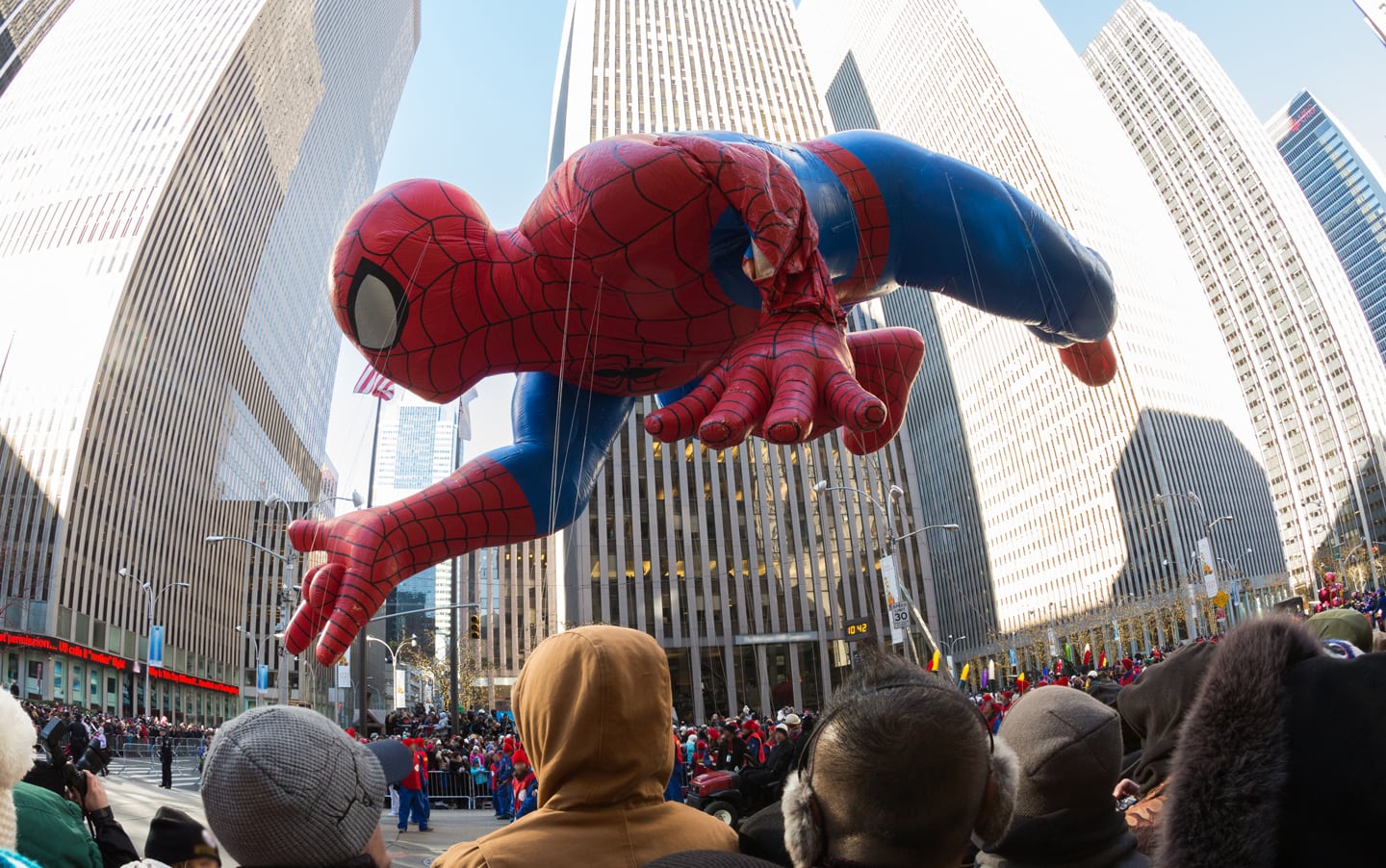 Photo: www.shutterstock.com/blvdone
It is an annual parade in New York City presented by the department store chain Macy’s. The parade is held in Manhattan, ending outside Macy’s Herald Square, and takes place in the morning on Thanksgiving Day, being nationally televised since 1953. Employees of Macy’s department stores participate in the parade.
It all started in 1924 when store employees marched to Macy’s Herald Square, the main store on 34th Street, dressed in vibrant costumes. There were floats, professional bands, and live animals borrowed from the Central Park Zoo. At the end of this first parade, Santa Claus was welcomed at Herald Square. With an audience of over 250,000 people, the parade was such a huge success that Macy’s declared it would become an annual event.
The parade was enough to push Ragamuffin Day, the typical Thanksgiving activity for children from 1870 until the 1920s, into obscurity. Ragamuffin Day featured children walking around and performing a primitive version of trick-or-treating, a practice that in the 1920s began to annoy most adults. The public reaction against such begging in the 1930s (when most Americans were struggling in the midst of the Great Depression) led to the promotion of alternatives, including the Macy’s parade.
Anthony “Tony” Frederick Sarg loved working with puppets from a young age. In London, he started his own puppet business, then Sarg moved to New York to perform with his puppets on the street.
The balloons were introduced in 1928, replacing the live zoo animals. The large animal-shaped balloons were Sarg’s. That year there was no procedure to deflate the balloons, and they were simply released.
In 1928, five of the giant balloons were designed and filled with helium to rise above 610 meters and slowly deflate for those lucky enough to catch the competitors in Macy’s “balloon race” and return them for a reward of $100, which lasted until 1932. The first Mickey Mouse balloon entered the parade in 1934.
The parade was suspended from 1942 to 1944 as a result of World War II because rubber and helium were needed for the war effort. The parade resumed in 1945 and became nationally known shortly thereafter, being featured in the 1947 film “Miracle on 34th Street”.
Due to the COVID-19 pandemic in New York City, the 2020 parade was scaled down and closed to the public – being filmed as a broadcast-only event in the Herald Square area. The event did not include marching bands or any participants under 18 years old. The balloons were tethered to a “specially equipped anchor vehicle structure of five special vehicles” instead of being carried by handlers.
In 2021, Macy’s department store resumed one of New York City’s most significant events, the Thanksgiving Day Parade.
Black Friday
Black Friday is a colloquial term for the Friday after Thanksgiving Day in the U.S. Traditionally, it marks the beginning of the Christmas shopping season. Many stores offer sales at discounted prices and usually open early, sometimes as early as midnight or even on Thanksgiving Day. Sales from some stores continue until the following Monday (“Cyber Monday”) or for a week (“Cyber Week”).
Etimology
For centuries, the adjective “black” has been applied to days on which calamities occurred. Many events have been described as “Black Friday,” although the most significant event in American history was the Panic of 1869, which occurred when financiers Jay Gould and James Fisk leveraged their connections with the Grant Administration in an attempt to corner the gold market. When President Grant learned of this manipulation, he ordered the Treasury to release a large gold offering, which interrupted the run and caused prices to drop by 18%. Fortunes were made and lost in a single day, and the president’s own brother-in-law, Abel Corbin, was ruined.
The first known use of “Black Friday” to refer to the day after Thanksgiving occurred in the magazine Factory Management and Maintenance in November 1951 and again in 1952. Here it refers to the practice of workers calling in sick the day after Thanksgiving to have a four-day weekend. However, this usage does not seem to have caught on. Around the same time, the terms “Black Friday” and “Black Saturday” began to be used by police in Philadelphia and Rochester to describe the crowds and traffic jams that accompany the start of the Christmas shopping season. In 1961, the city and merchants of Philadelphia tried to improve conditions.
The use of the phrase spread slowly, appearing for the first time in The New York Times in 1975, where it still refers specifically to the “busiest shopping and traffic day of the year” in Philadelphia.
As the phrase gained national attention in the early 1980s, merchants opposed to using an ironic term to refer to one of the most important shopping days of the year suggested an alternative derivation: that retailers traditionally operated at a financial loss for most of the year, January to November, and profited during the holiday season, starting the day after Thanksgiving. When this was recorded in financial records, once-common accounting practices used red ink to show negative values and black ink to show positive values. Black Friday, according to this theory, is the beginning of the period when retailers would no longer be “in the red.”
Black Friday is not an official holiday in the United States, but California and some other states observe “The Day After Thanksgiving” as a holiday for state government employees. It is sometimes observed instead of another federal holiday, such as Columbus Day. Many non-retail employees and schools have off on Thanksgiving Day and the following Friday. Along with the regular following weekend, this makes the Black Friday weekend a four-day weekend, which increases the number of potential shoppers.
Cyber Monday
Cyber Monday is a marketing term for e-commerce transactions on the Monday after Thanksgiving Day in the United States. It was created by retailers to encourage people to shop online. The term was coined based on a 2004 survey showing that “one of the biggest online shopping days of the year” was the Monday after Thanksgiving (the 12th largest day historically). Cyber Monday occurs on the Monday after Thanksgiving.
“The name Cyber Monday arose from the observation that millions of productive American workers, just coming off a Thanksgiving weekend of window shopping, were returning to high-speed Internet connections at work on Monday and buying what they liked.”
Sources: wikipedia.org & toco.woki